How Smart Toothbrushes Clean Every Surface of Your Teeth
Jan 21

Jan 21
When brushing your teeth, ensuring every surface is thoroughly cleaned is crucial for maintaining optimal oral health. While traditional toothbrushes might leave certain areas missed, smart toothbrushes, equipped with sensors and AI, can track coverage and guide you to clean every surface effectively. In this article, we’ll explore how smart toothbrushes, like BrushO, clean each surface of your teeth, from front to back and every hard-to-reach corner. Discover how this advanced technology ensures you never miss a spot while brushing.


How Smart Toothbrushes Clean Every Surface of Your Teeth

1. The Challenge of Cleaning Every Surface of Your Teeth

To achieve optimal oral health, it’s crucial to clean all surfaces of your teeth—front, back, chewing surfaces, and even the areas along the gumline. However, with traditional manual or even basic electric toothbrushes, it's easy to miss certain areas, especially those at the back of the mouth or in between teeth.
Smart toothbrushes are designed to address this challenge. They are equipped with sensors and AI technology that track brushing coverage and ensure that every part of the mouth is cleaned thoroughly.

2. How Sensors Track Brushing Coverage

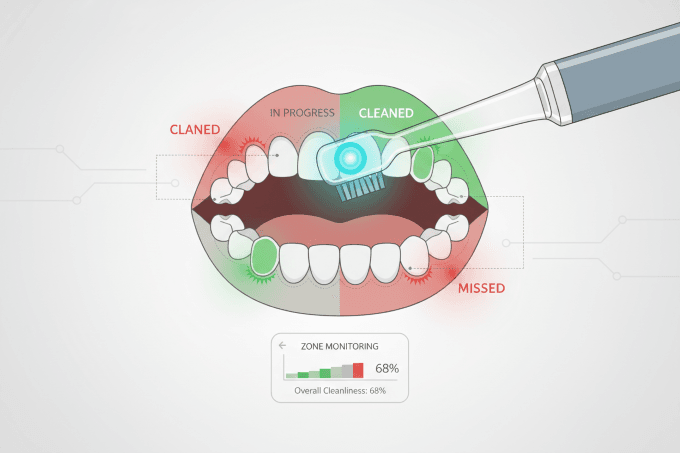
Smart toothbrushes use advanced motion sensors and accelerometers to track the movements of the toothbrush. These sensors map out the different zones of your mouth—often dividing the mouth into 6 zones, depending on the model. As you brush, the smart toothbrush monitors whether you’re covering all these areas effectively, ensuring that no part of your teeth is neglected.
The brushing process is monitored in real-time, and if you’re missing an area or brushing too quickly, the smart toothbrush will provide feedback through vibrations or visual indicators. This ensures that every surface, from the front of your teeth to the back molars, receives proper attention.

3. Brushing Technique: Covering All Surfaces Efficiently

Proper brushing technique is key to ensuring all tooth surfaces are cleaned effectively. Smart toothbrushes guide users in brushing at the correct angle and motion to ensure full-mouth coverage. Whether you’re using a circular or back-and-forth motion, the smart toothbrush’s AI system adapts to your style and gives personalized recommendations for better coverage.
For example, a smart toothbrush may suggest altering the angle for cleaning the gumline or adjusting pressure on the back molars. This targeted feedback improves the overall brushing technique and guarantees that no surface is left out.

4. The Importance of Brushing the Gumline and Hard-to-Reach Areas

The gumline and areas behind your teeth are often overlooked, especially when brushing manually. These areas are prone to plaque buildup and can contribute to gum disease if not cleaned properly. Smart toothbrushes are equipped with pressure sensors and coverage tracking features that alert you when you’re not brushing the gumline or other hard-to-reach areas thoroughly enough.
By ensuring proper cleaning of these often-neglected spots, smart toothbrushes help maintain healthier gums and reduce the risk of plaque and tartar buildup.

5. AI-Powered Feedback for Complete Coverage

AI technology in smart toothbrushes takes the guessing out of brushing. With AI-powered feedback, these devices track your brushing behavior over time, analyzing which areas of your mouth are getting the most attention and which areas are being missed.
By providing real-time guidance, smart toothbrushes help you improve your technique, making sure you cover all surfaces. These devices also keep track of your progress, offering insights and reminders that encourage better brushing habits.

6. Personalized Brushing Modes for Comprehensive Cleaning

Smart toothbrushes often come with different brushing modes tailored to specific needs, such as a "deep clean" mode, a "gum care" mode, or a "white+" mode. These modes optimize brushing for specific areas of your teeth and allow you to clean every surface more efficiently. For example, the deep clean mode may focus on areas that need extra attention, while the gum care mode targets the gumline.
These customizable modes, paired with AI-powered feedback, ensure that every surface of your teeth gets the attention it needs for optimal cleaning.

7. Progress Tracking and Continuous Improvement

The data collected by your smart toothbrush is stored and analyzed in the corresponding app, allowing you to track your progress over time. Weekly or monthly reports provide an overview of your brushing habits, highlighting areas that need improvement. If you’re consistently missing a certain surface or not brushing for the recommended duration, the app will remind you and offer tips for improvement.
By offering actionable feedback, smart toothbrushes help users develop better brushing habits and ensure that every surface of the teeth is cleaned effectively.

8. The Long-Term Benefits of Full Surface Cleaning

Cleaning all surfaces of your teeth is key to maintaining long-term oral health. Smart toothbrushes not only ensure that every surface is cleaned during each brushing session, but they also help you establish better brushing habits over time. Consistent use of a smart toothbrush can lead to healthier gums, reduced plaque buildup, and fewer cavities.
By preventing missed areas and ensuring proper coverage, smart toothbrushes promote long-term oral health and help you avoid common dental issues like gum disease and tooth decay.
 

Final Thoughts: Smart Toothbrushes for Thorough, Effective Cleaning

Smart toothbrushes take the guesswork out of brushing by providing real-time feedback and personalized recommendations. With advanced sensors and AI technology, these devices ensure that every surface of your teeth is cleaned thoroughly, from the front to the back and everywhere in between.
By using a smart toothbrush, you can ensure that your brushing habits are more effective, leading to healthier teeth, gums, and a brighter smile in the long run.

Aktuelle Beiträge

The Science of Teeth Whitening: What Works and What Doesn't

The Science of Teeth Whitening: What Works and What Doesn't

teeth whitening science, peroxide whitening mechanism, whitening safety, LED whitening efficacy, whitening toothpaste comparison

Interdental Cleaning: Floss, Water Flossers, and Interdental Brushes Compared

Interdental Cleaning: Floss, Water Flossers, and Interdental Brushes Compared

interdental cleaning comparison, water flosser vs string floss, interdental brush effectiveness, flossing science, plaque removal between teeth

Gum Recession: Causes, Prevention, and Modern Treatment Options

Gum Recession: Causes, Prevention, and Modern Treatment Options

gum recession causes, gingival recession treatment, gum graft surgery, pinhole technique, preventing receding gums

Fluoride: Myths, Facts, and How It Protects Your Teeth

Fluoride: Myths, Facts, and How It Protects Your Teeth

fluoride cavity prevention, fluoride myths debunked, remineralization fluoride, water fluoridation safety, hydroxyapatite vs fluoride

AI in Dentistry: How Machine Learning Is Changing Oral Health Care

AI in Dentistry: How Machine Learning Is Changing Oral Health Care

AI dentistry, machine learning dental diagnosis, AI cavity detection, dental AI radiography, computer vision oral health

Smart Toothbrush Sensors Explained: Pressure, Position, and the Tech That Tracks Your Brushing

Smart Toothbrush Sensors Explained: Pressure, Position, and the Tech That Tracks Your Brushing

The electric toothbrush has evolved from a simple oscillating handle into a sophisticated sensor platform. Modern smart toothbrushes pack accelerometers, gyroscopes, pressure sensors, and even camera-based vision systems into a waterproof housing smaller than a smartphone. The global smart toothbrus

The Oral Microbiome Explained: Good Bacteria, Bad Bacteria, and What Disrupts the Balance

The Oral Microbiome Explained: Good Bacteria, Bad Bacteria, and What Disrupts the Balance

Oral dysbiosis occurs when environmental pressures select for pathogenic species over commensals. The primary drivers include:

The Mouth-Heart Connection: How Gum Disease Increases Cardiovascular Risk

The Mouth-Heart Connection: How Gum Disease Increases Cardiovascular Risk

Periodontitis affects approximately 47.2% of adults aged 30 and older in the United States, according to the CDC's National Health and Nutrition Examination Survey (NHANES) data, with 8.5% classified as severe cases (Eke et al., 2015). Cardiovascular disease remains the leading cause of death global

How Enamel Erosion Happens: pH, Diet, and Prevention Strategies

How Enamel Erosion Happens: pH, Diet, and Prevention Strategies

Tooth enamel is composed of approximately 96% hydroxyapatite (Ca₁₀(PO₄)₆(OH)₂), a crystalline calcium phosphate mineral. The remaining 4% consists of water and organic matrix. This mineral structure gives enamel its remarkable hardness but also makes it chemically vulnerable—hydroxyapatite begins to

Diabetes and Oral Health: The Two-Way Relationship You Need to Know

Diabetes and Oral Health: The Two-Way Relationship You Need to Know

Diabetes affects over 537 million adults worldwide according to the International Diabetes Federation's 2021 Atlas, with projections reaching 783 million by 2045. Within this population, the prevalence of periodontitis is estimated at 60–70%, compared to 30–40% in the general population. The bidirec
