
Crossing time zones often means battling jet lag, changing routines, and adjusting your internal clock—but one overlooked casualty is your oral hygiene. Whether you’re on a long-haul flight, backpacking through continents, or just visiting a new country, your brushing habits are likely to suffer. Skipped brushing, irregular eating, dehydration, and exhaustion all increase your risk for plaque buildup, bad breath, and even cavities. Fortunately, with better awareness and the help of smart tools like BrushO, you can maintain strong oral care even while your body adjusts to new schedules.
Jet lag throws off your circadian rhythm, which governs your brushing routines just like it does sleep. When you:
• Fall asleep before brushing due to exhaustion
• Wake up disoriented and skip morning brushing
• Forget when your “nighttime” brushing should occur
…oral bacteria thrive. This disruption gives plaque more time to build up, leading to inflammation and decay.
Travel often means grazing throughout the day, trying unfamiliar foods, or relying on sugary, processed snacks at airports. These habits:
• Feed bacteria in the mouth
• Create more frequent acid attacks on enamel
• Are rarely followed by immediate brushing
Without proper cleaning, your teeth are more vulnerable to erosion and cavities.
Airplane cabins have low humidity levels, which reduce saliva flow—your body’s natural defense against bacteria. A dry mouth:
• Increases bad breath
• Weakens enamel protection
• Leads to a higher risk of gum inflammation
And travelers often drink less water or rely on caffeinated beverages, making it worse.
• Skipping a brushing session on overnight flights
• Brushing too soon after acidic in-flight meals or drinks
• Not packing travel-friendly oral care tools
• Using unfamiliar water sources without rinsing properly
These habits may seem minor, but can compound over several days.
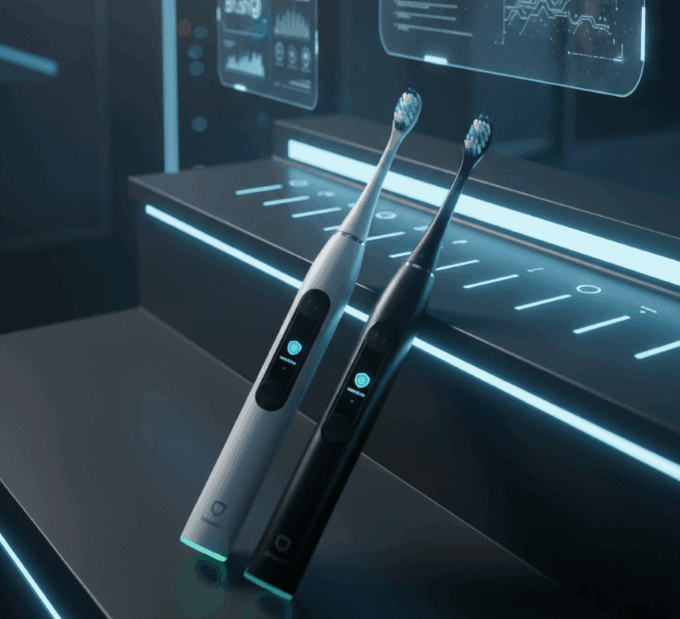
BrushO is an AI-powered smart toothbrush that makes oral hygiene convenient and consistent—even when you’re jet-lagged or on the go.
• Time Zone-Aware Reminders: The app can adjust reminders based on local time, helping you brush in sync with your new schedule.
• Habit Streak Tracking: Even when your routine shifts, BrushO logs your brushing data and motivates consistency with $BRUSH token rewards.
• Travel Mode: Long-lasting battery life (up to 45 days) and compact design make it easy to carry without extra accessories.
• Custom Modes for Sensitive Teeth: Perfect for those sensitive to dry air or frequent snacking during flights.
With FSB technology, BrushO monitors your brushing pressure, duration, and coverage—even if you’re brushing in an unfamiliar hotel bathroom or airport lounge.
• Pack a travel-sized BrushO and extra brush head
• Brush after waking up—even if it’s not your “home” morning
• Use bottled water to rinse if local tap water is questionable
• Chew sugar-free gum to stimulate saliva during flights
• Rinse with water after in-flight snacks or acidic beverages
• Set app reminders based on local time zones
Brushing regularly—even without your full routine—goes a long way.
Traveling across time zones doesn’t mean you have to sacrifice your oral health. In fact, the more disruptive your journey, the more important it is to protect your teeth and gums. With smart tools like BrushO, you can automate good habits, track your consistency, and brush smarter—even when everything else is in flux.
Jan 16
Jan 16

Water that leaves a dental unit is not sterile, and it has not been sterile for decades. The narrow tubing that carries coolant to the handpiece and the air-water syringe provides an ideal surface for a biofilm that sheds organisms into every patient's mouth. Sterilisation of the instruments does...

A young adult presents with soreness of the gums, and the examination shows a striking change that is easily mistaken for severe periodontal disease: the mucosa is thickened, folded and studded with tiny yellow pustules that rupture to leave shallow ulcers resembling snail tracks. This is pyostom...

A patient who becomes cyanosed minutes after an apparently routine infiltration, yet keeps talking and breathing comfortably, presents a diagnostic trap. The saturation monitor reads in the eighties, supplemental oxygen changes nothing, and the chest sounds clear. This is the classic signature of...

Most patients with clicking, locking and jaw pain improve with reassurance, soft diet, splint therapy and physical measures. A minority do not, and their imaging shows a displaced disc with degenerative change, a shortened condyle or a persistent closed lock. For that group, two operations compet...

A slowly growing palatal swelling that the patient has noticed for two years, a minor salivary gland tumor that looks deceptively well demarcated, and a nerve that carries tumor cells far beyond the visible mass: this is the natural history of adenoid cystic carcinoma. It is uncommon, it is rarel...

Saliva is easy to overlook until its volume changes. An excess produces drooling that soils clothing and isolates a patient socially, while a painless enlargement of both parotid glands raises the question of systemic disease. Sialorrhea and sialadenosis sit at opposite ends of the same physiolog...

When caries in a primary molar reaches the pulp but the tooth can still be restored and the supporting bone is intact, pulpectomy offers a way to keep the tooth comfortable and functional until exfoliation. The procedure removes both the coronal and the radicular pulp and replaces it with a resor...

Disorders of the fibroblast growth factor receptor genes produce some of the most distinctive facial appearances in medicine, and the two extremes are instructive. Pfeiffer syndrome allows survival with staged craniofacial surgery, while thanatophoric dysplasia is almost always lethal in the neon...

A panoramic radiograph that shows a uniformly dense mandible or maxilla can indicate an entirely benign finding, such as a dense bone island or a torus, or it can be the first clue to a generalized skeletal disorder. Osteopetrosis and the broader group of osteosclerotic conditions differ greatly ...

A patient who cannot open the mouth more than a finger breadth, yet whose temporomandibular joint still moves on imaging, presents one of the most easily misdiagnosed problems in oral surgery. The restriction in such cases lies outside the joint, and the condition is termed pseudoankylosis. An el...

Bauen Sie schnell und kostengünstig ein Netzwerk für Zahngesundheitsdaten auf, das jeder nutzen kann.
Bauen Sie schnell und kostengünstig ein Netzwerk für Zahngesundheitsdaten auf, das jeder nutzen kann.


Address: RM 1427, 14/F RADIO CITY 505, HENNESSY RD CAUSEWAY BAY, HONG KONG
Code: 000000
Phone: +852-53758652
Email: customerservice@brusho.com