
Whether you’re jet-setting for work or heading off on vacation, travel disrupts routines—including your oral care habits. Schedule changes, time zones, packing priorities, and even dietary choices can impact the consistency and quality of toothbrushing. Over time, these small lapses can lead to plaque buildup, bad breath, and long-term oral health problems. In this article, we’ll explore how travel affects brushing habits, the oral risks involved, and how tools like the BrushO smart toothbrush help you stay on track, wherever you are.
Jet lag and long-haul flights often lead to skipped brushing sessions or brushing at odd hours. Your circadian rhythm may be disrupted, making you forget to brush before bed or after meals.
Tip: Set reminders on your phone or use a smart toothbrush like BrushO, which tracks missed brushing sessions through its connected app.
When traveling, you may find yourself in places where brushing is inconvenient—planes, buses, road trips, or public restrooms. Lack of running water or sanitary environments discourages thorough cleaning.
Solution: Carry a travel-friendly oral care kit, including a collapsible cup, floss picks, and a compact smart toothbrush with long battery life.
Toothbrushes and floss are often left behind or tossed into a bag unprotected, exposing them to bacteria or damage. Some people rely on hotel amenities, which may be lower in quality or unavailable.
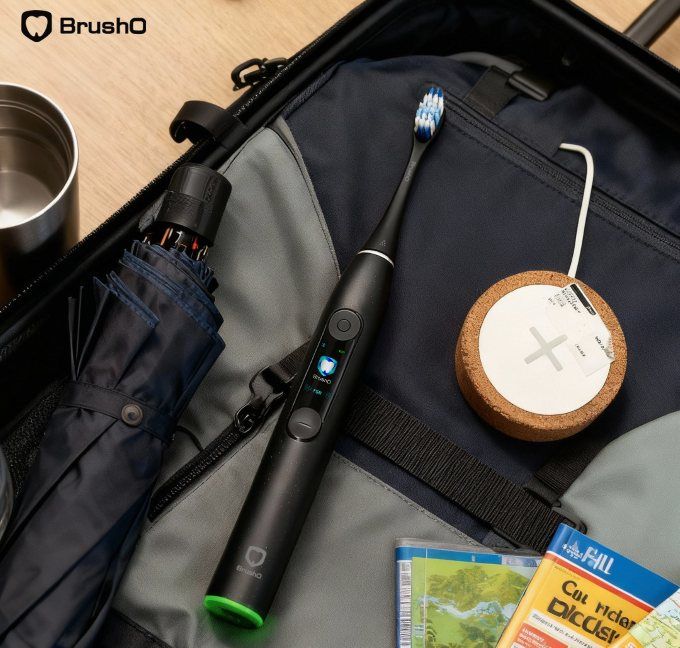
BrushO Bonus: The BrushO AI toothbrush features a 45-day battery life and wireless charging, perfect for travelers who want performance without worrying about recharging daily.
Traveling often means indulging in sugary snacks, alcohol, or acidic beverages, which increase plaque and erosion risk. Combined with irregular brushing, this raises your chances of cavities and sensitive gums.
Don’t skip brushing after that sweet dessert—BrushO’s real-time brushing feedback ensures thorough cleaning even after a travel splurge.
• A travel case for your toothbrush
• Fluoride toothpaste
• Disposable floss or interdental brushes
• A smart brush with an app-based reminder system
• Stick to twice-a-day brushing, no matter the schedule
• Use a 2-minute timer to avoid quick, ineffective brushes
• Plan for brushing before boarding or sleeping
Smart toothbrushes like BrushO help maintain your oral hygiene with:
• Brushing reminders
• Missed spot detection
• Zone-by-zone scoring
• App-based daily reports
• Brush & Earn rewards for brushing during your trip
BrushO’s AI-driven brushing system adapts to your brushing pressure, coverage, and time—even in a new environment. Whether you’re traveling for a weekend or a month, BrushO ensures you never miss a beat in your routine.
🔋 45-day battery life
🌐 Bluetooth-connected brushing reports
🪥 Zone-by-zone coverage reminders
🎁 Travel-friendly design with swappable heads
🎉 Reward system to keep habits consistent even on vacation
Traveling doesn’t have to derail your oral care. By being prepared and using smart tools like BrushO, you can maintain optimal brushing frequency, quality, and oral health outcomes. Stay protected from travel-related dental risks and turn your routine into a travel-friendly ritual.

<p class="lead">For decades, the only response to a carious lesion was to drill and fill it, removing tooth structure to place a restoration. Resin infiltration offers a different philosophy: instead of removing the lesion, it stops the lesion from progressing by sealing it from within. This mini...

<p class="lead">When a primary tooth is severely decayed or damaged, a simple filling is often not enough to restore its function and keep it healthy until it exfoliates naturally. Preformed crowns provide a durable, full-coverage restoration that protects the tooth and maintains space in the arc...

<p class="lead">After months or years of active orthodontic treatment, the teeth are aligned, the bite is corrected, and the braces come off. Yet the treatment is not finished: without retention, the teeth will drift back toward their original positions. Relapse is a natural consequence of the el...

<p class="lead">Primary herpetic gingivostomatitis is the first infection of the mouth with the herpes simplex virus, and it is one of the most painful conditions a child can experience. Affected children develop fever, widespread oral ulcers, and swollen gums, and they may refuse to eat or drink...

<p class="lead">When a tooth with an apical infection fails to heal after root canal treatment, the endodontist has a limited number of options: retreat the tooth, extract it, or perform periradicular surgery. Apicoectomy, the surgical removal of the root tip and the infected tissue around it, of...

<p class="lead">Osteoradionecrosis of the jaws is one of the most feared complications of radiotherapy for head and neck cancer. It presents as exposed, non-healing bone within the radiation field, causing pain, infection, and fistula formation, and it can severely impair the patient's quality of...

<p class="lead">Mucocele and ranula are the two most common benign lesions of the minor and sublingual salivary glands. Both arise from the obstruction or rupture of a salivary duct, producing a fluid-filled swelling that is usually painless but cosmetically and functionally troublesome. This art...

<p class="lead">Injury to the inferior alveolar or lingual nerve is among the most feared complications in dentistry, producing numbness, tingling, or altered sensation in the lip, chin, and tongue that can persist for months or years. Although rare, these injuries cause significant distress and ...

<p class="lead">The success of a composite restoration depends less on the resin itself than on the quality of the bond between the material and the tooth. Modern adhesive systems have transformed restorative dentistry by making micromechanical attachment to enamel and dentine predictable and dur...

<p class="lead">Bitewing radiographs are the single most valuable imaging tool for the detection of caries, particularly the interproximal lesions that are invisible to the naked eye and frequently missed on clinical examination alone. Yet their use must be balanced against radiation exposure and...

Bauen Sie schnell und kostengünstig ein Netzwerk für Zahngesundheitsdaten auf, das jeder nutzen kann.
Bauen Sie schnell und kostengünstig ein Netzwerk für Zahngesundheitsdaten auf, das jeder nutzen kann.


Address: RM 1427, 14/F RADIO CITY 505, HENNESSY RD CAUSEWAY BAY, HONG KONG
Code: 000000
Phone: +852-53758652
Email: customerservice@brusho.com