
Many people brush their teeth the same way every day—quick sweeps across the front, maybe a few seconds on the molars, and done. But even if you’re brushing twice a day, you may be missing key zones and surfaces in your mouth that need attention. That’s where the 6 Zones and 16 Surfaces model comes in. Used by dental professionals and now integrated into smart toothbrushes like BrushO, this model helps you understand your mouth better and brush smarter.
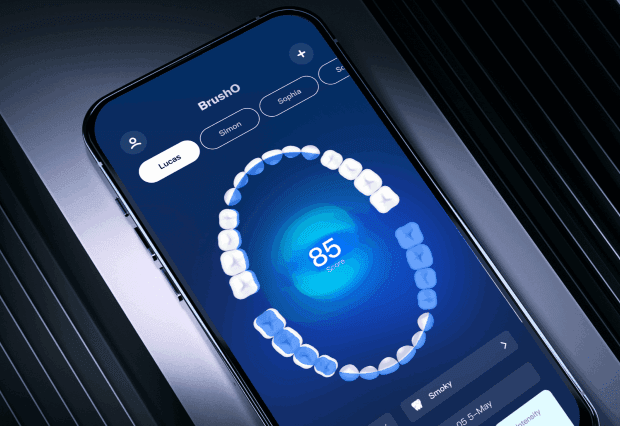
Your mouth is divided into 6 major zones for optimal cleaning:
1. Upper Right (back teeth to front)
2. Upper Left
3. Lower Left
4. Lower Right
5. Upper Front (inner and outer)
6. Lower Front (inner and outer)
These zones ensure that both sides and both arches (top and bottom) are cleaned evenly—no zone gets neglected.
Within each zone, your teeth have multiple surfaces that bacteria can cling to. The 16 surfaces typically refer to:
• Outer (buccal): Facing your cheeks and lips
• Inner (lingual/palatal): Facing your tongue
• Top (occlusal): The biting/chewing surface
• Interproximal: Between teeth (flossing zones)
If you multiply surfaces across molars, premolars, canines, and incisors in all zones, you get at least 16 unique brushing surfaces that need attention in each session.
Even if you brush twice a day, missing just one surface repeatedly allows plaque and bacteria to thrive. Over time, this leads to:
• Uneven whitening or yellowing
• Gum inflammation in neglected zones
• Cavities in hard-to-reach molars
• Tartar buildup near the gumline
• Bad breath from trapped food or bacteria
In other words, incomplete brushing leads to preventable oral health problems.
Manually remembering 6 zones and 16 surfaces during a 2-minute brush? Not realistic for most people. That’s why BrushO’s smart technology does the work for you:
Using motion sensors and AI, BrushO detects which zone you’re brushing and for how long.
It analyzes angles, pressure, and position to ensure you’re reaching all tooth surfaces—not just the visible ones.
If you skip or underbrush an area, BrushO reminds you to go back before finishing.
See a daily report of which zones were fully cleaned, over-brushed, or missed entirely—turning guessing into data.
We’ve entered an age where precision matters more than routine. The 6 zones and 16 surfaces framework moves brushing from an unconscious habit to a targeted hygiene strategy. Think of it like skincare—you wouldn’t only apply product to your cheeks and skip your forehead. Your mouth deserves the same care. Understanding your mouth’s zones and surfaces is the first step toward better dental health. With the help of AI-powered tools like BrushO, you don’t have to memorize anything—just brush as guided, and let the tech handle the coverage. Because in oral health, what gets measured gets managed.
BrushO is a next-generation smart toothbrush that uses AI and zone detection to transform how you brush. From personalized feedback to zone-by-zone guidance, BrushO helps users build healthier, more effective brushing habits—powered by technology and backed by dental science.

The uncontrolled hypertension is the condition that the dental practice meets in the patient who presents with the elevated pressure that the guideline does not permit for the elective treatment, and the management of this patient requires the deferral of the dental procedure and the referral to ...

The closure of the extraction space in the orthodontic treatment is the phase that demands the careful selection of the mechanics and the monitoring of the force that the appliance delivers. The sliding mechanics that rely on the continuous archwire and the power chain that connects the brackets ...

The transverse discrepancy of the maxilla is the problem that the crowding and the posterior crossbite often hide, and the maxillary expansion is the treatment that addresses the width of the arch rather than the position of the individual tooth. The clinician who diagnoses the constriction early...

The local anaesthesia is the daily procedure that the modern dentistry treats as the routine, and the complications that follow it range from the transient and the trivial to the permanent and the serious. The clinician who injects by the habit without the anatomy in the mind is the clinician who...

The hypertension is the condition that the dental practice meets in the every day, and the patient who carries the elevated pressure without the symptoms is the patient who presents the risk that the chair-side measurement reveals. The dental team occupies the position that no other profession ho...

The glass-ceramic crown has become the default restoration for the anterior and the many posterior teeth, and the material selection within the family is the decision that determines the strength, the aesthetics, and the longevity of the result. The lithium disilicate, the leucite, and the zircon...

The dental phobia is the extreme form of the dental fear that prevents the patient from attending the treatment that the oral health requires, and the management of the phobia demands the skill that extends beyond the routine behaviour guidance. The systematic desensitization, the exposure therap...

The dental fear of the child is the condition that shapes the attitude for the lifetime, and the clinician who manages the first visits with the skill builds the patient who attends the recall without the dread. The fear that the child develops follows the many sources, and the practice that reco...

The patient with controlled hypertension is the patient who requires the dental care that the oral health demands and the treatment that the blood pressure permits, and the clinician who manages the controlled case safely follows the guideline that the evidence supports. The controlled hypertensi...

The ceramic veneer is the restoration that the aesthetic dentistry depends on, and the bond that retains the veneer on the enamel is the critical link that determines whether the restoration survives the function or fractures and debonds. The clinical technique from the preparation to the cementa...

Bauen Sie schnell und kostengünstig ein Netzwerk für Zahngesundheitsdaten auf, das jeder nutzen kann.
Bauen Sie schnell und kostengünstig ein Netzwerk für Zahngesundheitsdaten auf, das jeder nutzen kann.


Address: RM 1427, 14/F RADIO CITY 505, HENNESSY RD CAUSEWAY BAY, HONG KONG
Code: 000000
Phone: +852-53758652
Email: customerservice@brusho.com