
Caffeine is beloved for its energy-boosting benefits — but its effects don’t stop at your brain. This powerful stimulant also interacts with your mouth in surprising ways. From reducing saliva flow to contributing to enamel erosion, your daily coffee may be doing more harm than you think if you’re not brushing smart. In this article, we explore the science behind caffeine’s impact on your saliva and teeth, and how a smarter brushing routine with tools like BrushO can help balance your daily habits.
Caffeine is known to have diuretic properties, which can lead to dehydration. Dehydration, in turn, affects saliva production — a key factor in maintaining oral health.
Saliva helps wash away food particles, neutralize acids, and prevent bacterial overgrowth. When saliva is reduced, your mouth becomes more acidic, increasing the risk of cavities and bad breath.
Common signs of reduced saliva from caffeine:
• Dry mouth
• Sticky feeling in the mouth
• Morning breath even after brushing
Most caffeinated beverages (coffee, tea, energy drinks, sodas) are acidic. This acid can weaken enamel over time — especially when consumed frequently or sipped slowly over long periods.
• Acid exposure leads to:
• Tooth sensitivity
• Dull or yellowish appearance
• Higher susceptibility to cavities
Coffee and tea contain chromogens, which cling to enamel and cause tooth discoloration. A weakened enamel surface makes it easier for these pigments to stick.
Drink water alongside your coffee to combat the dehydrating effects. This helps maintain saliva flow and rinse away acids.
Wait at least 30 minutes before brushing your teeth. Brushing right after acid exposure may further damage softened enamel.
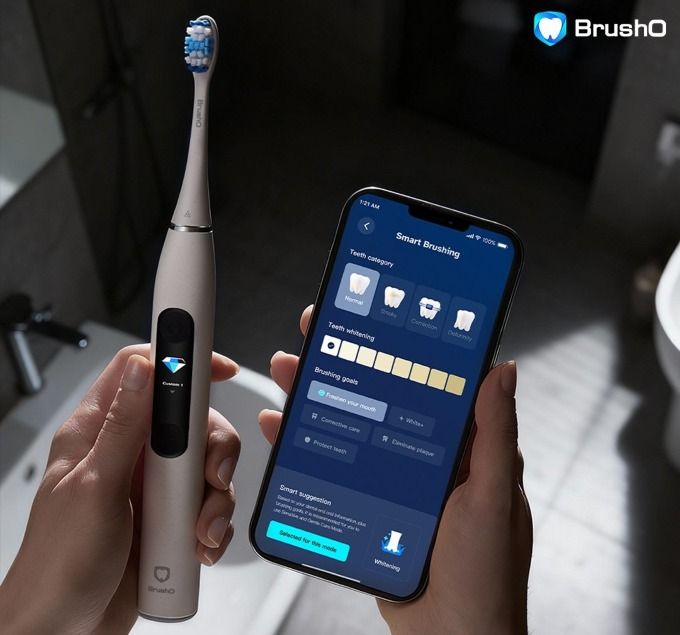
A smart brush like BrushO can help monitor pressure, ensure even coverage, and adapt to your enamel’s condition. Its feedback helps reinforce good brushing behavior, especially important for caffeine-heavy routines.
To counteract enamel loss, use fluoride or hydroxyapatite-based toothpaste that helps rebuild enamel over time.
BrushO’s AI brushing coach doesn’t just measure movement — it detects patterns that may indicate dry brushing or neglect of acid-prone areas. Pair it with saliva-promoting routines like chewing sugar-free gum or using a humidifier at night.
You don’t have to quit caffeine to protect your teeth — but you do need to understand its impact. By staying hydrated, timing your brushing properly, and using smarter oral care tools, you can enjoy your coffee without sacrificing your smile.

The xerostomia is the symptom that the patient describes as the dry mouth, and the Sjogren syndrome is the systemic autoimmune condition that the clinician identifies as one of the causes that the symptom reveals. The dry mouth that the patient reports may follow the medication, the radiation, th...

The sinus lift is the augmentation procedure that the clinician performs to create the bone height that the posterior maxilla requires for the implant, and the choice between the lateral window and the transcrestal approach determines the surgical trauma, the healing, and the implant that the sit...

Post-extraction bleeding is one of the most common and most distressing experiences after a tooth extraction. For most patients, a small amount of oozing from the extraction site for 24 to 48 hours after the procedure is completely normal. However, when bleeding becomes excessive, prolonged, or d...

The skeletal class III malocclusion is the condition that the clinician treats with the orthognathic surgery or the camouflage orthodontic treatment, and the decision between the two paths determines the function, the aesthetics, and the stability that the patient receives. The orthognathic surge...

Interproximal enamel reduction — commonly referred to as IPR, slenderizing, stripping, or contouring — is the controlled removal of small amounts of enamel from the proximal surfaces of teeth. Despite sounding more invasive than it is, IPR is one of the most widely used and clinically safe proced...

The gingival graft is the surgical procedure that the periodontist performs to restore the keratinized tissue and to cover the exposed root, and the choice between the free gingival graft and the connective tissue graft determines the outcome that the patient receives. The free gingival graft har...

Denture adhesives — commonly known as fixatives or denture creams — are among the most widely used adjuncts in prosthodontic care. Millions of complete and partial denture wearers use some form of adhesive daily, often without a clear understanding of what these products do, when they should be u...

When a young patient presents with an immature tooth that has lost its vitality — typically due to trauma or deep caries — the endodontist faces one of the most consequential decisions in paediatric endodontics. The permanent root has not finished forming, the apex remains open, and the tooth is ...

The ankyloglossia is the condition that the lingual frenulum restricts the movement of the tongue, and the release of the frenulum in the infant is the procedure that the clinician performs to restore the function that the feeding and the speech require. The assessment that the clinician performs...

Dental amalgam fillings have been in clinical use since the mid-19th century, making them one of the most historically established restorative materials. In 2026, the conversation around amalgam replacement has shifted from a simple material preference debate to a nuanced clinical assessment of w...

Build an oral health data network quickly and at low cost in a way that everyone can build.


Address: RM 1427, 14/F RADIO CITY 505, HENNESSY RD CAUSEWAY BAY, HONG KONG
Code: 000000
Phone: +852-53758652
Email: customerservice@brusho.com