
Do you think your toothbrush is personal and hygienic? Think again. Studies show that toothbrushes can harbor millions of bacteria, and under certain conditions, they can even transmit germs between people—especially when toothbrushes are stored close together or improperly cleaned. In this article, we’ll break down how germs spread through toothbrushes, the science behind contamination, and most importantly, how smart toothbrush hygiene habits and AI-powered tools like BrushO can help you stay protected.
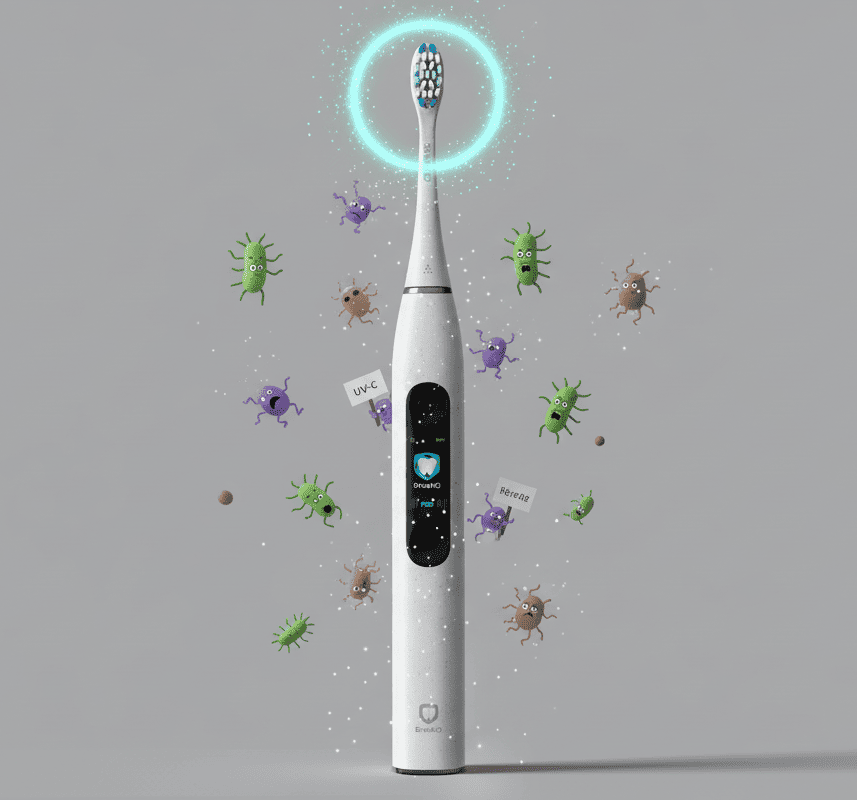
Even though you use it with toothpaste, your toothbrush can still accumulate harmful bacteria, viruses, and even mold. After each use, moisture combined with a warm bathroom environment creates a perfect breeding ground for microbial growth.
Bacterial buildup: Streptococcus, Staphylococcus, E. coli
Cross-contamination: From nearby brushes or shared holders
Fungal growth: From wet brush heads that never fully dry
Yes, especially when brushes are stored together in small spaces or cups, their bristles may touch, transferring bacteria. Even aerosols from toilet flushes can contaminate nearby toothbrushes if they’re left uncovered.
Couples or roommates storing brushes together
Families using shared holders in a single bathroom
Travel kits where brushes are crammed in one pouch
While most healthy adults won’t get sick from toothbrush germs, certain groups are more vulnerable:
Children with developing immune systems
Elderly individuals
People recovering from illnesses
Anyone with gum disease or oral wounds
Keep toothbrushes upright in a holder with enough space between each—never let bristles touch.
Caps can help during travel, but can also trap moisture. Use only ventilated covers, and avoid sealing a wet brush.
Air-drying is essential. BrushO’s charging base helps eliminate bacteria while drying your brush effectively.
Soak the head in antibacterial mouthwash or 3% hydrogen peroxide weekly to reduce bacterial load.
Unlike traditional toothbrushes, BrushO’s AI-powered toothbrush and smart system are designed with hygiene and safety in mind.
Reminds you when to replace your brush head
Compatible with free brush head replacement via reward points
Secure travel case design that supports proper airflow
BrushO isn’t just smarter—it’s cleaner. From AI hygiene monitoring to habit tracking, the system is built to protect your health, not just clean your teeth.
✅ Replace brush head every 3 months
Or sooner if you’ve been sick or the bristles look worn.
✅ Avoid group storage in the bathroom
Especially if someone is ill.
✅ Don’t share brushes—ever
Even with family or partners.

Squamous cell carcinoma is not a single, uniform disease, and two of its oral variants illustrate the extremes of its behavior. Verrucous carcinoma is a slow-growing, exophytic tumor that almost never metastasizes, while spindle cell carcinoma is an aggressive, sarcomatoid malignancy that can be ...

Most people expect a toothache to be the first sign of pulp disease, but some forms of pulpitis are surprisingly silent. A pulp polyp is the visible result of chronic hyperplastic pulpitis, a condition in which the dental pulp grows out of a large carious opening as a fleshy mass. Recognizing thi...

Dry mouth is not merely uncomfortable; it is a medical condition with real consequences for teeth, speech, swallowing and quality of life. When the salivary glands cannot produce enough saliva, medications called sialogogues can restore some of the missing fluid. Pilocarpine and cevimeline are th...

A blister in the mouth can be the first warning of a systemic autoimmune disease, and two disorders deserve particular attention in the dental chair: pemphigus vulgaris and mucous membrane pemphigoid. Both produce chronic oral ulceration, yet their immunologic targets, clinical behavior and long-...

When infection drains from a tooth, the body often creates a visible escape route, and the dentist must interpret these fistulous openings correctly. A parulis is the common gum boil that signals chronic periapical infection, while an oroantral fistula is a communication between the mouth and the...

Among the fibro-osseous lesions of the jaws, the ossifying fibroma holds a unique position because it is a true neoplasm, unlike the reactive cemento-osseous dysplasia discussed in an earlier article. It grows continuously, expands bone and requires surgical removal, and its cemental variant adds...

Not all keratocystic lesions of the jaw behave alike, and one of the most important distinctions in oral pathology separates the orthokeratinized odontogenic cyst from its better-known relative, the odontogenic keratocyst. Although the two lesions look similar under the microscope at first glance...

Periodontal disease is usually a slowly progressive infection, but a rare form called necrotizing ulcerative periodontitis destroys tissue with alarming speed. Unlike ordinary periodontitis, this condition produces necrotic, cratered papillae, deep pocketing and rapid bone loss, and it appears al...

Every parent has met the child who refuses to eat because of painful mouth sores, and most of these children have one of two viral illnesses: herpangina or hand, foot and mouth disease. Both are caused by enteroviruses, both produce fever and oral ulcers, and both are overwhelmingly common in you...

Cementoosseous dysplasia is one of the most common fibro-osseous lesions found on dental radiographs, yet it is also one of the most frequently misdiagnosed. The lesion replaces normal bone with cellular fibrous tissue and cementum-like material, and it appears in several forms that range from a ...

Construir rápidamente y a bajo costo una red de datos sobre salud bucal de una manera que todos puedan construir.
Construir rápidamente y a bajo costo una red de datos sobre salud bucal de una manera que todos puedan construir.


Address: RM 1427, 14/F RADIO CITY 505, HENNESSY RD CAUSEWAY BAY, HONG KONG
Code: 000000
Phone: +852-53758652
Email: customerservice@brusho.com