
Oral care isn’t just about fresh breath—it’s about building habits that improve your long-term health. BrushO uses AI, smart sensors, and real-time feedback to personalize each brushing session. With over 100 customizable modes, gum-protecting FSB technology, and a smart app for performance tracking, it turns brushing into a measurable, sustainable, and rewarding daily health ritual. Backed by leading institutions and praised by dental professionals, BrushO leads the next generation of oral care innovation.
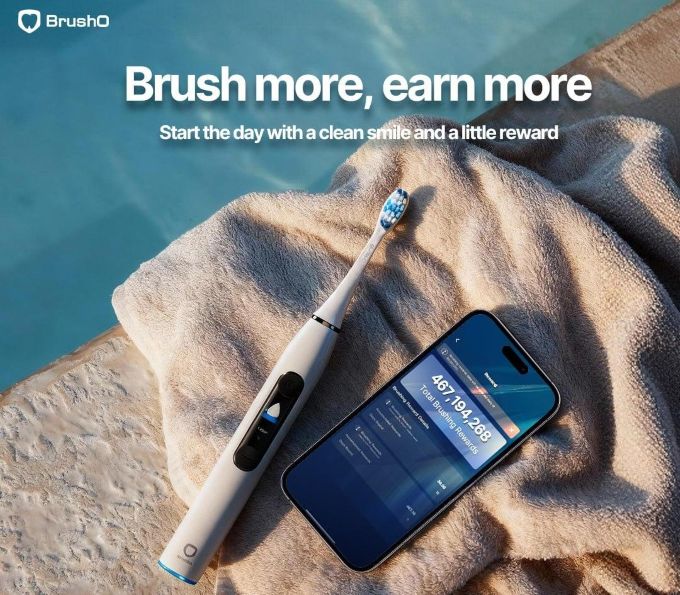
For most people, brushing is just a twice-a-day routine. But studies have shown that poor brushing habits can increase the risk of heart disease, cognitive decline, and chronic inflammation. That’s why BrushO treats oral care as a foundational health practice—by combining smart tech, user-centered design, and habit-forming motivation into one intelligent device.
What truly sets BrushO apart is its patented FSB Technology (Fully Smart Brushing), which adapts in real-time to your brushing pressure, angle, and motion. Unlike generic electric brushes, BrushO uses built-in sensors to detect how you’re brushing and makes micro-adjustments to prevent gum damage and maximize plaque removal.
Each session generates a unique “Brushprint”, showing:
• Coverage map of your brushing zones
• Pressure feedback (too hard or too soft)
• Time spent in each region of the mouth
This data is displayed visually via the BrushO companion app, helping users improve their technique with every session.
Whether you’re managing sensitive gums, trying to whiten teeth, or just want a deep clean after coffee, BrushO offers over 100 customizable brushing modes. You’re not stuck with one routine—you get a brush that adapts to you.
BrushO believes oral care should be rewarding in more ways than one. With its “Brush & Earn” system, users collect points for brushing consistently and properly. These points can be redeemed for lifetime free brush head replacements, reducing waste and promoting sustainability.
✅ Eco-friendly: Durable brush heads reduce plastic waste
✅ Long battery life: Up to 45 days on a single charge
✅ Waterproof & travel-ready: For health-conscious lifestyles on the go
By making brushing both motivating and eco-conscious, BrushO keeps users engaged while minimizing environmental impact.
BrushO has received international recognition at health and tech forums such as:
• Stanford School of Medicine
• UK Dental Taiwan Conference
• Web3 Health Tech Showcases
This global credibility reinforces BrushO’s status as a leader in smart oral care, blending wellness, habit formation, and sustainable design.
Your mouth is the gateway to your overall health. Poor brushing can lead to:
• Gum inflammation linked to heart disease and stroke
• Oral bacteria contributing to cognitive decline
• Extra burden on your immune system
BrushO’s intelligent reminders, pressure control, and brushing zone tracking help reduce these risks—making every brush matter.
BrushO isn’t just changing how we brush—it’s changing why we brush. From AI-powered feedback to eco-smart incentives, it turns a boring daily routine into a data-driven, health-positive, and emotionally rewarding experience. It’s the future of oral care, built for those who want to live smarter, not harder.
BrushO is a pioneering health tech brand redefining daily wellness through smart oral care. With AI-powered toothbrushes, personalized app insights, and eco-conscious design, BrushO helps users build better habits that stick—supporting both oral health and total body wellness.
Nov 9
Nov 7

Squamous cell carcinoma is not a single, uniform disease, and two of its oral variants illustrate the extremes of its behavior. Verrucous carcinoma is a slow-growing, exophytic tumor that almost never metastasizes, while spindle cell carcinoma is an aggressive, sarcomatoid malignancy that can be ...

Most people expect a toothache to be the first sign of pulp disease, but some forms of pulpitis are surprisingly silent. A pulp polyp is the visible result of chronic hyperplastic pulpitis, a condition in which the dental pulp grows out of a large carious opening as a fleshy mass. Recognizing thi...

Dry mouth is not merely uncomfortable; it is a medical condition with real consequences for teeth, speech, swallowing and quality of life. When the salivary glands cannot produce enough saliva, medications called sialogogues can restore some of the missing fluid. Pilocarpine and cevimeline are th...

A blister in the mouth can be the first warning of a systemic autoimmune disease, and two disorders deserve particular attention in the dental chair: pemphigus vulgaris and mucous membrane pemphigoid. Both produce chronic oral ulceration, yet their immunologic targets, clinical behavior and long-...

When infection drains from a tooth, the body often creates a visible escape route, and the dentist must interpret these fistulous openings correctly. A parulis is the common gum boil that signals chronic periapical infection, while an oroantral fistula is a communication between the mouth and the...

Among the fibro-osseous lesions of the jaws, the ossifying fibroma holds a unique position because it is a true neoplasm, unlike the reactive cemento-osseous dysplasia discussed in an earlier article. It grows continuously, expands bone and requires surgical removal, and its cemental variant adds...

Not all keratocystic lesions of the jaw behave alike, and one of the most important distinctions in oral pathology separates the orthokeratinized odontogenic cyst from its better-known relative, the odontogenic keratocyst. Although the two lesions look similar under the microscope at first glance...

Periodontal disease is usually a slowly progressive infection, but a rare form called necrotizing ulcerative periodontitis destroys tissue with alarming speed. Unlike ordinary periodontitis, this condition produces necrotic, cratered papillae, deep pocketing and rapid bone loss, and it appears al...

Every parent has met the child who refuses to eat because of painful mouth sores, and most of these children have one of two viral illnesses: herpangina or hand, foot and mouth disease. Both are caused by enteroviruses, both produce fever and oral ulcers, and both are overwhelmingly common in you...

Cementoosseous dysplasia is one of the most common fibro-osseous lesions found on dental radiographs, yet it is also one of the most frequently misdiagnosed. The lesion replaces normal bone with cellular fibrous tissue and cementum-like material, and it appears in several forms that range from a ...

Construir rápidamente y a bajo costo una red de datos sobre salud bucal de una manera que todos puedan construir.
Construir rápidamente y a bajo costo una red de datos sobre salud bucal de una manera que todos puedan construir.


Address: RM 1427, 14/F RADIO CITY 505, HENNESSY RD CAUSEWAY BAY, HONG KONG
Code: 000000
Phone: +852-53758652
Email: customerservice@brusho.com