How to Choose the Right Smart Toothbrush for Your Family
Jan 20

Jan 20

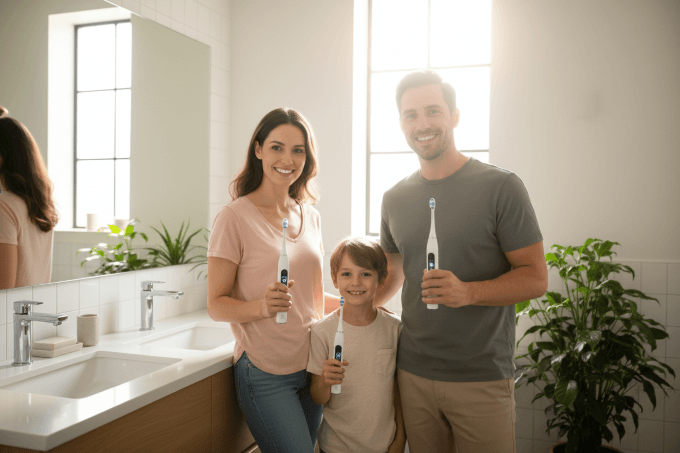
Choosing a smart toothbrush for your family is no longer just about the motor or battery life. Today’s smart toothbrushes use AI, pressure sensors, motion tracking, and give personalized feedback. These features help people of all ages build better brushing habits. But what works for adults may not suit children. Protecting sensitive gums may also differ from removing plaque effectively. In this guide, we’ll break down how to choose the right smart toothbrush for your family by focusing on safety, personalization, usability, and long-term oral health benefits. Whether you are brushing with young children, teenagers, or older family members, understanding these key factors will help you make a more informed and effective choice.

How to Choose the Right Smart Toothbrush for Your Family

1. Understand Different Oral Care Needs Within a Family

Every family member has unique oral health needs. Children are still developing proper brushing habits, while adults often focus on plaque control and whitening. Older family members may deal with gum sensitivity or receding gums.
A smart toothbrush for family use should support:
  • Gentle brushing modes for children and sensitive gums
  • Standard and deep-clean modes for adults
  • Customizable intensity and speed settings
Smart toothbrushes with AI-based personalization automatically adapt brushing recommendations. They adjust based on age, brushing behavior, and oral condition. This makes them suitable for households with mixed needs.

2. Look for Pressure Sensors to Protect Gums

One of the most important features when choosing a smart toothbrush is a reliable pressure sensor. Brushing too hard is a common problem across all age groups and can lead to gum recession, enamel wear, and long-term sensitivity.
A high-quality smart toothbrush should:
  • Detect excessive brushing pressure in real time.
  • Provide immediate feedback through lights, vibration, or screen alerts.
  • Automatically reduce motor speed to protect gums.
This feature is especially critical for children, who often lack pressure control, and for adults with existing gum issues.

3. Choose a Smart Toothbrush with Real-Time Brushing Feedback

For families, brushing guidance should go beyond a simple two-minute timer. Advanced smart toothbrushes use motion sensors and AI algorithms to track brushing coverage across different areas of the mouth.
  • Ensure all tooth surfaces are evenly cleaned.
  • Reduce missed zones, especially back molars.
  • Teach children correct brushing techniques visually.
Smart toothbrushes that visualize brushing progress make oral care easier to understand and more engaging for all family members.

4. Prioritize Family-Friendly App Features

A smart toothbrush app plays a crucial role in long-term habit building. When choosing a family smart toothbrush, look for an app that supports multiple user profiles under one account.
Key family-oriented app features include:
  • Individual brushing reports for each family member
  • Daily, weekly, and monthly brushing summaries
  • Personalized recommendations based on brushing behavior
For parents, this makes it easier to monitor children’s brushing habits without constant supervision, while adults benefit from data-driven improvements to their routine.

5. Consider Habit-Building and Motivation Features

Maintaining consistent brushing habits is one of the biggest challenges in family oral care. Smart toothbrushes that incorporate motivation systems can significantly improve consistency.
Effective habit-building features may include:
  • Brushing scores and progress tracking
  • Visual rewards or achievements
  • Positive reinforcement through app feedback
For children, especially, turning brushing into an interactive and rewarding experience can help establish healthy habits that last into adulthood.

6. Safety, Durability, and Ease of Use Matter

A family smart toothbrush should be safe, durable, and easy for everyone to use. Look for:
  • IPX7 waterproof rating for bathroom and shower use
  • Ergonomic handles suitable for both small and large hands
  • Simple controls and clear display screens
Long battery life and wireless charging also make daily use more convenient for families, reducing the need for frequent recharging.

7. Think Long-Term: Data, Privacy, and Smart Technology

Modern smart toothbrushes collect brushing data to improve oral health outcomes. When choosing a smart toothbrush for your family, it’s important to consider how this data is stored and protected.
A trustworthy smart toothbrush should:
  • Encrypt personal brushing data
  • Respect user privacy
  • Use data responsibly to provide meaningful insights.
AI-powered analysis can help families understand brushing patterns over time, identify areas for improvement, and maintain better oral health together.
 

Final Thoughts: Choosing the Best Smart Toothbrush for Your Family

Choosing the right smart toothbrush for your family is an investment in long-term oral health, not just a daily cleaning tool. By focusing on personalization, pressure protection, real-time feedback, and family-friendly app features, you can ensure that every family member brushes more effectively and safely.
A well-designed AI smart toothbrush helps turn brushing into a guided, educational, and rewarding experience—making healthy smiles easier to achieve for the entire family.

Publicaciones recientes

Missed quadrant streaks can expose a drifting weekend routine

Missed quadrant streaks can expose a drifting weekend routine

When the same quadrant keeps showing weaker brushing on weekends, the issue is usually routine drift rather than random forgetfulness. Repeated misses reveal where sleep changes, social plans, and looser timing are bending the same brushing sequence each week.

Mirror free sessions can reveal whether brushing pressure stays steady

Mirror free sessions can reveal whether brushing pressure stays steady

Brushing without watching the mirror can expose whether your pressure stays controlled or rises when visual reassurance disappears. The exercise helps people notice hidden overpressure, uneven route confidence, and which surfaces get scrubbed harder when the hand starts guessing.

Marginal ridges help premolars resist sideways bite stress

Marginal ridges help premolars resist sideways bite stress

Marginal ridges on premolars help support the crown when chewing forces slide sideways instead of straight down. When those ridges wear or break, the tooth can become more vulnerable to food packing, cracks, and uneven pressure.

Dry office air can make gum margins sting by dusk

Dry office air can make gum margins sting by dusk

Dry office air can quietly reduce saliva and leave gum margins feeling tight or stingy by late afternoon. The problem is often less about dramatic disease and more about long hours of mouth dryness, light plaque retention, and irritated tissue edges.

Citrus sparkling cans can restart enamel softening at dinner

Citrus sparkling cans can restart enamel softening at dinner

A citrus sparkling drink with dinner can keep enamel in a softened state longer than people expect, especially when the can is sipped slowly. The problem is often repeated acidic contact, not one dramatic drink.

Cervical curves change how force leaves the enamel edge

Cervical curves change how force leaves the enamel edge

The curved neck of a tooth changes how chewing and brushing forces leave enamel near the gumline. That helps explain why the cervical area can feel sensitive, wear faster, and react strongly when pressure, acidity, and gum changes overlap.

Workday logs can expose missed lunch brushing

Workday logs can expose missed lunch brushing

Missed lunch brushing often hides inside normal work routines instead of feeling like a conscious choice. Time logs, calendar gaps, and daily patterns can reveal where the habit breaks down and why simple awareness often fixes more than extra motivation does.

Tea sips can keep canker sores tender longer

Tea sips can keep canker sores tender longer

Warm tea can feel soothing at first, but repeated sipping can keep a small canker sore active by extending heat, dryness, acidity, and friction across already irritated tissue. The problem is often the sipping pattern, not the tea alone.

Retainer cases can reseed plaque after cleaning

Retainer cases can reseed plaque after cleaning

A retainer can look freshly cleaned and still pick up old residue from its case. When moisture, biofilm, and handling build up inside the container, the case can quietly place plaque back onto the appliance each time it is stored.

Pulp horns sit closer to the surface than people think

Pulp horns sit closer to the surface than people think

Pulp horns extend higher inside the crown than many people realize, which helps explain why small wear, chips, or cavities can become sensitive faster than expected. Surface damage and inner anatomy are often closer neighbors than they appear from outside.
