
Delaying a dental visit isn’t automatically harmful—but the safety margin depends on your risk profile, your daily plaque control, and whether silent problems are already developing. Cavities between teeth, early gum disease, enamel erosion, and bite-related wear often progress with little to no pain, which is exactly why routine checkups matter. A short delay may be reasonable if your gums are healthy, you have low cavity risk, and your home care is consistent and thorough. However, repeated postponement raises the odds that plaque turns into tartar, gum inflammation deepens below the gumline, and small areas of decay become larger (and more expensive) to treat. This guide explains what dental visits actually prevent, how long you can realistically stretch intervals, the warning signs that mean “do not delay,” and how data-driven brushing tools like BrushO can help you maintain a dentist-level standard of consistency between appointments.
A dental visit is not just a polish. It’s a screening and measurement checkpoint that home care can’t replicate. Dentists and hygienists can detect issues that are invisible or symptom-free early on, including:
• Interproximal cavities (between teeth) that you won’t see in the mirror
• Early gum disease developing under the gumline
• Enamel erosion from acids or reflux
• Bite and wear changes from clenching, grinding, or misalignment
• Tartar (calculus) deposits that brushing cannot remove once hardened
If you delay too long, these problems don’t pause—they simply become harder to treat.
A short delay may be relatively low risk (not “risk-free”) if most of these are true:
• You rarely get cavities and have no recent dental work
• Your gums don’t bleed when brushing or flossing
• You floss (or clean between teeth) consistently
• You don’t have frequent snacking/sugary drinks
• You don’t have chronic dry mouth, smoking/vaping habits, or untreated reflux
• You’re not currently experiencing sensitivity, pain, swelling, or persistent bad breath
In this situation, postponing a routine checkup by a few months is often less likely to cause sudden harm—but only if your daily plaque removal stays strong.
The main danger of delaying is that many dental problems are quiet at first.
Plaque left along the gumline can mineralize into tartar. Once tartar forms, it creates a rough surface that retains even more plaque and bacteria—raising the risk of gingivitis and, later, periodontal disease.
Decay often starts as microscopic demineralization. It may not hurt until it gets closer to the nerve, at which point treatment may shift from a simple filling to a deeper restoration.
Early gum inflammation can look mild, but the real issue may be under the gumline. Periodontal problems can advance with minimal discomfort until they become harder to reverse.
Grinding and clenching can flatten biting surfaces, trigger sensitivity, and stress restorations. Without checkups, wear patterns can go unnoticed until they cause pain or fractures.
Pain is a late signal in dentistry. Many conditions are painless until they’re advanced:
• early cavities
• early gum disease
• enamel erosion
• bite stress and wear
If you rely on pain as your indicator, you’re essentially waiting for the problem to become more complicated.
There isn’t one perfect schedule for everyone, but the core rule is simple: The higher your risk, the shorter your safe interval.
You’re more likely to need tighter intervals if you have:
• a history of cavities
• bleeding gums or past gum treatment
• orthodontic retainers/aligners
• dry mouth (mouth breathing, medications, dehydration)
• smoking or vaping habits
• reflux, frequent acidic drinks, or frequent snacking
• pregnancy or hormonal shifts that affect gums
• diabetes or immune-related conditions
If any of these apply, delaying routine visits tends to carry a bigger downside.
Do not “wait it out” if you notice any of the following:
• gums bleeding when brushing or flossing
• persistent bad breath that returns quickly
• sensitivity to cold, sweets, or brushing
• a dull ache or pressure that comes and goes
• swelling, a pimple-like bump, or bad taste near a tooth
• gum recession or teeth looking “longer”
• jaw pain, clicking, or frequent morning headaches
• rough deposits near the gumline that don’t brush off
These are often signs that something is already in motion.
If you want more flexibility between dental visits, your daily routine has to be consistently high quality, not just “twice a day.”
Focus on:
• gumline cleaning (where plaque triggers inflammation fastest)
• even coverage across back molars and inner surfaces
• gentle but effective pressure (too hard can worsen recession; too light leaves plaque)
• between-teeth cleaning (floss, interdental brushes, or water flosser)
The most common reason people get surprised at a checkup is predictable: they brush regularly—but miss the same zones every day.
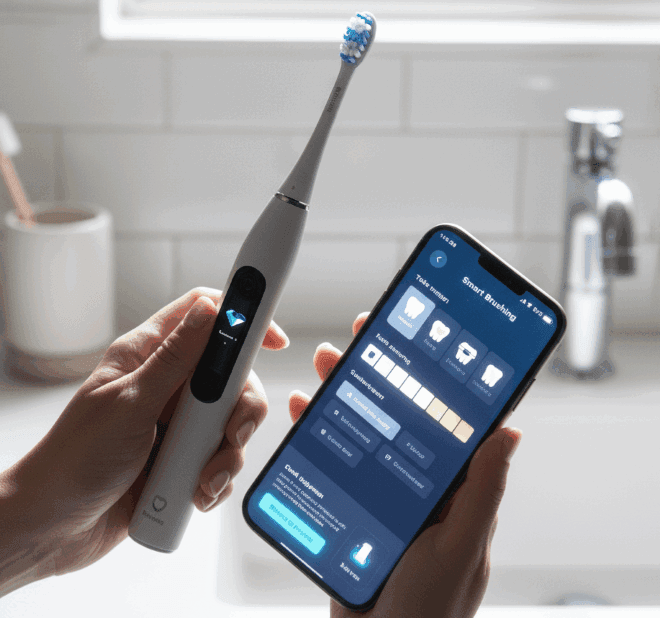
BrushO helps close the gap between “I brush daily” and “I brush effectively” by making the invisible parts measurable:
• coverage awareness so you don’t repeatedly miss the same spots
• pressure monitoring to protect gum tissue while still removing plaque
• habit reinforcement so consistency doesn’t collapse during busy weeks
• session feedback that turns brushing into a repeatable, high-standard routine
If you’re going to delay a visit, the best strategy is to make home care more precise, not merely more frequent.
You can sometimes delay a dental visit without immediate harm—but only if your cavity and gum risk are low and your daily plaque control is genuinely thorough. The bigger risk isn’t what you feel today; it’s what can progress quietly: tartar buildup, between-teeth decay, early gum disease, and enamel wear. If you’re postponing, treat your routine like prevention medicine—consistent, complete, and gumline-focused—with tools (like BrushO) that help you avoid the “same missed spots” pattern that leads to unpleasant surprises.
Feb 18
Feb 18

Trigeminal neuralgia (TN), also known as tic douloureux, is a chronic orofacial pain disorder characterized by recurrent, unilateral, brief, electric shock-like pain in the distribution of one or more divisions of the trigeminal nerve. It is widely regarded as one of the most severe pain conditions

Tooth whitening has become one of the most sought-after elective dental procedures worldwide. With increasing emphasis on facial aesthetics, a bright, white smile is now widely perceived as a marker of health, youth, and social confidence. This article provides a comprehensive review of contemporary

The edentulous posterior maxilla presents unique challenges for implant rehabilitation due to the pneumatization of the maxillary sinus and the progressive resorption of the alveolar ridge following tooth loss. Sinus floor elevation, or sinus lift surgery, is a predictable and well-documented surgic

Photodynamic therapy (PDT) is a minimally invasive therapeutic modality that combines a photosensitizing agent, light of a specific wavelength, and molecular oxygen to produce cytotoxic reactive oxygen species. Originally developed for oncological applications, PDT has been increasingly adopted in d

The introduction of temporary anchorage devices (TADs) has fundamentally transformed orthodontic treatment by providing skeletal anchorage that is independent of patient compliance. TADs, also known as mini-implants or miniscrews, enable tooth movements that were previously impossible or required co

Dental caries remains one of the most prevalent chronic diseases worldwide, disproportionately affecting children, elderly populations, and communities with limited access to conventional restorative care. The traditional restorative approach requires expensive equipment, cooperative patients, and m

Platelet-rich fibrin (PRF), a second-generation platelet concentrate, has emerged as one of the most widely adopted autologous biomaterials in contemporary dentistry and oral surgery. Developed by Dr. Joseph Choukroun and colleagues in France in 2001, PRF represents a conceptual evolution from first

The transition from conventional to digital impressions represents one of the most significant technological shifts in contemporary dentistry. Intraoral scanners (IOS) have evolved from experimental prototypes in the 1980s to sophisticated clinical instruments that now rival and, in several key metr

Gingival recession, defined as the apical migration of the gingival margin beyond the cementoenamel junction with exposure of the root surface, is a prevalent condition affecting a substantial proportion of the adult population. Epidemiological studies report that approximately 50% of adults exhibit

Cone beam computed tomography (CBCT) has revolutionized endodontic diagnosis and treatment planning by providing three-dimensional imaging that overcomes the inherent limitations of conventional periapical radiography. While two-dimensional radiographs remain the first-line imaging modality for endo

Construire rapidement et à faible coût un réseau de données sur la santé bucco-dentaire de manière que tout le monde puisse y contribuer.
Construire rapidement et à faible coût un réseau de données sur la santé bucco-dentaire de manière que tout le monde puisse y contribuer.


Address: RM 1427, 14/F RADIO CITY 505, HENNESSY RD CAUSEWAY BAY, HONG KONG
Code: 000000
Phone: +852-53758652
Email: customerservice@brusho.com