
Even if you’re brushing twice a day, you might still be missing the same areas over and over — like the back molars or along the gumline. These “brushing blind spots” can silently lead to cavities and gum disease. In this article, we break down the most commonly missed areas, why they’re often overlooked, and how smart toothbrushes like BrushO help you achieve complete coverage every time.
Despite our best efforts, brushing isn’t always consistent or accurate. Most people miss the same areas repeatedly without even realizing it. Here’s why:
You probably brush the same way every day — starting from a familiar spot, applying the same pressure, and ending at a predictable location. This autopilot mode leads to over-brushing some areas while neglecting others, especially the hard-to-reach back teeth.
You can’t see inside your own mouth while brushing. Areas behind the molars, inner surfaces, and gumline edges often go untouched simply because they’re not in your line of sight.
Right-handed people tend to neglect the right back molars, and left-handed people often miss the left side. Your dominant hand makes some areas easier to reach than others — unless you’re consciously balancing your brushing.
If you rush, you’re more likely to miss spots — especially lower-priority areas like behind the front lower teeth or back molars. Incomplete coverage leads to plaque buildup and decay in predictable zones.
Missing the same spot during every brushing session has real consequences over time:
🦠 Plaque Accumulation in neglected areas.
🦷 Cavities where brushing is insufficient.
😬 Gum Inflammation along the unbrushed gumline.
🫢 Persistent Bad Breath from bacterial buildup.
💰 Costly Dental Visits for preventable issues.
Even small missed zones can become long-term oral health risks if ignored daily.
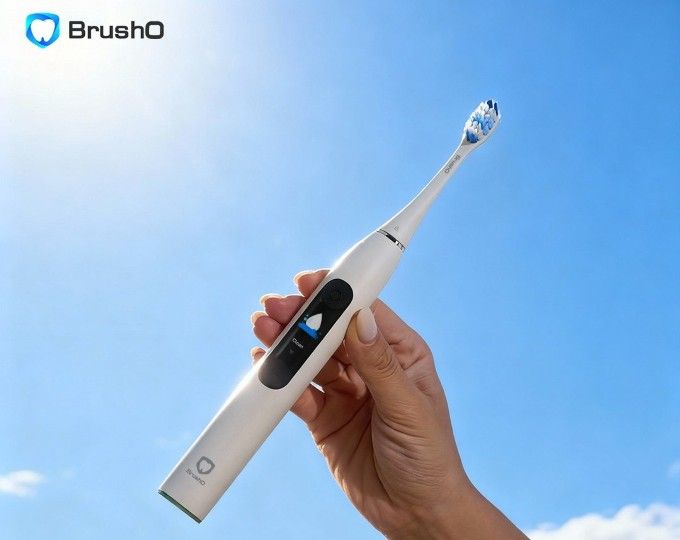
BrushO is an AI-powered toothbrush designed to eliminate brushing blind spots with smart technology:
✅ FSB Technology (Fully Smart Brushing): Tracks your brushing zones in real-time and detects which teeth you’re missing.
📱 App Feedback: Visual heatmaps and brushing scores show which areas were underbrushed or completely skipped.
🦷 Zone-Based Alerts: Reminds you if you’ve missed a zone or haven’t brushed long enough.
🪥 Customizable Modes: Adjusts brushing for deep clean or sensitive zones so no area is left out.
With BrushO, you get complete coverage, every single time — and never wonder if you’re missing that one stubborn molar again.
Even without smart tech, these brushing techniques help:
🕰️ Brush for two full minutes — set a timer.
🔄 Start in a different quadrant each time to avoid repetition.
✋ Switch hands mid-brushing to reach opposite sides more effectively.
🔍 Use a mirror or the BrushO app to visually guide your brushing.
🧼 Don’t forget the inner surfaces and gumline — they’re the most overlooked.
When you brush the same but miss the same spots, you’re not really cleaning your teeth — you’re just going through the motions. Smart brushing with BrushO turns your routine into a precision health ritual, eliminating missed zones, preventing cavities, and promoting full-mouth health.
Dec 30
Dec 29

An in-depth exploration of periodontal disease pathogenesis, the 2017 World Workshop classification system, and the principles of non-surgical periodontal therapy including scaling, root planing, and adjunctive antimicrobials.

An evidence-based comparison of clear aligner therapy versus conventional fixed orthodontic appliances, covering treatment efficacy, duration, patient compliance, comfort, and aesthetic outcomes based on systematic reviews and clinical trials.

A practical guide to third molar assessment and management, including indications for extraction versus retention, surgical techniques for impacted teeth, and prevention and management of common postoperative complications.

A comprehensive review of contemporary root canal treatment protocols, including rotary instrumentation, advanced irrigation systems, and obturation techniques. Examines evidence-based success rates and prognostic factors affecting endodontic outcomes.

A review of modern resin composite technologies including nanofilled, bulk-fill, and bioactive composites. Covers polymerization shrinkage management, bonding protocols, and clinical longevity data for anterior and posterior restorations.

A comprehensive guide to pediatric dental behavior management techniques, including tell-show-do, positive reinforcement, protective stabilization, and pharmacological approaches, along with early interceptive orthodontic intervention strategies.

A comprehensive guide to caries management by risk assessment (CAMBRA), covering risk factor identification, caries detection methods, non-surgical management with fluoride and sealants, and minimally invasive restorative techniques.

A practical overview of contemporary digital dentistry workflows, including intraoral scanning technology, CAD/CAM systems for chairside and laboratory restorations, 3D printing applications, and digital implant planning.

An evidence-based review of traumatic dental injuries based on the Andreasen classification, covering crown fractures, luxation injuries, avulsion, and alveolar fractures, with step-by-step emergency management protocols.

An in-depth review of the dentist's role in managing obstructive sleep apnea, covering mandibular advancement devices, tongue-retaining devices, patient selection criteria, polysomnography interpretation, and collaborative care with sleep physicians.

Construire rapidement et à faible coût un réseau de données sur la santé bucco-dentaire de manière que tout le monde puisse y contribuer.
Construire rapidement et à faible coût un réseau de données sur la santé bucco-dentaire de manière que tout le monde puisse y contribuer.


Address: RM 1427, 14/F RADIO CITY 505, HENNESSY RD CAUSEWAY BAY, HONG KONG
Code: 000000
Phone: +852-53758652
Email: customerservice@brusho.com