
Your mood matters when it comes to brushing. From energetic beats that make brushing feel fun, to calming music that helps build consistency, music and emotions have a surprising effect on how well—and how often—you brush your teeth. This article explores the psychology behind music, mood, and brushing behavior, and shows how BrushO’s smart feedback system enhances the experience for better oral health outcomes.
Music has the power to elevate mood, structure time, and trigger emotions—all of which affect your brushing habits. Here’s how:
• Songs are naturally time-based. A 2-minute track helps users brush for the dentist-recommended duration without feeling bored.
• Using playlists encourages consistent timing and transforms brushing into a rhythm-based ritual.
• Upbeat songs make brushing more enjoyable, especially for kids and teens.
• Relaxing music helps reduce nighttime brushing anxiety or stress-related oral neglect.
• Music can create a positive emotional association with brushing, increasing long-term habit formation.
Your emotional state can drastically affect your oral hygiene efforts:
| Mood | Common Brushing Behavior |
| 😴 Tired / Unmotivated | Rushed or skipped brushing |
| 😠 Stressed | Brushing with too much pressure, leading to enamel damage |
| 😀 Happy / Energized | Full, focused brushing session |
| 😞 Anxious | Forgetfulness, poor technique |
When brushing is connected to positive moods—especially when supported by music—it becomes more consistent, enjoyable, and effective.
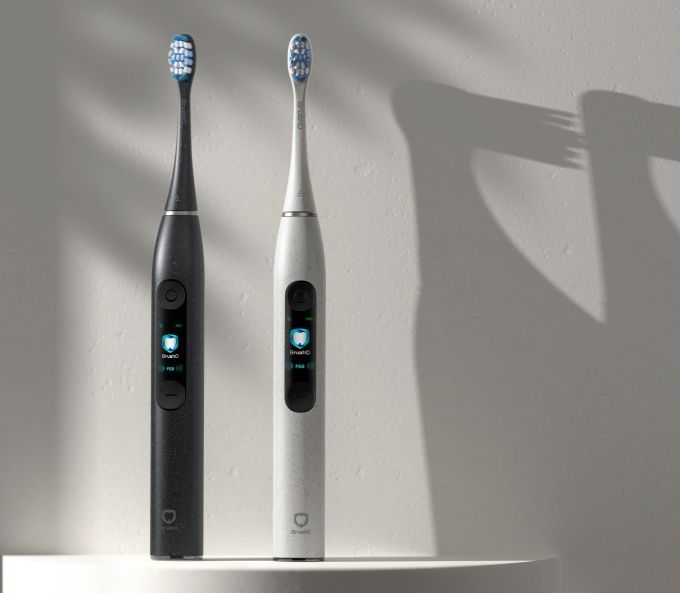
BrushO is more than just a toothbrush—it’s a smart oral care system that understands behavior. Here’s how it complements the music and mood effect:
• BrushO can be paired with your favorite playlists for mood-aligned sessions—energetic in the morning, calming at night.
• Encourages users to build a brushing ritual around their favorite tunes.
• If distracted or brushing unevenly (common when mood is low), real-time feedback corrects behavior immediately.
• Encourages mindfulness during brushing, improving technique, and mood regulation.
• $BRUSH token rewards boost dopamine—the same neurotransmitter activated by music.
• Motivation grows, and brushing becomes an emotionally rewarding act.
Children and teens often resist brushing because it feels boring or forced. Music changes that:
• Interactive brushing with music becomes a game.
• Paired with BrushO’s app feedback and rewards, it builds daily habit strength.
• Kids are more likely to brush longer and better when music is part of the experience.
• Use a 2-minute brushing song to naturally time your session
• Choose a relaxing track for night brushing to unwind before bed
• Build a “brushing playlist” on your music app for consistency
• Pair music with BrushO’s smart feedback to track progress and earn rewards
Psychologically, music acts as a cue that leads to a brushing behavior and ends with a reward (e.g., clean mouth, $BRUSH tokens). This habit loop becomes stronger with repetition:
Music 🎧 → Emotion 😌 → Brushing Behavior 🪥 → Feedback & Rewards 🎁 → Consistency ✅
Oral care is not just mechanical—it’s emotional. What you feel while brushing influences how long and how well you do it. By harnessing the power of music and mood, and combining it with AI-powered feedback like BrushO, brushing becomes a daily wellness ritual instead of a chore.
Jan 19
Jan 19

Squamous cell carcinoma is not a single, uniform disease, and two of its oral variants illustrate the extremes of its behavior. Verrucous carcinoma is a slow-growing, exophytic tumor that almost never metastasizes, while spindle cell carcinoma is an aggressive, sarcomatoid malignancy that can be ...

Most people expect a toothache to be the first sign of pulp disease, but some forms of pulpitis are surprisingly silent. A pulp polyp is the visible result of chronic hyperplastic pulpitis, a condition in which the dental pulp grows out of a large carious opening as a fleshy mass. Recognizing thi...

Dry mouth is not merely uncomfortable; it is a medical condition with real consequences for teeth, speech, swallowing and quality of life. When the salivary glands cannot produce enough saliva, medications called sialogogues can restore some of the missing fluid. Pilocarpine and cevimeline are th...

A blister in the mouth can be the first warning of a systemic autoimmune disease, and two disorders deserve particular attention in the dental chair: pemphigus vulgaris and mucous membrane pemphigoid. Both produce chronic oral ulceration, yet their immunologic targets, clinical behavior and long-...

When infection drains from a tooth, the body often creates a visible escape route, and the dentist must interpret these fistulous openings correctly. A parulis is the common gum boil that signals chronic periapical infection, while an oroantral fistula is a communication between the mouth and the...

Among the fibro-osseous lesions of the jaws, the ossifying fibroma holds a unique position because it is a true neoplasm, unlike the reactive cemento-osseous dysplasia discussed in an earlier article. It grows continuously, expands bone and requires surgical removal, and its cemental variant adds...

Not all keratocystic lesions of the jaw behave alike, and one of the most important distinctions in oral pathology separates the orthokeratinized odontogenic cyst from its better-known relative, the odontogenic keratocyst. Although the two lesions look similar under the microscope at first glance...

Periodontal disease is usually a slowly progressive infection, but a rare form called necrotizing ulcerative periodontitis destroys tissue with alarming speed. Unlike ordinary periodontitis, this condition produces necrotic, cratered papillae, deep pocketing and rapid bone loss, and it appears al...

Every parent has met the child who refuses to eat because of painful mouth sores, and most of these children have one of two viral illnesses: herpangina or hand, foot and mouth disease. Both are caused by enteroviruses, both produce fever and oral ulcers, and both are overwhelmingly common in you...

Cementoosseous dysplasia is one of the most common fibro-osseous lesions found on dental radiographs, yet it is also one of the most frequently misdiagnosed. The lesion replaces normal bone with cellular fibrous tissue and cementum-like material, and it appears in several forms that range from a ...

Construire rapidement et à faible coût un réseau de données sur la santé bucco-dentaire de manière que tout le monde puisse y contribuer.
Construire rapidement et à faible coût un réseau de données sur la santé bucco-dentaire de manière que tout le monde puisse y contribuer.


Address: RM 1427, 14/F RADIO CITY 505, HENNESSY RD CAUSEWAY BAY, HONG KONG
Code: 000000
Phone: +852-53758652
Email: customerservice@brusho.com