
What if brushing your teeth could be more than just a mindless routine? Imagine turning those two minutes into a data-driven, goal-crushing, smile-transforming ritual. That’s exactly what happened when I spent 30 days with the BrushO AI-Powered Toothbrush — a device that blends cutting-edge AI technology, real-time brushing feedback, and personalized oral care tracking into one sleek, futuristic tool. Here’s my week-by-week journey, from mild curiosity to full-blown obsession. 😁
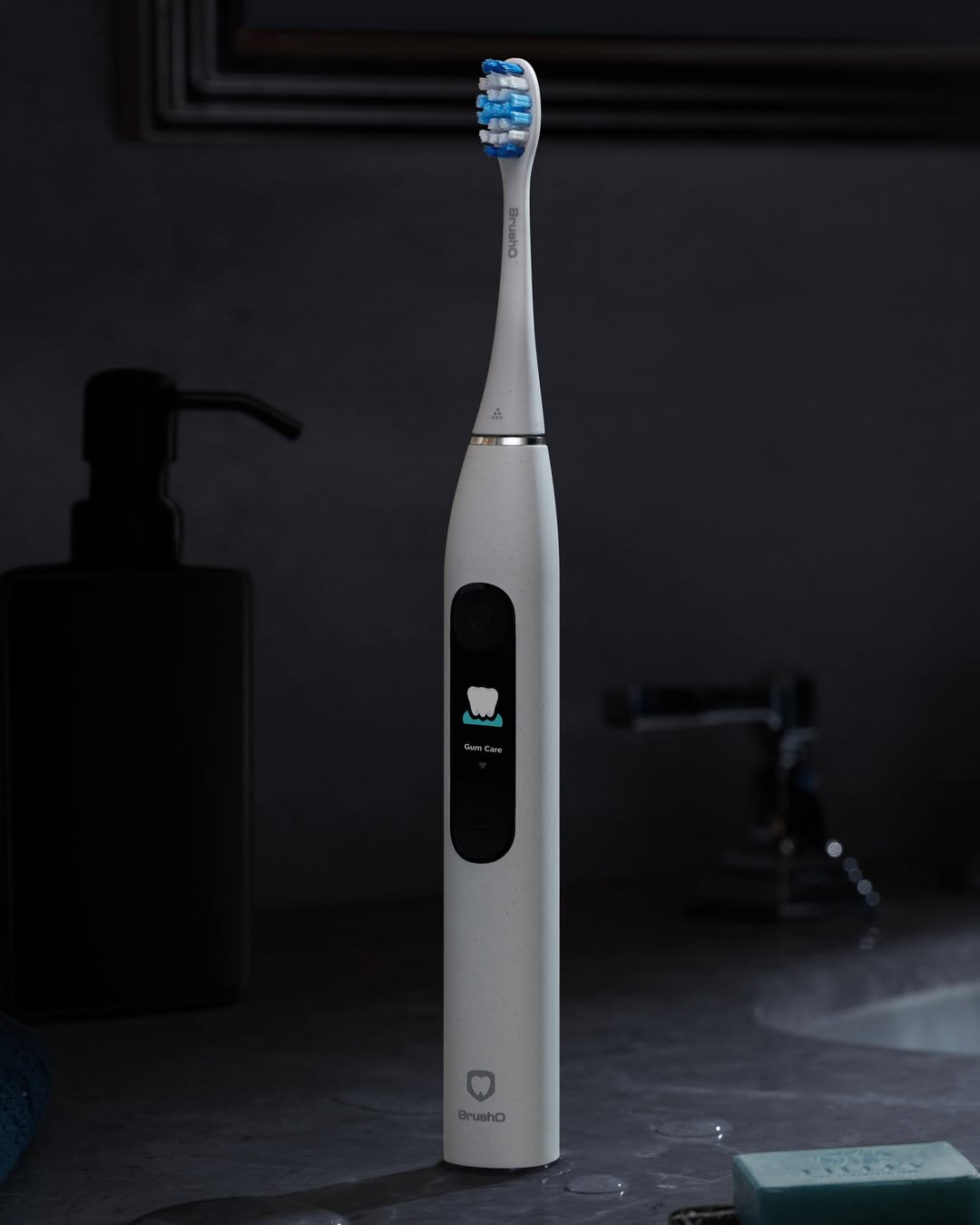
On day one, I was confident. I’d been brushing twice a day for years — surely I had nothing to worry about. Then I opened the BrushO app after my first session. The shock was real. I wasn’t cleaning nearly 30% of my tooth surfaces. My back molars were getting only a half-hearted scrub, and the inside of my front teeth? Practically untouched.
Worse yet, the built-in pressure sensor gently buzzed to warn me I was brushing far too hard — something I never realized could wear down enamel and irritate gums over time. It was humbling. And honestly, a little embarrassing. This was my first real taste of oral health tracking with AI and just how far my habits were from perfect.
By the second week, something clicked. Brushing wasn’t a chore anymore; it was a challenge. The app’s real-time brushing feedback and daily score system gamified the process — I found myself aiming for 100% coverage every single time.
The oral hygiene improvement tips tailored to my brushing patterns were surprisingly effective. For example, it suggested I start on my weaker zones first to avoid “rushing” through them at the end. Little by little, my habits transformed. My dentist had told me for years to “be thorough,” but this was the first time I actually had proof I was doing it right.
By week three, I began to notice changes that went beyond just appearance. My teeth stayed cleaner throughout the day, and my gums looked healthier with less redness. Even my breath stayed fresher for longer — something I didn’t expect.
I started appreciating the early detection of dental issues feature. The AI could flag unusual brushing patterns or skipped areas that might suggest trouble spots. If left unchecked, these could have turned into cavities or gum problems. This wasn’t just a toothbrush anymore — it felt like a personal oral health coach.
By the final week, going back to a regular toothbrush felt unthinkable. BrushO had become part of my morning and night rituals, and I genuinely looked forward to using it.
The Oral Health ID feature was another pleasant surprise. It kept all my brushing data private, but gave me the option to share anonymized insights with researchers in exchange for potential rewards — a glimpse into oral health data monetization. Knowing I could contribute to dental research while improving my own oral care made the experience even more meaningful.
AI-Powered Oral Health Tracking – Monitors brushing habits in real time and adjusts feedback instantly.
Personalized Brushing Feedback – Adapts to your unique brushing style and corrects mistakes before they become habits.
Pressure Sensor for Gum Safety – Prevents over-brushing and gum damage.
Multi-User Profiles – Perfect for families who want to track everyone’s progress.
Long Battery Life – Travel-friendly with up to 45 days of use per charge.
Privacy-Focused Design – Your data stays in your control.
Do you need an AI-powered toothbrush? Maybe not. But do you want healthier gums, fresher breath, and the peace of mind that you’re brushing the right way every single time? Absolutely.
After 30 days, I can confidently say that the BrushO AI-Powered Toothbrush isn’t just the best electric toothbrush I’ve ever used — it’s a total upgrade to my oral health routine.
💡Learn more: www.brusho.com
💡Join Community: www.t.me/brushocommunity
📢Order here: www.brusho.com
Aug 15
Aug 14

Squamous cell carcinoma is not a single, uniform disease, and two of its oral variants illustrate the extremes of its behavior. Verrucous carcinoma is a slow-growing, exophytic tumor that almost never metastasizes, while spindle cell carcinoma is an aggressive, sarcomatoid malignancy that can be ...

Most people expect a toothache to be the first sign of pulp disease, but some forms of pulpitis are surprisingly silent. A pulp polyp is the visible result of chronic hyperplastic pulpitis, a condition in which the dental pulp grows out of a large carious opening as a fleshy mass. Recognizing thi...

Dry mouth is not merely uncomfortable; it is a medical condition with real consequences for teeth, speech, swallowing and quality of life. When the salivary glands cannot produce enough saliva, medications called sialogogues can restore some of the missing fluid. Pilocarpine and cevimeline are th...

A blister in the mouth can be the first warning of a systemic autoimmune disease, and two disorders deserve particular attention in the dental chair: pemphigus vulgaris and mucous membrane pemphigoid. Both produce chronic oral ulceration, yet their immunologic targets, clinical behavior and long-...

When infection drains from a tooth, the body often creates a visible escape route, and the dentist must interpret these fistulous openings correctly. A parulis is the common gum boil that signals chronic periapical infection, while an oroantral fistula is a communication between the mouth and the...

Among the fibro-osseous lesions of the jaws, the ossifying fibroma holds a unique position because it is a true neoplasm, unlike the reactive cemento-osseous dysplasia discussed in an earlier article. It grows continuously, expands bone and requires surgical removal, and its cemental variant adds...

Not all keratocystic lesions of the jaw behave alike, and one of the most important distinctions in oral pathology separates the orthokeratinized odontogenic cyst from its better-known relative, the odontogenic keratocyst. Although the two lesions look similar under the microscope at first glance...

Periodontal disease is usually a slowly progressive infection, but a rare form called necrotizing ulcerative periodontitis destroys tissue with alarming speed. Unlike ordinary periodontitis, this condition produces necrotic, cratered papillae, deep pocketing and rapid bone loss, and it appears al...

Every parent has met the child who refuses to eat because of painful mouth sores, and most of these children have one of two viral illnesses: herpangina or hand, foot and mouth disease. Both are caused by enteroviruses, both produce fever and oral ulcers, and both are overwhelmingly common in you...

Cementoosseous dysplasia is one of the most common fibro-osseous lesions found on dental radiographs, yet it is also one of the most frequently misdiagnosed. The lesion replaces normal bone with cellular fibrous tissue and cementum-like material, and it appears in several forms that range from a ...

Costruire rapidamente e a basso costo una rete di dati sulla salute orale in modo che tutti possano creare.
Costruire rapidamente e a basso costo una rete di dati sulla salute orale in modo che tutti possano creare.


Address: RM 1427, 14/F RADIO CITY 505, HENNESSY RD CAUSEWAY BAY, HONG KONG
Code: 000000
Phone: +852-53758652
Email: customerservice@brusho.com