
Many people assume that brushing more often or harder can eliminate tartar buildup. Unfortunately, once tartar (calculus) has hardened on your teeth, your toothbrush—no matter how advanced—can’t fully remove it. In this article, we’ll explore what tartar is, why brushing can’t remove it, how it forms, and what you can do to prevent tartar from developing in the first place. We’ll also introduce how BrushO’s smart brushing data helps users reduce tartar risk before it starts.
Tartar is hardened dental plaque that forms when plaque isn’t removed effectively. It’s made up of:
• Bacteria
• Food debris
• Salivary minerals
When plaque remains on your teeth for too long, it mineralizes, forming a rock-hard layer called tartar (or calculus). It often appears yellow or brown and typically builds up:
• Behind the lower front teeth
• Along the gumline
• Between teeth
Once tartar forms, it bonds to the enamel surface. Brushing—even aggressively—won’t break it apart. You need:
• Professional dental tools, such as scalers or ultrasonic instruments
• A hygienist or dentist to perform a dental cleaning
Brushing harder won’t help—it can actually damage your enamel and gums instead.
Brushing before tartar forms is essential. Plaque typically turns into tartar within 24 to 72 hours if not removed. That means your toothbrush is your first line of defense—but only if:
• You brush twice daily
• Use proper technique (not just fast scrubbing)
• Brush for at least 2 minutes
• Reach all tooth surfaces and gumlines
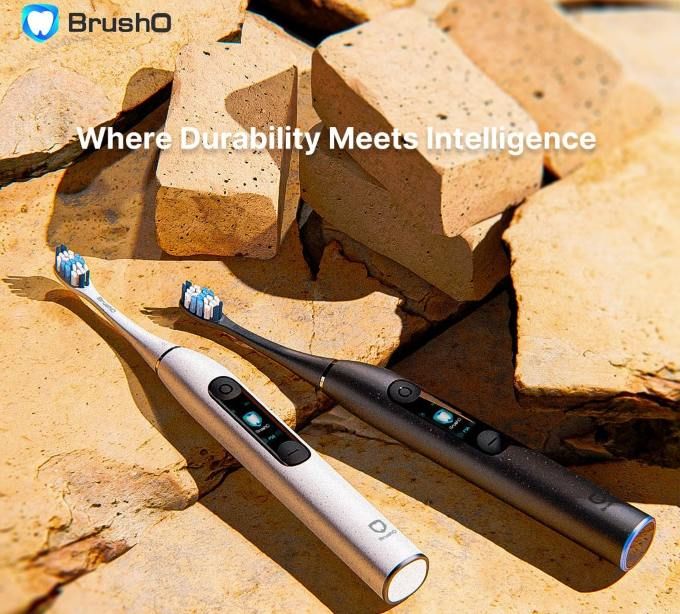
BrushO, the AI-powered toothbrush, helps reduce tartar risk through smart feedback and habit tracking:
Instead of the outdated 30-second quadrant method, BrushO uses AI to analyze 6 zones and 16 surfaces, ensuring no area is skipped—which is key for removing plaque before it turns to tartar.
BrushO’s app delivers real-time data, scoring your brushing and alerting you to consistently missed zones—often where tartar forms first.
With daily brushing scores, BrushO users build routines proven to reduce plaque, preventing tartar buildup over time.
Not really. Despite some myths, DIY tartar scrapers, baking soda pastes, or vinegar rinses aren’t safe or effective. These can:
• Injure your gums
• Weaken enamel
• Leave residual tartar behind
Always leave tartar removal to professionals.
• Brush twice daily with fluoride toothpaste
• Use an electric toothbrush with feedback systems like BrushO
• Floss once a day
• Use antimicrobial mouthwash if recommended
• Visit your dentist every 6 months
• Limit sugary and starchy foods
Tartar can’t be removed at home—but it can be prevented with smart, consistent brushing. By upgrading your brushing habits and tools—especially with AI-guided solutions like BrushO—you stay ahead of the problem. Don’t wait for tartar to send you to the dentist. Let your toothbrush be your daily defense.

Fluoride in drinking water is the most cost-effective caries preventive measure in public health, and it is also the source of most avoidable fluoride exposure in young children. The balance between benefit and risk depends on concentration, on total intake from all sources and on the age of the ...

A mouthguard is the only piece of protective equipment that a dentist can prescribe, and the difference between the cheapest and the best version is often less than the cost of a single repair. This guide explains what each type of mouthguard actually protects, how to judge fit, and what to check...

Distinguishing reversible from irreversible pulpitis is the single most consequential decision in endodontic diagnosis, because one leads to a restoration and the other to root canal treatment or extraction. The distinction rests on symptoms and pulp testing rather than on radiographs alone, and ...

A pregnancy epulis is a benign overgrowth of gum tissue that appears during pregnancy, most often in the second or third trimester. It can alarm patients because it grows quickly and bleeds easily, yet in most cases it needs no surgery and settles after delivery. Understanding what drives the gro...

When several teeth are missing, the choice usually narrows to a removable partial denture or a fixed implant-supported restoration, and cost is the factor patients raise first. Upfront price is only part of the comparison, because the two options differ in maintenance, comfort, effects on neighbo...

Most root canal failures are not caused by inadequate cleaning of canals that were found, but by canals that were never located. Molar anatomy varies widely, and the variation is not random: specific teeth in specific populations have predictable additional canals. Knowing where they hide is the ...

Gum massage is one of the oldest recommendations in oral care and one of the least understood. It has been described as a treatment for bleeding gums, a route to firmer tissue and, more recently, a way to reduce brushing force. This article separates the mechanisms that are supported by physiolog...

Interdental cleaning is the part of oral hygiene most people abandon first, and the choice between a floss pick and a length of string floss is often made on convenience. Convenience matters, because a tool that is used daily outperforms a superior tool that stays in the drawer, but the two devic...

Dementia changes the way a denture is worn, cleaned and tolerated, and the people who notice the change first are usually family carers rather than clinicians. Poor denture hygiene in this group is associated with mucosal infection, reduced food intake and, in frail patients, respiratory complica...

Chewing tobacco keeps nicotine and plant irritants in prolonged contact with a small area of mucosa, and the damage that results is concentrated exactly where the quid is held. The lesions that develop are often painless, which is why they are discovered during routine examination rather than bec...

Costruire rapidamente e a basso costo una rete di dati sulla salute orale in modo che tutti possano creare.
Costruire rapidamente e a basso costo una rete di dati sulla salute orale in modo che tutti possano creare.


Address: RM 1427, 14/F RADIO CITY 505, HENNESSY RD CAUSEWAY BAY, HONG KONG
Code: 000000
Phone: +852-53758652
Email: customerservice@brusho.com