How Smart Toothbrushes Clean Every Surface of Your Teeth
Jan 21

Jan 21
When brushing your teeth, ensuring every surface is thoroughly cleaned is crucial for maintaining optimal oral health. While traditional toothbrushes might leave certain areas missed, smart toothbrushes, equipped with sensors and AI, can track coverage and guide you to clean every surface effectively. In this article, we’ll explore how smart toothbrushes, like BrushO, clean each surface of your teeth, from front to back and every hard-to-reach corner. Discover how this advanced technology ensures you never miss a spot while brushing.


How Smart Toothbrushes Clean Every Surface of Your Teeth

1. The Challenge of Cleaning Every Surface of Your Teeth

To achieve optimal oral health, it’s crucial to clean all surfaces of your teeth—front, back, chewing surfaces, and even the areas along the gumline. However, with traditional manual or even basic electric toothbrushes, it's easy to miss certain areas, especially those at the back of the mouth or in between teeth.
Smart toothbrushes are designed to address this challenge. They are equipped with sensors and AI technology that track brushing coverage and ensure that every part of the mouth is cleaned thoroughly.

2. How Sensors Track Brushing Coverage

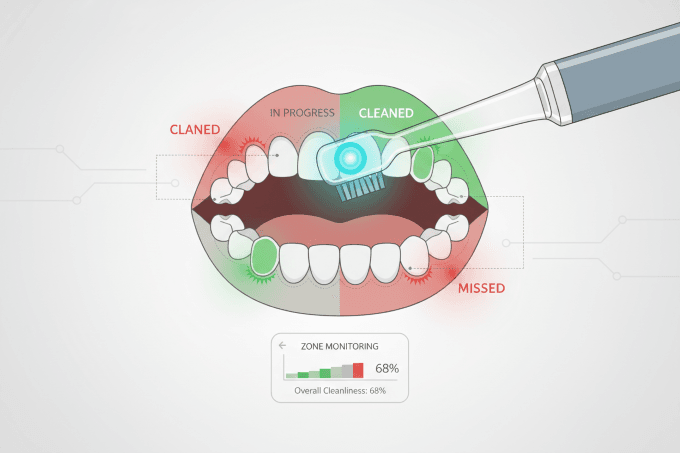
Smart toothbrushes use advanced motion sensors and accelerometers to track the movements of the toothbrush. These sensors map out the different zones of your mouth—often dividing the mouth into 6 zones, depending on the model. As you brush, the smart toothbrush monitors whether you’re covering all these areas effectively, ensuring that no part of your teeth is neglected.
The brushing process is monitored in real-time, and if you’re missing an area or brushing too quickly, the smart toothbrush will provide feedback through vibrations or visual indicators. This ensures that every surface, from the front of your teeth to the back molars, receives proper attention.

3. Brushing Technique: Covering All Surfaces Efficiently

Proper brushing technique is key to ensuring all tooth surfaces are cleaned effectively. Smart toothbrushes guide users in brushing at the correct angle and motion to ensure full-mouth coverage. Whether you’re using a circular or back-and-forth motion, the smart toothbrush’s AI system adapts to your style and gives personalized recommendations for better coverage.
For example, a smart toothbrush may suggest altering the angle for cleaning the gumline or adjusting pressure on the back molars. This targeted feedback improves the overall brushing technique and guarantees that no surface is left out.

4. The Importance of Brushing the Gumline and Hard-to-Reach Areas

The gumline and areas behind your teeth are often overlooked, especially when brushing manually. These areas are prone to plaque buildup and can contribute to gum disease if not cleaned properly. Smart toothbrushes are equipped with pressure sensors and coverage tracking features that alert you when you’re not brushing the gumline or other hard-to-reach areas thoroughly enough.
By ensuring proper cleaning of these often-neglected spots, smart toothbrushes help maintain healthier gums and reduce the risk of plaque and tartar buildup.

5. AI-Powered Feedback for Complete Coverage

AI technology in smart toothbrushes takes the guessing out of brushing. With AI-powered feedback, these devices track your brushing behavior over time, analyzing which areas of your mouth are getting the most attention and which areas are being missed.
By providing real-time guidance, smart toothbrushes help you improve your technique, making sure you cover all surfaces. These devices also keep track of your progress, offering insights and reminders that encourage better brushing habits.

6. Personalized Brushing Modes for Comprehensive Cleaning

Smart toothbrushes often come with different brushing modes tailored to specific needs, such as a "deep clean" mode, a "gum care" mode, or a "white+" mode. These modes optimize brushing for specific areas of your teeth and allow you to clean every surface more efficiently. For example, the deep clean mode may focus on areas that need extra attention, while the gum care mode targets the gumline.
These customizable modes, paired with AI-powered feedback, ensure that every surface of your teeth gets the attention it needs for optimal cleaning.

7. Progress Tracking and Continuous Improvement

The data collected by your smart toothbrush is stored and analyzed in the corresponding app, allowing you to track your progress over time. Weekly or monthly reports provide an overview of your brushing habits, highlighting areas that need improvement. If you’re consistently missing a certain surface or not brushing for the recommended duration, the app will remind you and offer tips for improvement.
By offering actionable feedback, smart toothbrushes help users develop better brushing habits and ensure that every surface of the teeth is cleaned effectively.

8. The Long-Term Benefits of Full Surface Cleaning

Cleaning all surfaces of your teeth is key to maintaining long-term oral health. Smart toothbrushes not only ensure that every surface is cleaned during each brushing session, but they also help you establish better brushing habits over time. Consistent use of a smart toothbrush can lead to healthier gums, reduced plaque buildup, and fewer cavities.
By preventing missed areas and ensuring proper coverage, smart toothbrushes promote long-term oral health and help you avoid common dental issues like gum disease and tooth decay.
 

Final Thoughts: Smart Toothbrushes for Thorough, Effective Cleaning

Smart toothbrushes take the guesswork out of brushing by providing real-time feedback and personalized recommendations. With advanced sensors and AI technology, these devices ensure that every surface of your teeth is cleaned thoroughly, from the front to the back and everywhere in between.
By using a smart toothbrush, you can ensure that your brushing habits are more effective, leading to healthier teeth, gums, and a brighter smile in the long run.

Post recenti

Missed quadrant streaks can expose a drifting weekend routine

Missed quadrant streaks can expose a drifting weekend routine

When the same quadrant keeps showing weaker brushing on weekends, the issue is usually routine drift rather than random forgetfulness. Repeated misses reveal where sleep changes, social plans, and looser timing are bending the same brushing sequence each week.

Mirror free sessions can reveal whether brushing pressure stays steady

Mirror free sessions can reveal whether brushing pressure stays steady

Brushing without watching the mirror can expose whether your pressure stays controlled or rises when visual reassurance disappears. The exercise helps people notice hidden overpressure, uneven route confidence, and which surfaces get scrubbed harder when the hand starts guessing.

Marginal ridges help premolars resist sideways bite stress

Marginal ridges help premolars resist sideways bite stress

Marginal ridges on premolars help support the crown when chewing forces slide sideways instead of straight down. When those ridges wear or break, the tooth can become more vulnerable to food packing, cracks, and uneven pressure.

Dry office air can make gum margins sting by dusk

Dry office air can make gum margins sting by dusk

Dry office air can quietly reduce saliva and leave gum margins feeling tight or stingy by late afternoon. The problem is often less about dramatic disease and more about long hours of mouth dryness, light plaque retention, and irritated tissue edges.

Citrus sparkling cans can restart enamel softening at dinner

Citrus sparkling cans can restart enamel softening at dinner

A citrus sparkling drink with dinner can keep enamel in a softened state longer than people expect, especially when the can is sipped slowly. The problem is often repeated acidic contact, not one dramatic drink.

Cervical curves change how force leaves the enamel edge

Cervical curves change how force leaves the enamel edge

The curved neck of a tooth changes how chewing and brushing forces leave enamel near the gumline. That helps explain why the cervical area can feel sensitive, wear faster, and react strongly when pressure, acidity, and gum changes overlap.

Workday logs can expose missed lunch brushing

Workday logs can expose missed lunch brushing

Missed lunch brushing often hides inside normal work routines instead of feeling like a conscious choice. Time logs, calendar gaps, and daily patterns can reveal where the habit breaks down and why simple awareness often fixes more than extra motivation does.

Tea sips can keep canker sores tender longer

Tea sips can keep canker sores tender longer

Warm tea can feel soothing at first, but repeated sipping can keep a small canker sore active by extending heat, dryness, acidity, and friction across already irritated tissue. The problem is often the sipping pattern, not the tea alone.

Retainer cases can reseed plaque after cleaning

Retainer cases can reseed plaque after cleaning

A retainer can look freshly cleaned and still pick up old residue from its case. When moisture, biofilm, and handling build up inside the container, the case can quietly place plaque back onto the appliance each time it is stored.

Pulp horns sit closer to the surface than people think

Pulp horns sit closer to the surface than people think

Pulp horns extend higher inside the crown than many people realize, which helps explain why small wear, chips, or cavities can become sensitive faster than expected. Surface damage and inner anatomy are often closer neighbors than they appear from outside.
