
Sleep bruxism, or involuntary teeth grinding during sleep, is a hidden enemy of oral health that affects millions—often without them even knowing. This silent condition can gradually wear down enamel, damage gums, and cause jaw pain that extends beyond oral concerns. In this article, we explore what causes sleep bruxism, how to detect it, and how to minimize its damage. We’ll also look at how smart toothbrushes like BrushO, with pressure detection and personalized guidance, can play a key role in protecting your teeth and improving your daily routine. Whether you’re grinding due to stress, misalignment, or sleep disorders, identifying and addressing bruxism early can save your smile.
Sleep bruxism is the medical term for unconscious grinding or clenching of the teeth during sleep. It differs from daytime bruxism, which is usually stress-related and occurs when awake. According to the American Dental Association, an estimated 10–15% of adults and a growing number of children suffer from sleep bruxism. This condition often goes unnoticed until symptoms—like jaw pain or tooth wear—begin to appear. Left untreated, bruxism can have long-term consequences on oral health.
Sleep bruxism doesn’t always present immediate signs, but common symptoms include:
• Flattened, chipped, or worn-down teeth
• Increased tooth sensitivity
• Jaw soreness or tightness upon waking
• Headaches, especially near the temples
• Clicking or popping in the jaw (TMJ disorders)
• Gum recession or inflammation due to excessive pressure
If you experience any of these, it may be time to evaluate your brushing routine and consult a dentist.
Understanding what leads to nighttime grinding is essential. The most common causes include:
• Stress and anxiety: Psychological tension is a leading trigger.
• Sleep disorders: Conditions like sleep apnea are closely linked to bruxism.
• Misaligned bite (malocclusion): Improper tooth alignment can cause grinding.
• Lifestyle factors: Alcohol, caffeine, and smoking can increase risk.
• Genetics: Bruxism often runs in families.
Bruxism wears away your smile from the inside out:
• Tooth enamel erosion reduces protection and leads to cavities.
• Gum trauma can accelerate periodontal disease.
• Jaw strain may cause long-term TMJ dysfunction.
• Cosmetic impact: Teeth may appear shorter or uneven.
These changes are gradual but irreversible without early intervention.
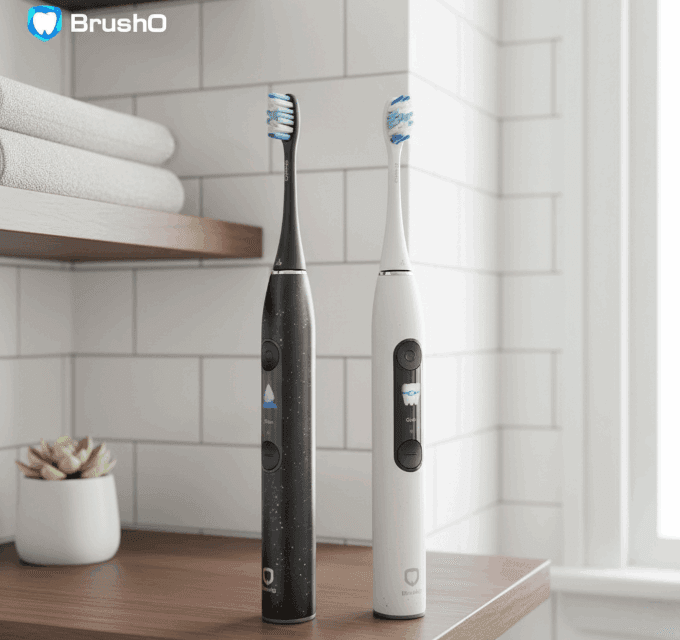
While toothbrushes can’t cure bruxism, AI-powered toothbrushes like BrushO are becoming valuable tools in oral care management by:
Bruxism can lead to overbrushing or uneven brushing due to sensitive areas. BrushO detects excessive pressure and gives real-time alerts, helping protect already weakened enamel and gum lines.
After each session, BrushO’s app shows detailed brushing reports, identifying areas where users may apply too much pressure—useful data for those trying to compensate for grinding-related soreness.
Through custom brushing modes such as “Sensitive Mode”, BrushO helps users develop gentler routines that are ideal for those with grinding-related enamel loss or gum inflammation.
Alongside smart tools, lifestyle and dental adjustments help manage bruxism effectively:
• Use a nightguard (ask your dentist for a custom-fitted one)
• Reduce stress through mindfulness, exercise, or therapy
• Limit alcohol and caffeine, especially before bed
• Maintain a consistent sleep schedule
• Track symptoms using oral health apps or wearables
If you suspect you’re grinding your teeth during sleep—or your smart toothbrush frequently alerts you of pressure spikes—book a dental appointment. Dentists can:
• Examine enamel wear
• Fit nightguards
• Suggest orthodontic or behavioral interventions
Smart brushing doesn’t stop bruxism, but it supports your recovery:
| Feature | Traditional Toothbrush | BrushO Smart Toothbrush |
| Pressure Alerts | ❌ | ✅ Real-time vibration warning |
| Custom Modes | ❌ | ✅ Sensitive & Gum Care Modes |
| Brushing Data | ❌ | ✅ AI-generated brushing reports |
| Gamified Routine | ❌ | ✅ Brush & Earn Reward System |
Sleep bruxism often flies under the radar until it causes permanent harm. Recognizing early symptoms and using smart technology to adapt your brushing habits can make all the difference. BrushO helps by offering not just brushing—it offers awareness, protection, and encouragement to build a smile that lasts. Your teeth rest while you do. Make sure your toothbrush is working while you sleep.
Jan 30
Jan 29

Water that leaves a dental unit is not sterile, and it has not been sterile for decades. The narrow tubing that carries coolant to the handpiece and the air-water syringe provides an ideal surface for a biofilm that sheds organisms into every patient's mouth. Sterilisation of the instruments does...

A young adult presents with soreness of the gums, and the examination shows a striking change that is easily mistaken for severe periodontal disease: the mucosa is thickened, folded and studded with tiny yellow pustules that rupture to leave shallow ulcers resembling snail tracks. This is pyostom...

A patient who becomes cyanosed minutes after an apparently routine infiltration, yet keeps talking and breathing comfortably, presents a diagnostic trap. The saturation monitor reads in the eighties, supplemental oxygen changes nothing, and the chest sounds clear. This is the classic signature of...

Most patients with clicking, locking and jaw pain improve with reassurance, soft diet, splint therapy and physical measures. A minority do not, and their imaging shows a displaced disc with degenerative change, a shortened condyle or a persistent closed lock. For that group, two operations compet...

A slowly growing palatal swelling that the patient has noticed for two years, a minor salivary gland tumor that looks deceptively well demarcated, and a nerve that carries tumor cells far beyond the visible mass: this is the natural history of adenoid cystic carcinoma. It is uncommon, it is rarel...

Saliva is easy to overlook until its volume changes. An excess produces drooling that soils clothing and isolates a patient socially, while a painless enlargement of both parotid glands raises the question of systemic disease. Sialorrhea and sialadenosis sit at opposite ends of the same physiolog...

When caries in a primary molar reaches the pulp but the tooth can still be restored and the supporting bone is intact, pulpectomy offers a way to keep the tooth comfortable and functional until exfoliation. The procedure removes both the coronal and the radicular pulp and replaces it with a resor...

Disorders of the fibroblast growth factor receptor genes produce some of the most distinctive facial appearances in medicine, and the two extremes are instructive. Pfeiffer syndrome allows survival with staged craniofacial surgery, while thanatophoric dysplasia is almost always lethal in the neon...

A panoramic radiograph that shows a uniformly dense mandible or maxilla can indicate an entirely benign finding, such as a dense bone island or a torus, or it can be the first clue to a generalized skeletal disorder. Osteopetrosis and the broader group of osteosclerotic conditions differ greatly ...

A patient who cannot open the mouth more than a finger breadth, yet whose temporomandibular joint still moves on imaging, presents one of the most easily misdiagnosed problems in oral surgery. The restriction in such cases lies outside the joint, and the condition is termed pseudoankylosis. An el...

Costruire rapidamente e a basso costo una rete di dati sulla salute orale in modo che tutti possano creare.
Costruire rapidamente e a basso costo una rete di dati sulla salute orale in modo che tutti possano creare.


Address: RM 1427, 14/F RADIO CITY 505, HENNESSY RD CAUSEWAY BAY, HONG KONG
Code: 000000
Phone: +852-53758652
Email: customerservice@brusho.com