
Over the past decade, smart technology has transformed almost every aspect of our daily lives. Our watches track our heart rate and sleep patterns, our TVs recommend shows based on our viewing habits, and our thermostats adjust automatically to save energy. Now, in 2025, our bathrooms are getting smarter too — and the humble toothbrush is at the center of this transformation.
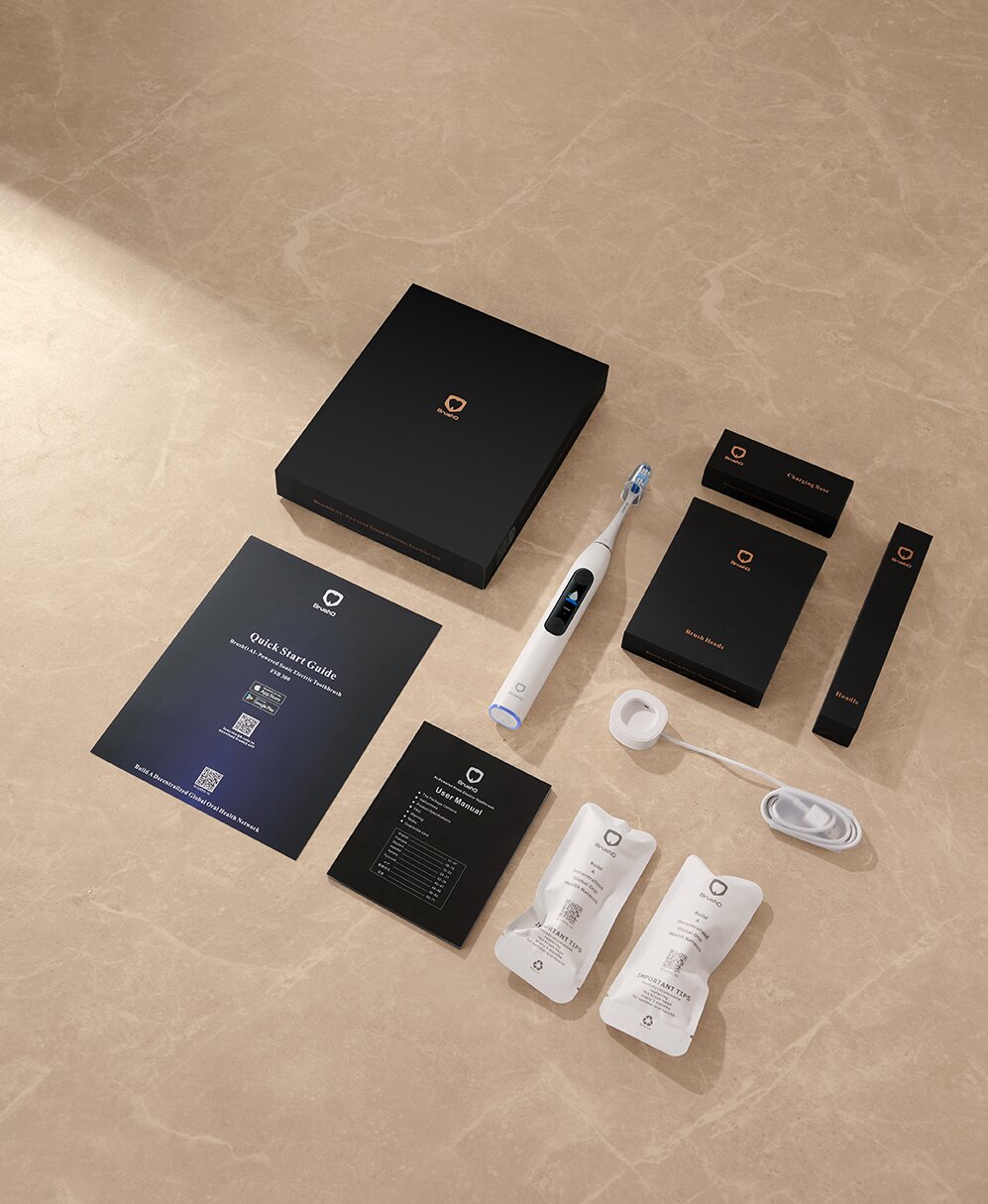
Smart toothbrushes have evolved from being niche tech gadgets to becoming essential tools for better oral health. With features like AI-powered feedback, multi-user tracking, and child-friendly brushing modes, these devices are helping people of all ages improve their dental care. In this article, we’ll explore six key smart toothbrush trends of 2025, and see how BrushO is leading the way.
One of the biggest shifts in oral care is the move from passive brushing to active, guided brushing. AI-powered toothbrushes use advanced algorithms to monitor your technique in real time — identifying missed areas, detecting when you’re brushing too hard, and even timing your brushing to ensure you meet the recommended two minutes.
How BrushO Leads:
BrushO’s built-in pressure sensors and AI-driven motion tracking work together to give you a comprehensive brushing score after every session. The app provides visual coverage maps and gentle reminders when pressure is too high, helping users protect their enamel and gums.
As families embrace smart home devices, the demand for shared, multi-user features is rising. A smart toothbrush that can store separate data profiles for each family member makes oral care easier to monitor and manage.
How BrushO Leads:
BrushO’s companion app supports multiple profiles, allowing parents to track their children’s brushing progress without switching devices. Whether it’s two kids, a couple, or elderly family members, everyone can have their own stats and feedback — all from the same toothbrush model.
For children, brushing can be a challenge — or a chore. The latest trend in smart toothbrushes is turning brushing into an engaging activity with built-in timers, animations, and even music. Gamification helps children build lasting habits while ensuring proper technique.
How BrushO Leads:
BrushO’s children’s mode plays music for exactly two minutes, keeping kids entertained while guiding them to brush for the right amount of time. Parents can also view their child’s progress through the app and offer encouragement or rewards.
With increasingly mobile lifestyles, battery performance has become a key factor in smart toothbrush design. Consumers want a device that can handle weeks — even months — between charges.
How BrushO Leads:
BrushO delivers an impressive 45-day battery life from just a 6-hour charge. It’s IPX7 waterproof, making it safe to use in the shower, and comes with wireless charging for convenience at home or on the go. This makes it a perfect companion for frequent travelers and busy professionals.
Eco-conscious consumers are demanding products that last longer and produce less waste. In the world of smart toothbrushes, this means high-quality, replaceable brush heads and durable handles that can be used for years.
How BrushO Leads:
BrushO offers multiple brush head options, allowing users to choose the right fit for sensitive gums, whitening, or deep cleaning — all while reducing plastic waste by reusing the handle.
In 2025, smart toothbrushes aren’t just standalone devices; they’re part of a larger health ecosystem. Integration with mobile apps allows users to track brushing history, set reminders, and receive personalized recommendations.
How BrushO Leads:
The BrushO app syncs effortlessly with your brushing sessions, providing detailed reports and tips for improvement. Its intuitive interface makes it easy to track progress over time, ensuring better oral health with minimal effort.
Real-world feedback brings these features to life. Here’s what BrushO users are saying:
- Family Use:
“The multi-user profile lets me track both my kids’ brushing habits without switching devices. It’s like having a personal dental coach for the whole family.” — Emily W., Parent of Two
- Child-Friendly Mode:
“My daughter actually asks to brush her teeth now because of the music mode. It’s a win-win for both of us.” — David R., Father
- Travel Convenience:
“I travel for work a lot, and the 45-day battery life means I don’t even pack the charger for short trips.” — Mark T., Frequent Traveler
- Sensitive Gums:
“I have sensitive gums, and BrushO’s gentle mode has been a game changer for me. No more soreness after brushing.” — Sophie L., Teacher
Smart toothbrushes are redefining oral care in 2025, offering more than just clean teeth — they provide guidance, motivation, and measurable improvement. BrushO combines cutting-edge technology with practical features for families, travelers, and individuals alike, proving that smarter brushing leads to healthier smiles.
Ready to upgrade your brushing routine? Discover BrushO here and experience the future of oral care today.
🌐 Website: www.brusho.com
💬 Community: t.me/brushocommunity
Aug 12
Aug 11

Squamous cell carcinoma is not a single, uniform disease, and two of its oral variants illustrate the extremes of its behavior. Verrucous carcinoma is a slow-growing, exophytic tumor that almost never metastasizes, while spindle cell carcinoma is an aggressive, sarcomatoid malignancy that can be ...

Most people expect a toothache to be the first sign of pulp disease, but some forms of pulpitis are surprisingly silent. A pulp polyp is the visible result of chronic hyperplastic pulpitis, a condition in which the dental pulp grows out of a large carious opening as a fleshy mass. Recognizing thi...

Dry mouth is not merely uncomfortable; it is a medical condition with real consequences for teeth, speech, swallowing and quality of life. When the salivary glands cannot produce enough saliva, medications called sialogogues can restore some of the missing fluid. Pilocarpine and cevimeline are th...

A blister in the mouth can be the first warning of a systemic autoimmune disease, and two disorders deserve particular attention in the dental chair: pemphigus vulgaris and mucous membrane pemphigoid. Both produce chronic oral ulceration, yet their immunologic targets, clinical behavior and long-...

When infection drains from a tooth, the body often creates a visible escape route, and the dentist must interpret these fistulous openings correctly. A parulis is the common gum boil that signals chronic periapical infection, while an oroantral fistula is a communication between the mouth and the...

Among the fibro-osseous lesions of the jaws, the ossifying fibroma holds a unique position because it is a true neoplasm, unlike the reactive cemento-osseous dysplasia discussed in an earlier article. It grows continuously, expands bone and requires surgical removal, and its cemental variant adds...

Not all keratocystic lesions of the jaw behave alike, and one of the most important distinctions in oral pathology separates the orthokeratinized odontogenic cyst from its better-known relative, the odontogenic keratocyst. Although the two lesions look similar under the microscope at first glance...

Periodontal disease is usually a slowly progressive infection, but a rare form called necrotizing ulcerative periodontitis destroys tissue with alarming speed. Unlike ordinary periodontitis, this condition produces necrotic, cratered papillae, deep pocketing and rapid bone loss, and it appears al...

Every parent has met the child who refuses to eat because of painful mouth sores, and most of these children have one of two viral illnesses: herpangina or hand, foot and mouth disease. Both are caused by enteroviruses, both produce fever and oral ulcers, and both are overwhelmingly common in you...

Cementoosseous dysplasia is one of the most common fibro-osseous lesions found on dental radiographs, yet it is also one of the most frequently misdiagnosed. The lesion replaces normal bone with cellular fibrous tissue and cementum-like material, and it appears in several forms that range from a ...

Costruire rapidamente e a basso costo una rete di dati sulla salute orale in modo che tutti possano creare.
Costruire rapidamente e a basso costo una rete di dati sulla salute orale in modo che tutti possano creare.


Address: RM 1427, 14/F RADIO CITY 505, HENNESSY RD CAUSEWAY BAY, HONG KONG
Code: 000000
Phone: +852-53758652
Email: customerservice@brusho.com