
Think your brushing routine is just a two-minute task? Think again. If you’re using a smart toothbrush like BrushO, every brushing session creates a data-rich report—one that reveals more about your habits, risks, and long-term dental health than you might expect. This article breaks down what your brushing report says about you, and how it can help you improve your smile.
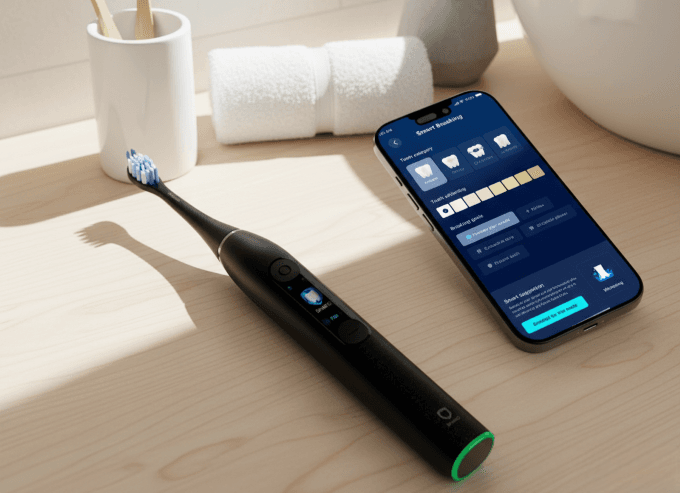
A brushing report is a summary of your oral care performance, automatically generated by your AI-powered smart toothbrush. With BrushO, this report includes:
• Time spent in each zone of the mouth
• Coverage accuracy across 6 zones and 16 surfaces
• Pressure levels applied during brushing
• Brushing frequency, consistency, and skipped sessions
• Habit streaks and daily performance scores
What was once a matter of guesswork is now measurable. And it turns out, that data tells a very personal story.
A good smile is built on habit, not hype. Your report shows:
• How often you brush
• If you miss morning or evening sessions
• Which days you tend to forget
Insight: Inconsistent brushing leaves you vulnerable to plaque buildup, bad breath, and gum inflammation. BrushO flags skipped sessions so you can fix patterns early.
Even if you brush every day, poor technique can undermine your efforts. Your report shows:
• Zones frequently missed (like molars or the gumline)
• Overbrushing certain areas at the expense of others
• Imbalanced pressure, which can cause enamel erosion or gum recession
Insight: The BrushO app maps your brushing patterns visually, so you can see where you’re going wrong—and fix it in real time.
Based on repeated behaviors, the report may reveal risk trends:
| Brushing Pattern | Associated Risk |
| Skipping tongue cleaning | Bad breath |
| Consistently high pressure | Gum recession, enamel wear |
| Poor lower molar coverage | Cavities in hard-to-reach areas |
| Brushing <2 minutes | Incomplete plaque removal |
Insight: These subtle trends often go unnoticed without smart feedback. BrushO helps you intercept them before they become dental problems.
BrushO tracks your improvement over time:
• Increases in coverage accuracy
• Reduced pressure alerts
• Longer brushing durations
• Habit streaks and rewards
Insight: These metrics turn oral care into a motivating journey, not a daily chore. Plus, you earn $BRUSH tokens for sticking to your goals.
Your brushing report isn’t just a recap—it’s a guide for better behavior. BrushO’s smart features include:
• Live Feedback: Real-time pressure alerts and zone guidance
• Personalized Modes: Adjust settings for sensitivity, whitening, or deep clean
• Parent Monitoring: Track children’s brushing in the app remotely
• Gamified Rewards: Earn points and $BRUSH tokens for good habits
By translating your brushing into visual data and alerts, BrushO helps you course-correct daily—and prevents long-term dental issues.
🦷 A clean report = peace of mind
💡 A flawed report = chance to improve
📈 A tracked report = a healthier smile over time
Without insight, brushing is a guessing game. With BrushO, it becomes precision self-care.
Your brushing report reflects more than time—it reflects your intentionality, discipline, and risk awareness. With BrushO, you’re not just brushing—you’re learning. And with each report, you move one step closer to stronger habits and a healthier, brighter smile. Let your report speak—and listen closely. Your teeth will thank you.
BrushO is an AI-powered smart toothbrush that transforms your brushing routine into a personalized, data-driven habit. With real-time zone tracking, pressure alerts, brushing reports, and a reward system using $BRUSH tokens, BrushO helps you build a smile that’s not just beautiful—but truly healthy.
Jan 21
Jan 21

The xerostomia is the symptom that the patient describes as the dry mouth, and the Sjogren syndrome is the systemic autoimmune condition that the clinician identifies as one of the causes that the symptom reveals. The dry mouth that the patient reports may follow the medication, the radiation, th...

The sinus lift is the augmentation procedure that the clinician performs to create the bone height that the posterior maxilla requires for the implant, and the choice between the lateral window and the transcrestal approach determines the surgical trauma, the healing, and the implant that the sit...

Post-extraction bleeding is one of the most common and most distressing experiences after a tooth extraction. For most patients, a small amount of oozing from the extraction site for 24 to 48 hours after the procedure is completely normal. However, when bleeding becomes excessive, prolonged, or d...

The skeletal class III malocclusion is the condition that the clinician treats with the orthognathic surgery or the camouflage orthodontic treatment, and the decision between the two paths determines the function, the aesthetics, and the stability that the patient receives. The orthognathic surge...

Interproximal enamel reduction — commonly referred to as IPR, slenderizing, stripping, or contouring — is the controlled removal of small amounts of enamel from the proximal surfaces of teeth. Despite sounding more invasive than it is, IPR is one of the most widely used and clinically safe proced...

The gingival graft is the surgical procedure that the periodontist performs to restore the keratinized tissue and to cover the exposed root, and the choice between the free gingival graft and the connective tissue graft determines the outcome that the patient receives. The free gingival graft har...

Denture adhesives — commonly known as fixatives or denture creams — are among the most widely used adjuncts in prosthodontic care. Millions of complete and partial denture wearers use some form of adhesive daily, often without a clear understanding of what these products do, when they should be u...

When a young patient presents with an immature tooth that has lost its vitality — typically due to trauma or deep caries — the endodontist faces one of the most consequential decisions in paediatric endodontics. The permanent root has not finished forming, the apex remains open, and the tooth is ...

The ankyloglossia is the condition that the lingual frenulum restricts the movement of the tongue, and the release of the frenulum in the infant is the procedure that the clinician performs to restore the function that the feeding and the speech require. The assessment that the clinician performs...

Dental amalgam fillings have been in clinical use since the mid-19th century, making them one of the most historically established restorative materials. In 2026, the conversation around amalgam replacement has shifted from a simple material preference debate to a nuanced clinical assessment of w...

Costruire rapidamente e a basso costo una rete di dati sulla salute orale in modo che tutti possano creare.
Costruire rapidamente e a basso costo una rete di dati sulla salute orale in modo che tutti possano creare.


Address: RM 1427, 14/F RADIO CITY 505, HENNESSY RD CAUSEWAY BAY, HONG KONG
Code: 000000
Phone: +852-53758652
Email: customerservice@brusho.com