
Plaque accumulation begins within hours after brushing, forming a biofilm that adheres tightly to tooth surfaces and gumlines. Many people assume that occasional intensive cleaning sessions can compensate for daily inconsistencies, yet dental science consistently shows the opposite: early plaque removal is far more effective at preventing oral disease than reactive deep cleaning. Once plaque matures and mineralizes into tartar, it becomes resistant to routine brushing and requires professional intervention. Preventive biofilm disruption maintains microbial balance, protects enamel integrity, and stabilizes gum health. This article explores why timing, frequency, and precision in plaque control outweigh aggressive cleaning efforts and how smart brushing technologies help manage plaque before it evolves into pathology.
Dental plaque is a living microbial biofilm composed of:
• Bacterial colonies
• Salivary proteins
• Food particles
• Extracellular structural matrices
It begins forming within 4–12 hours after cleaning.
Early-stage plaque is:
• Soft
• Loosely attached
• Easily removable
Delayed removal allows plaque to:
• Thicken
• Harden
• Increase bacterial complexity
• Trigger inflammation
Timing determines whether plaque remains manageable or becomes pathogenic.
Removing plaque before maturation prevents:
• Matrix reinforcement
• Microbial communication networks
• Acidogenic species dominance
Early disruption stops disease processes before activation.
Plaque bacteria metabolize sugars and release acids that:
• Demineralize enamel
• Increase sensitivity
• Initiate cavities
Frequent plaque removal shortens acid exposure cycles and preserves tooth mineral density.
Accumulated plaque along the gumline causes:
• Gingival irritation
• Bleeding
• Immune activation
Consistent early cleaning stabilizes soft tissue defenses and prevents periodontal progression.
After 24–72 hours:
• Plaque begins calcifying
• Becomes tartar
• Adheres strongly to enamel
At this stage:
• Brushing is ineffective
• Professional scaling required
Mature plaque hosts more pathogenic species associated with:
• Periodontitis
• Tissue destruction
• Bone loss
Reactive cleaning addresses damage — not root cause.
Attempting aggressive removal later may cause:
• Gum trauma
• Enamel abrasion
• Sensitivity
Preventive care avoids excessive mechanical stress.
Common hygiene patterns that delay plaque removal:
• Skipping nighttime brushing
• Rushing sessions
• Missing molars or gumline
• Inconsistent routine timing
These behaviors allow plaque to mature repeatedly. Small daily gaps accumulate into long-term clinical issues.
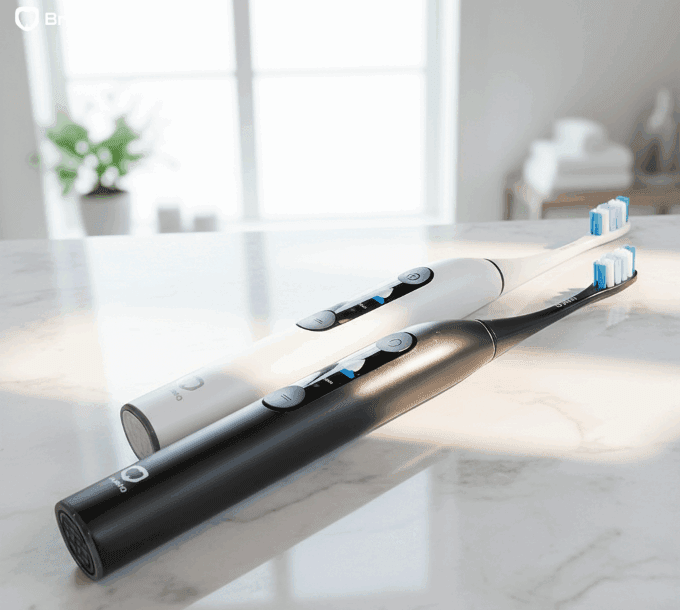
Precision brushing tools like BrushO improve preventive removal by addressing habit variability.
Ensures no surface becomes a persistent plaque reservoir.
Maintains effective cleaning without tissue damage.
Identifies neglected regions before biofilm stabilizes.
Habit tracking encourages consistent timing and frequency.
Early intervention becomes measurable and repeatable rather than guesswork.
Managing biofilm adaptation helps:
• Lower cavity incidence
• Prevent gingival inflammation
• Maintain microbiome diversity
• Reduce tartar formation
• Stabilize enamel integrity
Oral health improves when the hygiene strategy evolves faster than microbial adaptation.
Oral biofilm is a responsive biological system shaped by daily hygiene behavior. Rather than simply accumulating, microbial communities reorganize and adapt to brushing consistency, technique, and environmental conditions. Understanding this dynamic interaction reframes oral hygiene as ecological management rather than routine cleaning. AI-guided brushing technologies support this approach by minimizing predictable gaps and improving coverage precision. By influencing how biofilm evolves, individuals gain proactive control over long-term oral health outcomes.

Water that leaves a dental unit is not sterile, and it has not been sterile for decades. The narrow tubing that carries coolant to the handpiece and the air-water syringe provides an ideal surface for a biofilm that sheds organisms into every patient's mouth. Sterilisation of the instruments does...

A young adult presents with soreness of the gums, and the examination shows a striking change that is easily mistaken for severe periodontal disease: the mucosa is thickened, folded and studded with tiny yellow pustules that rupture to leave shallow ulcers resembling snail tracks. This is pyostom...

A patient who becomes cyanosed minutes after an apparently routine infiltration, yet keeps talking and breathing comfortably, presents a diagnostic trap. The saturation monitor reads in the eighties, supplemental oxygen changes nothing, and the chest sounds clear. This is the classic signature of...

Most patients with clicking, locking and jaw pain improve with reassurance, soft diet, splint therapy and physical measures. A minority do not, and their imaging shows a displaced disc with degenerative change, a shortened condyle or a persistent closed lock. For that group, two operations compet...

A slowly growing palatal swelling that the patient has noticed for two years, a minor salivary gland tumor that looks deceptively well demarcated, and a nerve that carries tumor cells far beyond the visible mass: this is the natural history of adenoid cystic carcinoma. It is uncommon, it is rarel...

Saliva is easy to overlook until its volume changes. An excess produces drooling that soils clothing and isolates a patient socially, while a painless enlargement of both parotid glands raises the question of systemic disease. Sialorrhea and sialadenosis sit at opposite ends of the same physiolog...

When caries in a primary molar reaches the pulp but the tooth can still be restored and the supporting bone is intact, pulpectomy offers a way to keep the tooth comfortable and functional until exfoliation. The procedure removes both the coronal and the radicular pulp and replaces it with a resor...

Disorders of the fibroblast growth factor receptor genes produce some of the most distinctive facial appearances in medicine, and the two extremes are instructive. Pfeiffer syndrome allows survival with staged craniofacial surgery, while thanatophoric dysplasia is almost always lethal in the neon...

A panoramic radiograph that shows a uniformly dense mandible or maxilla can indicate an entirely benign finding, such as a dense bone island or a torus, or it can be the first clue to a generalized skeletal disorder. Osteopetrosis and the broader group of osteosclerotic conditions differ greatly ...

A patient who cannot open the mouth more than a finger breadth, yet whose temporomandibular joint still moves on imaging, presents one of the most easily misdiagnosed problems in oral surgery. The restriction in such cases lies outside the joint, and the condition is termed pseudoankylosis. An el...

Costruire rapidamente e a basso costo una rete di dati sulla salute orale in modo che tutti possano creare.
Costruire rapidamente e a basso costo una rete di dati sulla salute orale in modo che tutti possano creare.


Address: RM 1427, 14/F RADIO CITY 505, HENNESSY RD CAUSEWAY BAY, HONG KONG
Code: 000000
Phone: +852-53758652
Email: customerservice@brusho.com