
Dental wellness is the foundation of overall health, but conventional dentistry has been in stasis for decades. What if toothbrushing not only prevented cavities but also had more benefits? What if it could be integrated into a global platform that advances dental science, compensates users, and secures individual health information?
Meet Web3 and DeSci (Decentralized Science) a technological shift that’s transforming the landscape for oral wellness!
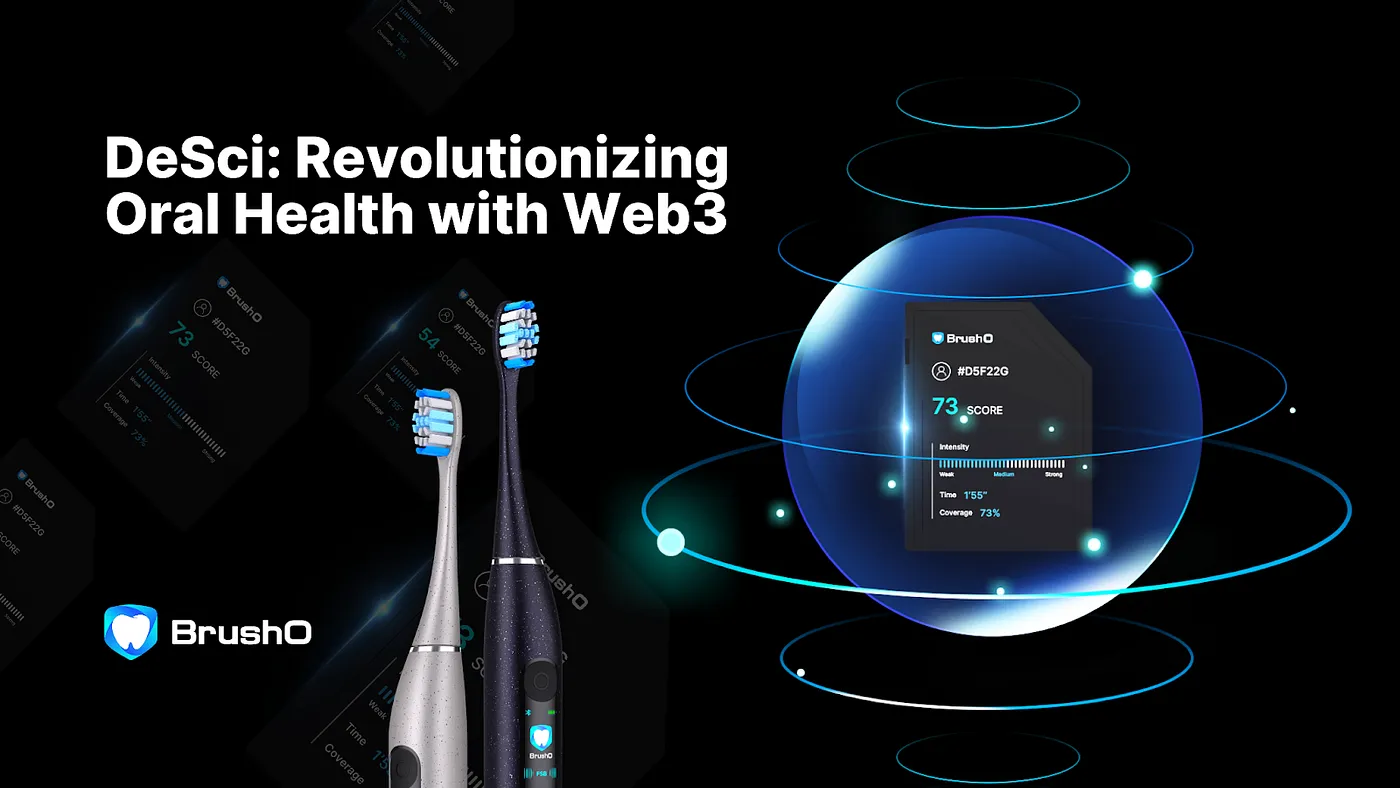
Decentralized Science (DeSci) utilizes blockchain technology to turn scientific research on its head, distributed, and funded. Isolated medical research, governed by monolithic institutions, has been inaccessible to the broader public. Web3 reverses this on its head and makes it open-accessed, decentralized and community-governed.
For oral health, this means:
Conventionally, brushing is a daily chore without any extrinsic rewards. web3 provides a “brush-to-earn” paradigm where people are rewarded for healthy oral hygiene habits. Through Fully Smart Brushing (FSB) Technology, brushing behaviour, length, and frequency are tracked and translated into tangible value in the form of tokenized rewards.
Blockchain and decentralized research allow institutions to gather real-time oral health information from users worldwide. This gives dental clinicians and researchers irreplaceable feedback on global brushing habits, patterns of oral diseases, and the efficiencies of various oral care methods.
With legacy healthcare systems, patient information tends to be centralized into databases that are susceptible to being hacked. Web3 allows users to maintain full ownership of their oral health data, with complete control over when and how they share it with complete encryption and privacy protection.
Behavioural modification is the key to better oral health, and gamification is essential in ensuring that brushing habits are consistent. With challenges, leaderboards, and rewards based on milestones, Web3 turns oral care into a fun experience, motivating users to remain consistent.
How BrushO is Bringing Web3 and DeSci to Oral Health
BrushO is leading the integration of Web3 and DeSci to turn oral health into a fun, rewarding, and data-rich experience. Using blockchain, BrushO introduces a brush-to-earn approach in which users are rewarded for practising proper oral hygiene and sharing valuable anonymized insights into decentralized research. The DeSci-backed research streamlines innovation by offering dental professionals real-time knowledge of brushing trends globally in a bid to formulate better care protocols.
In the process, BrushO also ensures data sovereignty and privacy, with users being completely in control of their oral health information through encryption and permission-based sharing. To make brushing as a routine oral care a habit, BrushO utilizes gamification, adding challenges, leaderboards, and interactive rewards that engage users in a rewarding and fun experience while brushing. By such ingenuity, BrushO is making the routine brush a worthy addition to science and an effort toward healthier oral well-being for everyone.
The integration of Web3, DeSci, and smart brushing technology is not an upgrade — it is a revolution in the way we practice oral care. It bridges the loop between technology and health and transforms oral care into a proactive, incentive-oriented, and community-oriented practice.
As we move toward a future in which technology streamlines and tailors healthcare, Web3-enabled oral care will revolutionize the practice and perception of dental hygiene. The only question now is not if this revolution will happen, but how quickly we can make it happen.
The revolution is already here are you ready to brush smarter, Join us and learn about BrushO.
About BrushO:
BrushO is revolutionizing oral health with smart technology, AI-driven insights, and a decentralized ecosystem. Our Fully Smart Brushing (FSB) technology transforms everyday brushing into a rewarding and data-driven experience, empowering users with better oral care while maintaining full control over their data.
Join the future of oral health innovation.
Feb 18
Feb 28

Squamous cell carcinoma is not a single, uniform disease, and two of its oral variants illustrate the extremes of its behavior. Verrucous carcinoma is a slow-growing, exophytic tumor that almost never metastasizes, while spindle cell carcinoma is an aggressive, sarcomatoid malignancy that can be ...

Most people expect a toothache to be the first sign of pulp disease, but some forms of pulpitis are surprisingly silent. A pulp polyp is the visible result of chronic hyperplastic pulpitis, a condition in which the dental pulp grows out of a large carious opening as a fleshy mass. Recognizing thi...

Dry mouth is not merely uncomfortable; it is a medical condition with real consequences for teeth, speech, swallowing and quality of life. When the salivary glands cannot produce enough saliva, medications called sialogogues can restore some of the missing fluid. Pilocarpine and cevimeline are th...

A blister in the mouth can be the first warning of a systemic autoimmune disease, and two disorders deserve particular attention in the dental chair: pemphigus vulgaris and mucous membrane pemphigoid. Both produce chronic oral ulceration, yet their immunologic targets, clinical behavior and long-...

When infection drains from a tooth, the body often creates a visible escape route, and the dentist must interpret these fistulous openings correctly. A parulis is the common gum boil that signals chronic periapical infection, while an oroantral fistula is a communication between the mouth and the...

Among the fibro-osseous lesions of the jaws, the ossifying fibroma holds a unique position because it is a true neoplasm, unlike the reactive cemento-osseous dysplasia discussed in an earlier article. It grows continuously, expands bone and requires surgical removal, and its cemental variant adds...

Not all keratocystic lesions of the jaw behave alike, and one of the most important distinctions in oral pathology separates the orthokeratinized odontogenic cyst from its better-known relative, the odontogenic keratocyst. Although the two lesions look similar under the microscope at first glance...

Periodontal disease is usually a slowly progressive infection, but a rare form called necrotizing ulcerative periodontitis destroys tissue with alarming speed. Unlike ordinary periodontitis, this condition produces necrotic, cratered papillae, deep pocketing and rapid bone loss, and it appears al...

Every parent has met the child who refuses to eat because of painful mouth sores, and most of these children have one of two viral illnesses: herpangina or hand, foot and mouth disease. Both are caused by enteroviruses, both produce fever and oral ulcers, and both are overwhelmingly common in you...

Cementoosseous dysplasia is one of the most common fibro-osseous lesions found on dental radiographs, yet it is also one of the most frequently misdiagnosed. The lesion replaces normal bone with cellular fibrous tissue and cementum-like material, and it appears in several forms that range from a ...

모두가 쉽게 구축할 수 있는 방식으로 구강 건강 데이터 네트워크를 저렴한 비용으로 빠르게 구축하세요.


Address: RM 1427, 14/F RADIO CITY 505, HENNESSY RD CAUSEWAY BAY, HONG KONG
Code: 000000
Phone: +852-53758652
Email: customerservice@brusho.com