
Are toothbrush bristles really important?
Absolutely. Bristles are the first point of contact between your toothbrush and your teeth, and they play a major role in cleaning efficiency, gum protection, and long-term oral health. The wrong bristles can damage enamel or irritate gums, while high-quality bristles improve comfort and effectiveness. In this article, we’ll explore the role of toothbrush bristles, the soft vs hard debate, dentist recommendations, and how BrushO’s premium bristle design, pressure sensor technology, and four included replacement heads ensure your daily brushing is safe, effective, and future-proof.
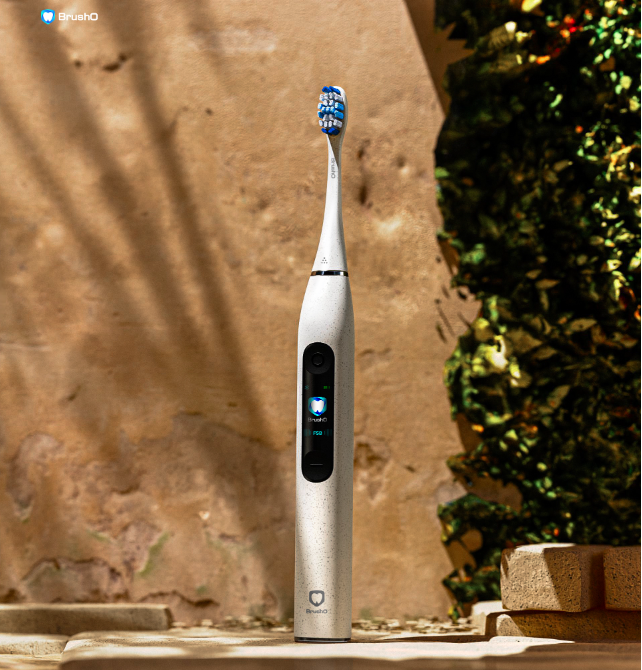
Toothbrush bristles may look simple, but their job is critical:
Without well-designed bristles, even the most advanced toothbrush won’t deliver good results.
Soft Bristles: Recommended by most dentists. They bend easily, reach between teeth, and clean effectively without harming enamel. Perfect for sensitive gums.
Hard Bristles: Often marketed as “extra cleaning,” but can actually wear down enamel and irritate gums if used daily.
👉 The American Dental Association (ADA) generally recommends soft or medium bristles, combined with proper brushing technique.
Not all bristles are created equal. Low-quality brushes may fray quickly, harbor bacteria, or fail to remove plaque effectively. High-quality bristles provide:
Poor bristles can lead to premature wear on your teeth and gums—exactly the opposite of what you want from daily brushing.
Dentists consistently advise patients to:
Proper bristles combined with smart technology are the best formula for healthier teeth and gums.
The BrushO Smart Electric Toothbrush combines advanced design with premium bristle quality to ensure safe and effective cleaning:
Designed for both durability and softness, giving a thorough clean while protecting enamel.
Enough for a full year of dentist-recommended replacements, ensuring optimal hygiene without extra purchases.
Even with soft bristles, brushing too hard can cause damage. BrushO’s sensor prevents enamel erosion and gum irritation.
From Sensitive to Deep Clean, you can pair bristle quality with the right vibration mode for your needs.
👉 With BrushO, bristles aren’t just an afterthought; they’re the foundation of effective, safe brushing.
Q1: Are hard bristles better at cleaning?
Not necessarily. They may remove more plaque short-term, but risk long-term damage.
Q2: Do I really need to replace brush heads every 3 months?
Yes. Old bristles lose effectiveness and harbor bacteria. BrushO makes this easy by including 4 replacements per set.
Q3: What type of bristles are best for sensitive teeth?
Soft bristles are safest, especially when paired with pressure sensors.
Q4: Why are premium bristles worth the cost?
They clean better, last longer, and protect your teeth and gums, preventing costly dental treatments later.
So, are toothbrush bristles really important? Without a doubt. They’re the direct connection between your toothbrush and your teeth, and their quality determines how well you clean and protect your smile. With BrushO’s premium bristles, smart pressure sensing, and multiple cleaning modes, you get the best of both worlds: effective plaque removal and long-term oral health.

Squamous cell carcinoma is not a single, uniform disease, and two of its oral variants illustrate the extremes of its behavior. Verrucous carcinoma is a slow-growing, exophytic tumor that almost never metastasizes, while spindle cell carcinoma is an aggressive, sarcomatoid malignancy that can be ...

Most people expect a toothache to be the first sign of pulp disease, but some forms of pulpitis are surprisingly silent. A pulp polyp is the visible result of chronic hyperplastic pulpitis, a condition in which the dental pulp grows out of a large carious opening as a fleshy mass. Recognizing thi...

Dry mouth is not merely uncomfortable; it is a medical condition with real consequences for teeth, speech, swallowing and quality of life. When the salivary glands cannot produce enough saliva, medications called sialogogues can restore some of the missing fluid. Pilocarpine and cevimeline are th...

A blister in the mouth can be the first warning of a systemic autoimmune disease, and two disorders deserve particular attention in the dental chair: pemphigus vulgaris and mucous membrane pemphigoid. Both produce chronic oral ulceration, yet their immunologic targets, clinical behavior and long-...

When infection drains from a tooth, the body often creates a visible escape route, and the dentist must interpret these fistulous openings correctly. A parulis is the common gum boil that signals chronic periapical infection, while an oroantral fistula is a communication between the mouth and the...

Among the fibro-osseous lesions of the jaws, the ossifying fibroma holds a unique position because it is a true neoplasm, unlike the reactive cemento-osseous dysplasia discussed in an earlier article. It grows continuously, expands bone and requires surgical removal, and its cemental variant adds...

Not all keratocystic lesions of the jaw behave alike, and one of the most important distinctions in oral pathology separates the orthokeratinized odontogenic cyst from its better-known relative, the odontogenic keratocyst. Although the two lesions look similar under the microscope at first glance...

Periodontal disease is usually a slowly progressive infection, but a rare form called necrotizing ulcerative periodontitis destroys tissue with alarming speed. Unlike ordinary periodontitis, this condition produces necrotic, cratered papillae, deep pocketing and rapid bone loss, and it appears al...

Every parent has met the child who refuses to eat because of painful mouth sores, and most of these children have one of two viral illnesses: herpangina or hand, foot and mouth disease. Both are caused by enteroviruses, both produce fever and oral ulcers, and both are overwhelmingly common in you...

Cementoosseous dysplasia is one of the most common fibro-osseous lesions found on dental radiographs, yet it is also one of the most frequently misdiagnosed. The lesion replaces normal bone with cellular fibrous tissue and cementum-like material, and it appears in several forms that range from a ...

모두가 쉽게 구축할 수 있는 방식으로 구강 건강 데이터 네트워크를 저렴한 비용으로 빠르게 구축하세요.


Address: RM 1427, 14/F RADIO CITY 505, HENNESSY RD CAUSEWAY BAY, HONG KONG
Code: 000000
Phone: +852-53758652
Email: customerservice@brusho.com