
When we think about brushing our teeth, we often focus only on the teeth themselves—front, back, and chewing surfaces. But what about the roof of your mouth? Also known as the palate, this area is often skipped in daily routines, despite its role in harboring bacteria and affecting breath freshness. In this article, we’ll explore why cleaning the roof of your mouth matters, what risks are associated with ignoring it, and how BrushO’s smart feedback system helps ensure no area is left behind.
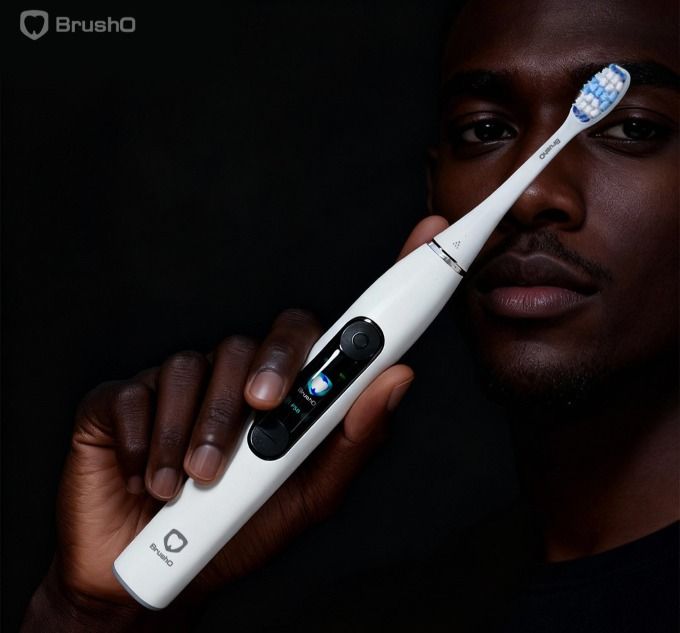
The roof of your mouth—the hard and soft palate—is part of the oral cavity and plays an active role in speech, swallowing, and even your immune response. Like your tongue and teeth, it can accumulate bacteria, food debris, and dead cells throughout the day.
• Bacterial buildup: This area provides a warm, moist environment where bacteria thrive.
• Halitosis (bad breath): When left uncleaned, it can contribute to persistent bad breath.
• Oral health imbalance: Neglecting any part of the mouth can throw off your overall oral hygiene balance.
Most traditional brushing routines and even many electric toothbrushes don’t include guidance for cleaning the roof of the mouth. The lack of awareness, combined with the awkwardness of reaching this area, means it’s easily forgotten.
• It’s not part of conventional brushing instructions.
• Discomfort or gag reflex when brushing that area.
• Misconception that only teeth and tongue need cleaning.
1. Use a soft-bristled toothbrush head (like BrushO’s gentle mode head).
2. After brushing your teeth and tongue, gently glide the brush over the hard and soft palate using slow circular motions.
3. Be gentle—you’re not scrubbing, just sweeping away buildup.
4. Finish with a rinse, preferably with a mouthwash that targets bacteria.
BrushO’s FSB (Fully Smart Brushing) technology is designed to ensure no area is overlooked during your routine.
🧠 AI-Powered Heatmaps: Tracks coverage, including commonly missed areas like the palate and inner cheeks.
📱 App-Based Reminders: Suggests full-mouth hygiene, including less commonly cleaned surfaces.
🚨 Real-Time Alerts: If you’re skipping areas, the app provides gentle guidance and tips for a complete clean.
Whether it’s the back molars or the roof of your mouth, BrushO helps form whole-mouth awareness—a key to better breath and lasting oral health.
Your mouth is the gateway to your body. Ensuring all surfaces—including the roof—are properly cleaned reduces oral bacteria that can contribute to:
• Gum disease
• Systemic inflammation
• Bad breath and dry mouth
With BrushO, whole-mouth care becomes not just easier—but smarter and more rewarding.
Ignoring the roof of your mouth might seem like a small oversight, but it can have big consequences for your oral hygiene. By giving this often-forgotten area the attention it deserves, you enhance your brushing routine and support your full-body health. With the help of smart tools like BrushO, no surface gets left behind.
Dec 15
Dec 11

The xerostomia is the symptom that the patient describes as the dry mouth, and the Sjogren syndrome is the systemic autoimmune condition that the clinician identifies as one of the causes that the symptom reveals. The dry mouth that the patient reports may follow the medication, the radiation, th...

The sinus lift is the augmentation procedure that the clinician performs to create the bone height that the posterior maxilla requires for the implant, and the choice between the lateral window and the transcrestal approach determines the surgical trauma, the healing, and the implant that the sit...

Post-extraction bleeding is one of the most common and most distressing experiences after a tooth extraction. For most patients, a small amount of oozing from the extraction site for 24 to 48 hours after the procedure is completely normal. However, when bleeding becomes excessive, prolonged, or d...

The skeletal class III malocclusion is the condition that the clinician treats with the orthognathic surgery or the camouflage orthodontic treatment, and the decision between the two paths determines the function, the aesthetics, and the stability that the patient receives. The orthognathic surge...

Interproximal enamel reduction — commonly referred to as IPR, slenderizing, stripping, or contouring — is the controlled removal of small amounts of enamel from the proximal surfaces of teeth. Despite sounding more invasive than it is, IPR is one of the most widely used and clinically safe proced...

The gingival graft is the surgical procedure that the periodontist performs to restore the keratinized tissue and to cover the exposed root, and the choice between the free gingival graft and the connective tissue graft determines the outcome that the patient receives. The free gingival graft har...

Denture adhesives — commonly known as fixatives or denture creams — are among the most widely used adjuncts in prosthodontic care. Millions of complete and partial denture wearers use some form of adhesive daily, often without a clear understanding of what these products do, when they should be u...

When a young patient presents with an immature tooth that has lost its vitality — typically due to trauma or deep caries — the endodontist faces one of the most consequential decisions in paediatric endodontics. The permanent root has not finished forming, the apex remains open, and the tooth is ...

The ankyloglossia is the condition that the lingual frenulum restricts the movement of the tongue, and the release of the frenulum in the infant is the procedure that the clinician performs to restore the function that the feeding and the speech require. The assessment that the clinician performs...

Dental amalgam fillings have been in clinical use since the mid-19th century, making them one of the most historically established restorative materials. In 2026, the conversation around amalgam replacement has shifted from a simple material preference debate to a nuanced clinical assessment of w...

모두가 쉽게 구축할 수 있는 방식으로 구강 건강 데이터 네트워크를 저렴한 비용으로 빠르게 구축하세요.


Address: RM 1427, 14/F RADIO CITY 505, HENNESSY RD CAUSEWAY BAY, HONG KONG
Code: 000000
Phone: +852-53758652
Email: customerservice@brusho.com