
Your bathroom may seem like the perfect place to store a toothbrush—but its warm, damp environment could be cutting your toothbrush’s life short without you realizing it. High humidity accelerates bacteria growth, weakens structural integrity, and shortens both manual and electric toothbrush performance. In this post, we explore how humidity affects the lifespan of your toothbrush, signs of moisture damage, and how BrushO’s waterproof design is built to resist these everyday threats.
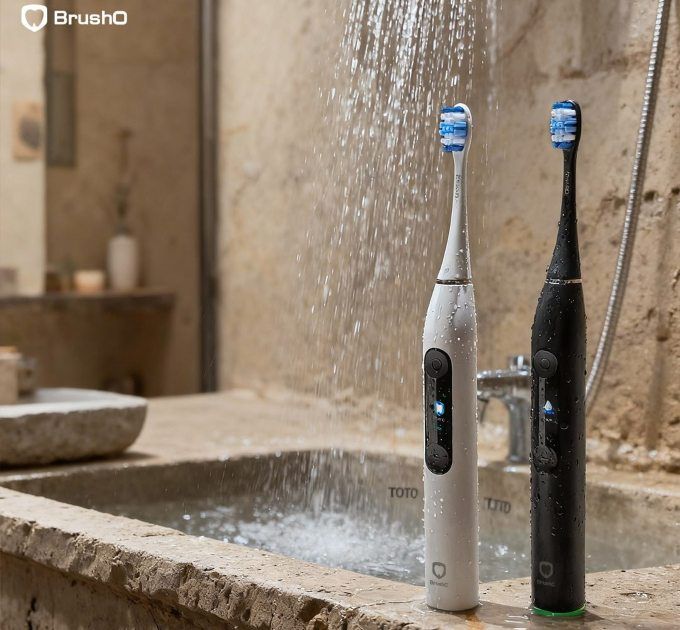
Bathrooms are one of the most humid spaces in any home. Daily showers create steam, condensation clings to surfaces, and airflow is often limited.
Toothbrushes stored near sinks, tubs, or in enclosed holders are frequently exposed to:
• Trapped moisture
• Warm, stagnant air
• Splash zones from faucets
This humidity doesn’t just cause mild discomfort—it can lead to bacterial growth, mildew, and long-term material breakdown.
Even simple manual brushes are vulnerable. Excess moisture can:
• Soften bristles prematurely
• Warp brush heads over time
• Promote mold growth at the base or in travel caps
• Cause musty odors from bacterial buildup
Most people keep their toothbrush in a cup or holder with no airflow, creating a breeding ground for germs that cling to your brush—even after rinsing.
Electric toothbrushes involve sensitive electronics, batteries, and motors. Humidity-related risks include:
• Corroded charging ports
• Short-circuited internal boards
• Sticky or unresponsive buttons
• Condensation under sealed screens
Over time, this moisture damage can degrade performance or cause complete failure—especially if the toothbrush isn’t IP-rated for waterproof use.
BrushO was engineered with real bathrooms in mind—not just ideal lab conditions. That’s why its design includes:
Sealed casing and no exposed screws protect internal electronics from steam, splashes, and moisture.
No metal prongs or corrosion-prone contacts.
Reduces buildup of moisture in the handle area for hygienic daily use.
BrushO’s packaging and travel kits include breathable features to prevent trapped moisture.
No matter what toothbrush you use, follow these simple steps to extend its life in a damp bathroom:
• Store upright in an open-air space
• Avoid closed containers or drawers
• Wipe electric toothbrush handles dry after each use
• Use a UV sanitizer or fast-drying stand if available
• Keep your brush away from steamy shower zones
• Replace brush heads every 3 months (or sooner if bristles fray or smell)
Your toothbrush works hard every day—but if humidity is quietly damaging it, you may not be getting the clean you think. Bacteria, mold, and electronic wear are all silent threats that can be prevented with smart storage and durable design. With BrushO, you don’t just get a smart toothbrush—you get peace of mind that your device can handle the real-world conditions of your bathroom.
BrushO is a next-generation AI-powered smart toothbrush that adapts to your brushing behavior with real-time feedback and zone scoring. Engineered with waterproof materials, ergonomic comfort, and smart charging, BrushO helps users build better oral care habits—even in humid, high-moisture environments.
Dec 17
Dec 17

Squamous cell carcinoma is not a single, uniform disease, and two of its oral variants illustrate the extremes of its behavior. Verrucous carcinoma is a slow-growing, exophytic tumor that almost never metastasizes, while spindle cell carcinoma is an aggressive, sarcomatoid malignancy that can be ...

Most people expect a toothache to be the first sign of pulp disease, but some forms of pulpitis are surprisingly silent. A pulp polyp is the visible result of chronic hyperplastic pulpitis, a condition in which the dental pulp grows out of a large carious opening as a fleshy mass. Recognizing thi...

Dry mouth is not merely uncomfortable; it is a medical condition with real consequences for teeth, speech, swallowing and quality of life. When the salivary glands cannot produce enough saliva, medications called sialogogues can restore some of the missing fluid. Pilocarpine and cevimeline are th...

A blister in the mouth can be the first warning of a systemic autoimmune disease, and two disorders deserve particular attention in the dental chair: pemphigus vulgaris and mucous membrane pemphigoid. Both produce chronic oral ulceration, yet their immunologic targets, clinical behavior and long-...

When infection drains from a tooth, the body often creates a visible escape route, and the dentist must interpret these fistulous openings correctly. A parulis is the common gum boil that signals chronic periapical infection, while an oroantral fistula is a communication between the mouth and the...

Among the fibro-osseous lesions of the jaws, the ossifying fibroma holds a unique position because it is a true neoplasm, unlike the reactive cemento-osseous dysplasia discussed in an earlier article. It grows continuously, expands bone and requires surgical removal, and its cemental variant adds...

Not all keratocystic lesions of the jaw behave alike, and one of the most important distinctions in oral pathology separates the orthokeratinized odontogenic cyst from its better-known relative, the odontogenic keratocyst. Although the two lesions look similar under the microscope at first glance...

Periodontal disease is usually a slowly progressive infection, but a rare form called necrotizing ulcerative periodontitis destroys tissue with alarming speed. Unlike ordinary periodontitis, this condition produces necrotic, cratered papillae, deep pocketing and rapid bone loss, and it appears al...

Every parent has met the child who refuses to eat because of painful mouth sores, and most of these children have one of two viral illnesses: herpangina or hand, foot and mouth disease. Both are caused by enteroviruses, both produce fever and oral ulcers, and both are overwhelmingly common in you...

Cementoosseous dysplasia is one of the most common fibro-osseous lesions found on dental radiographs, yet it is also one of the most frequently misdiagnosed. The lesion replaces normal bone with cellular fibrous tissue and cementum-like material, and it appears in several forms that range from a ...

모두가 쉽게 구축할 수 있는 방식으로 구강 건강 데이터 네트워크를 저렴한 비용으로 빠르게 구축하세요.


Address: RM 1427, 14/F RADIO CITY 505, HENNESSY RD CAUSEWAY BAY, HONG KONG
Code: 000000
Phone: +852-53758652
Email: customerservice@brusho.com