
Crossing time zones often means battling jet lag, changing routines, and adjusting your internal clock—but one overlooked casualty is your oral hygiene. Whether you’re on a long-haul flight, backpacking through continents, or just visiting a new country, your brushing habits are likely to suffer. Skipped brushing, irregular eating, dehydration, and exhaustion all increase your risk for plaque buildup, bad breath, and even cavities. Fortunately, with better awareness and the help of smart tools like BrushO, you can maintain strong oral care even while your body adjusts to new schedules.
Jet lag throws off your circadian rhythm, which governs your brushing routines just like it does sleep. When you:
• Fall asleep before brushing due to exhaustion
• Wake up disoriented and skip morning brushing
• Forget when your “nighttime” brushing should occur
…oral bacteria thrive. This disruption gives plaque more time to build up, leading to inflammation and decay.
Travel often means grazing throughout the day, trying unfamiliar foods, or relying on sugary, processed snacks at airports. These habits:
• Feed bacteria in the mouth
• Create more frequent acid attacks on enamel
• Are rarely followed by immediate brushing
Without proper cleaning, your teeth are more vulnerable to erosion and cavities.
Airplane cabins have low humidity levels, which reduce saliva flow—your body’s natural defense against bacteria. A dry mouth:
• Increases bad breath
• Weakens enamel protection
• Leads to a higher risk of gum inflammation
And travelers often drink less water or rely on caffeinated beverages, making it worse.
• Skipping a brushing session on overnight flights
• Brushing too soon after acidic in-flight meals or drinks
• Not packing travel-friendly oral care tools
• Using unfamiliar water sources without rinsing properly
These habits may seem minor, but can compound over several days.
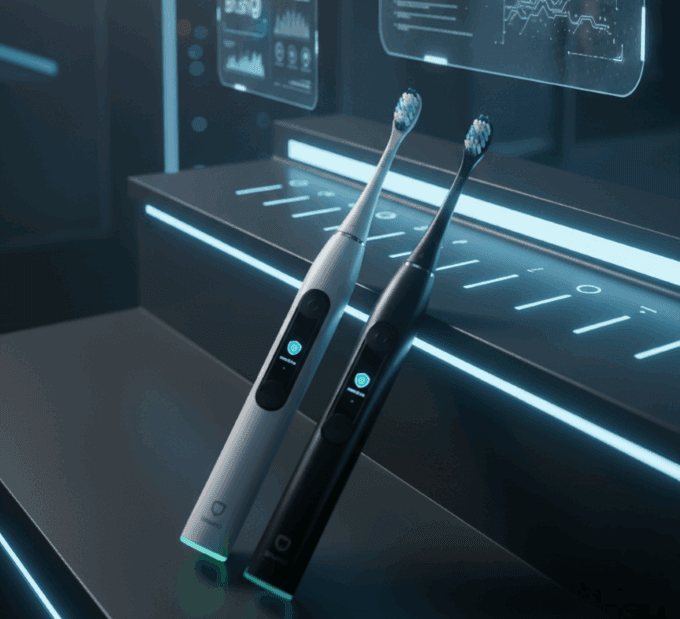
BrushO is an AI-powered smart toothbrush that makes oral hygiene convenient and consistent—even when you’re jet-lagged or on the go.
• Time Zone-Aware Reminders: The app can adjust reminders based on local time, helping you brush in sync with your new schedule.
• Habit Streak Tracking: Even when your routine shifts, BrushO logs your brushing data and motivates consistency with $BRUSH token rewards.
• Travel Mode: Long-lasting battery life (up to 45 days) and compact design make it easy to carry without extra accessories.
• Custom Modes for Sensitive Teeth: Perfect for those sensitive to dry air or frequent snacking during flights.
With FSB technology, BrushO monitors your brushing pressure, duration, and coverage—even if you’re brushing in an unfamiliar hotel bathroom or airport lounge.
• Pack a travel-sized BrushO and extra brush head
• Brush after waking up—even if it’s not your “home” morning
• Use bottled water to rinse if local tap water is questionable
• Chew sugar-free gum to stimulate saliva during flights
• Rinse with water after in-flight snacks or acidic beverages
• Set app reminders based on local time zones
Brushing regularly—even without your full routine—goes a long way.
Traveling across time zones doesn’t mean you have to sacrifice your oral health. In fact, the more disruptive your journey, the more important it is to protect your teeth and gums. With smart tools like BrushO, you can automate good habits, track your consistency, and brush smarter—even when everything else is in flux.
Jan 16
Jan 16

Thumb sucking and pacifier use are normal self-soothing behaviors in infancy, and most children give them up on their own by school age. The dental problem arises when the habit continues past the eruption of the permanent front teeth, because the persistent pressure reshapes the growing jaw and ...

Most people never think about the shape of their tooth roots, but root morphology determines how a tooth is treated when disease strikes. Taurodontism and dilaceration are two developmental anomalies that change root anatomy in distinctive ways, and both have major implications for endodontics, e...

Dental injuries are among the most common sports-related injuries, and a mouthguard is the simplest piece of equipment an athlete can wear. Yet many players still train without one, often because they have never been told which type to choose or how a well-fitted guard feels. Understanding the pr...

Piezoelectric surgery has changed the way oral surgeons cut bone. Instead of a rotating bur, a piezotome uses ultrasonic vibrations to cut mineralized tissue while leaving soft tissue largely untouched. The technique is now routine for osteotomies, sinus lifts and delicate procedures where precis...

Children's teeth vary naturally in size, but some variations are large enough to affect function, appearance and future orthodontic care. Microdontia means teeth that are smaller than normal, and macrodontia means teeth that are larger than normal, and both can appear as isolated findings or as p...

Two patients can have identical teeth and completely different treatment outcomes, and the reason is often hiding in the gums. Gingival biotype describes the thickness and morphology of the soft tissue around the teeth, and it influences how the gum reacts to surgery, implants, braces and even si...

Guided bone regeneration, or GBR, is the standard method for rebuilding bone before and around dental implants. The concept is simple: a membrane creates a protected space that allows bone-forming cells to grow while excluding competing soft tissue. Choosing a resorbable membrane changes the prot...

Periodontal disease destroys not only the gum but the bone and ligament that anchor teeth, and the goal of regenerative treatment is to rebuild all three. Emdogain, an enamel matrix derivative, has become one of the most studied biological agents for this task, and its results improve further whe...

A chipped tooth is one of the most common dental emergencies, affecting children and adults alike through falls, sports, biting on hard objects and even normal wear. The right repair depends less on the size of the fragment and more on which layer of the tooth is exposed. Bonding, veneers and cro...

A knocked-out tooth is one of the few dental emergencies where minutes decide the outcome. When a permanent tooth is completely displaced from its socket, immediate and correct handling can save it, while delays or mistakes can condemn it to loss. The steps are simple enough for any parent, coach...

모두가 쉽게 구축할 수 있는 방식으로 구강 건강 데이터 네트워크를 저렴한 비용으로 빠르게 구축하세요.


Address: RM 1427, 14/F RADIO CITY 505, HENNESSY RD CAUSEWAY BAY, HONG KONG
Code: 000000
Phone: +852-53758652
Email: customerservice@brusho.com