
Braces make great smiles—but they also trap plaque, test your patience, and can irritate gums. A gentle electric toothbrush solves the puzzle: sonic power for deep cleaning, smart pressure control to protect tissue, and app guidance so you don’t miss a spot. Here’s a braces-friendly routine with BrushO to keep teeth, gums, and brackets happy. 🦷✨
Brackets and wires create tiny hideouts for food and bacteria 🦠. Scrubbing harder won’t fix it—overbrushing risks enamel wear and gum recession. What you need is precise, low-pressure cleaning that reaches around hardware without stressing your mouth.
A gentle electric toothbrush does the heavy lifting with micro-vibrations, not elbow grease.
BrushO Smart Electric Toothbrush combines comfort with control:
🌸 Gentle & Gum-Care modes — soothing on tissue, effective on plaque
📳 Smart pressure sensor — nudges you to ease up before gums get irritated
🌊 Sonic micro-vibrations — help dislodge buildup around brackets and between teeth
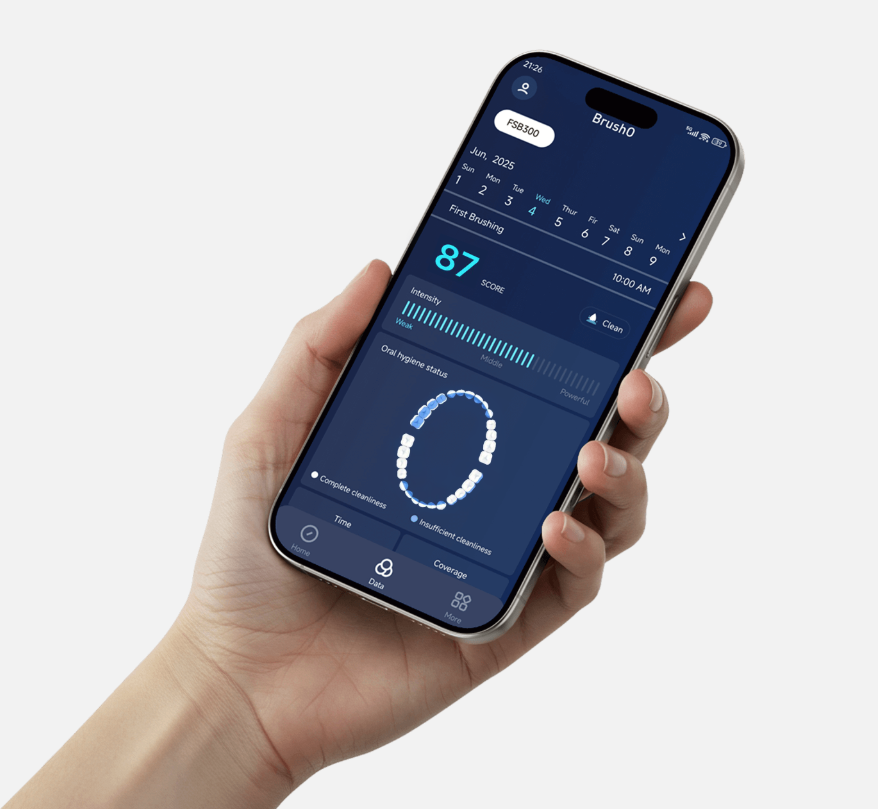
📱 App guidance — real-time coverage feedback so no quadrant gets ignored
🔋 Travel-ready battery — up to ~45 days per full 6-hour charge (perfect for school trips)
🚿 IPX7 waterproof — brush at the sink or in the shower with confidence
1. Pick Gentle or Gum-Care mode. Start soft; let sonic power do the work.
2. Angle 45° to the gumline. Glide, don’t scrub. Short, slow passes win.
3. Above the bracket → on the bracket → below the bracket. Think of it as a three-lane sweep for each tooth.
4. Trace the wire. Tilt the brush to clean where plaque likes to hide.
5. Sweep behind front teeth. Use the tip to clean the lingual surfaces.
6. Finish with tongue & cheeks. Quick pass for fresher breath. 😮💨
7. Check coverage in the app. Fill the map; aim for 100% over time.
⏱️ Timing tip: 2 minutes, twice a day. Add 30–60 seconds at night for bracket detail work.
Morning (2–3 min)
Evening (3–4 min)
Weekly add-ons
Quick FAQ for Brace-Wearers ❓
Is an electric brush safe with braces?
Yes—choose gentle modes and pressure control to protect tissue and hardware.
Which bristles should I use?
Soft, rounded bristles are kinder to enamel and gum margins.
How long should I brush?
At least 2 minutes (AM/PM). Add focused bracket passes at night.
Do I still need interdental cleaning?
Absolutely. Your brush handles surfaces; floss/interdental tools handle in-between
Braces demand precision, not force. With BrushO’s gentle modes, sonic power, pressure sensing, and app coaching, you’ll clean more thoroughly, protect your gums, and keep brackets spotless—without the aches and guesswork.
🛒 Ready for brace-friendly brushing?
👉 Get the BrushO Gentle Electric Toothbrush

Squamous cell carcinoma is not a single, uniform disease, and two of its oral variants illustrate the extremes of its behavior. Verrucous carcinoma is a slow-growing, exophytic tumor that almost never metastasizes, while spindle cell carcinoma is an aggressive, sarcomatoid malignancy that can be ...

Most people expect a toothache to be the first sign of pulp disease, but some forms of pulpitis are surprisingly silent. A pulp polyp is the visible result of chronic hyperplastic pulpitis, a condition in which the dental pulp grows out of a large carious opening as a fleshy mass. Recognizing thi...

Dry mouth is not merely uncomfortable; it is a medical condition with real consequences for teeth, speech, swallowing and quality of life. When the salivary glands cannot produce enough saliva, medications called sialogogues can restore some of the missing fluid. Pilocarpine and cevimeline are th...

A blister in the mouth can be the first warning of a systemic autoimmune disease, and two disorders deserve particular attention in the dental chair: pemphigus vulgaris and mucous membrane pemphigoid. Both produce chronic oral ulceration, yet their immunologic targets, clinical behavior and long-...

When infection drains from a tooth, the body often creates a visible escape route, and the dentist must interpret these fistulous openings correctly. A parulis is the common gum boil that signals chronic periapical infection, while an oroantral fistula is a communication between the mouth and the...

Among the fibro-osseous lesions of the jaws, the ossifying fibroma holds a unique position because it is a true neoplasm, unlike the reactive cemento-osseous dysplasia discussed in an earlier article. It grows continuously, expands bone and requires surgical removal, and its cemental variant adds...

Not all keratocystic lesions of the jaw behave alike, and one of the most important distinctions in oral pathology separates the orthokeratinized odontogenic cyst from its better-known relative, the odontogenic keratocyst. Although the two lesions look similar under the microscope at first glance...

Periodontal disease is usually a slowly progressive infection, but a rare form called necrotizing ulcerative periodontitis destroys tissue with alarming speed. Unlike ordinary periodontitis, this condition produces necrotic, cratered papillae, deep pocketing and rapid bone loss, and it appears al...

Every parent has met the child who refuses to eat because of painful mouth sores, and most of these children have one of two viral illnesses: herpangina or hand, foot and mouth disease. Both are caused by enteroviruses, both produce fever and oral ulcers, and both are overwhelmingly common in you...

Cementoosseous dysplasia is one of the most common fibro-osseous lesions found on dental radiographs, yet it is also one of the most frequently misdiagnosed. The lesion replaces normal bone with cellular fibrous tissue and cementum-like material, and it appears in several forms that range from a ...

모두가 쉽게 구축할 수 있는 방식으로 구강 건강 데이터 네트워크를 저렴한 비용으로 빠르게 구축하세요.


Address: RM 1427, 14/F RADIO CITY 505, HENNESSY RD CAUSEWAY BAY, HONG KONG
Code: 000000
Phone: +852-53758652
Email: customerservice@brusho.com