
Artificial intelligence (AI) is transforming the world in different sectors, including dentistry. Application of AI to dental care has also seen impressive advances, such as personalized brushing instructions and oral hygiene monitoring in real-time. The application of AI has enabled organizations to improve the act of brushing, detect the formation of plaques, and provide feedback for brushing. The improvement in efficacy and enhanced oral hygiene awareness has reduced the risk of cavities and gum disease.
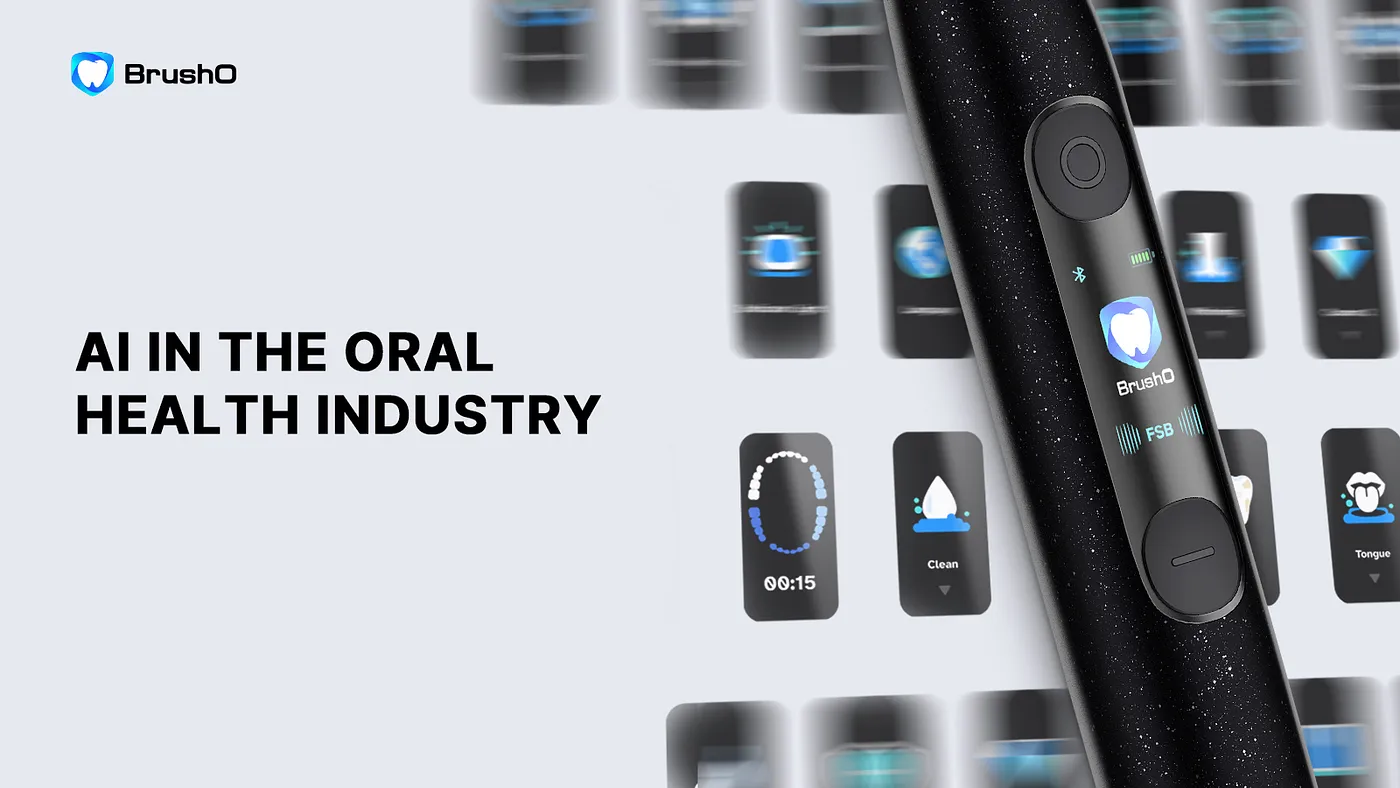
AI toothbrushes and toothbrushing apps can now track users’ brushing habits, highlight where they miss spots, and provide real-time advice for better brushing. Some deliver minimal essential AI help, providing reminders and a timer, but others make use of more sophisticated features such as pressure detection and movement tracking. Such features ensure users brush with their optimum oral health by enforcing dentist-recommended brushing methods.
In addition, artificial intelligence is also being utilized in professional dental treatment through smart diagnostic devices, which help dentists identify cavities, gum disease, and even pre-oral cancer. AI imaging devices can examine dental scans with great accuracy, enabling quicker and more precise diagnoses.
While other companies use AI for incremental improvements in oral hygiene, BrushO leads the way with its Fully Smart Brushing (FSB) technology. Unlike most AI-equipped toothbrushes that provide surface recommendations, BrushO’s AI goes deeper, optimizing brushing with zero learning curve for customers.
How BrushO is setting a new standard:
With its blend of AI-driven oral care and dynamic, reward-based system, BrushO is the future standard of the industry. The AI-driven FSB technology that guarantees everyone gets dentist-quality cleanings without having to learn difficult brushing techniques makes BrushO the most advanced AI toothbrush on the market today, which completely turns the game of how individuals engage in oral hygiene on its head.
As AI continues to advance, its role in oral care will extend beyond brushing. Emerging developments can include AI-powered dental consultations, computerized plaque detection, and oral disease prevention using predictive analytics. With its full AI integration, BrushO leads the charge on this revolution, paving the way for a wiser, healthier future in oral care.
About BrushO
BrushO is a DePIN game-changer on Solana that is revolutionizing oral care with Web3 and AI technology. The crowning glory is the BrushO AI-Powered Mining Toothbrush, a Fully Smart Brushing (FSB) tech with real-time AI instructions that streamlines and makes oral care simple. Besides personal care, BrushO enables users to donate their brushing data to a decentralized oral health network, converting personal brushing habits into shared health information.
Through its “Brush and Earn” model, users are encouraged to maintain good oral hygiene, making brushing rewarding as well as healthy. By integrating AI-driven precision, blockchain security, and tokenized rewards, BrushO is revolutionizing the future of smart oral health.
Join BrushO now and step into the new era of smart brushing!
Official Website: https://brusho.io/
Telegram Community: https://t.me/BrushOcommunity
For a visual overview of BrushO’s AI-Powered Toothbrush, you can watch the following video:
https://youtu.be/hnX0kbd0Ug4?si=CuMxcSo8yE-PArx3
Apr 9
Apr 2

The xerostomia is the symptom that the patient describes as the dry mouth, and the Sjogren syndrome is the systemic autoimmune condition that the clinician identifies as one of the causes that the symptom reveals. The dry mouth that the patient reports may follow the medication, the radiation, th...

The sinus lift is the augmentation procedure that the clinician performs to create the bone height that the posterior maxilla requires for the implant, and the choice between the lateral window and the transcrestal approach determines the surgical trauma, the healing, and the implant that the sit...

Post-extraction bleeding is one of the most common and most distressing experiences after a tooth extraction. For most patients, a small amount of oozing from the extraction site for 24 to 48 hours after the procedure is completely normal. However, when bleeding becomes excessive, prolonged, or d...

The skeletal class III malocclusion is the condition that the clinician treats with the orthognathic surgery or the camouflage orthodontic treatment, and the decision between the two paths determines the function, the aesthetics, and the stability that the patient receives. The orthognathic surge...

Interproximal enamel reduction — commonly referred to as IPR, slenderizing, stripping, or contouring — is the controlled removal of small amounts of enamel from the proximal surfaces of teeth. Despite sounding more invasive than it is, IPR is one of the most widely used and clinically safe proced...

The gingival graft is the surgical procedure that the periodontist performs to restore the keratinized tissue and to cover the exposed root, and the choice between the free gingival graft and the connective tissue graft determines the outcome that the patient receives. The free gingival graft har...

Denture adhesives — commonly known as fixatives or denture creams — are among the most widely used adjuncts in prosthodontic care. Millions of complete and partial denture wearers use some form of adhesive daily, often without a clear understanding of what these products do, when they should be u...

When a young patient presents with an immature tooth that has lost its vitality — typically due to trauma or deep caries — the endodontist faces one of the most consequential decisions in paediatric endodontics. The permanent root has not finished forming, the apex remains open, and the tooth is ...

The ankyloglossia is the condition that the lingual frenulum restricts the movement of the tongue, and the release of the frenulum in the infant is the procedure that the clinician performs to restore the function that the feeding and the speech require. The assessment that the clinician performs...

Dental amalgam fillings have been in clinical use since the mid-19th century, making them one of the most historically established restorative materials. In 2026, the conversation around amalgam replacement has shifted from a simple material preference debate to a nuanced clinical assessment of w...

Construa uma rede de dados de saúde bucal rapidamente e com baixo custo de forma que todos possam construir.
Construa uma rede de dados de saúde bucal rapidamente e com baixo custo de forma que todos possam construir.


Address: RM 1427, 14/F RADIO CITY 505, HENNESSY RD CAUSEWAY BAY, HONG KONG
Code: 000000
Phone: +852-53758652
Email: customerservice@brusho.com