
A healthy smile starts in the morning. Your first oral care session of the day doesn’t just fight bad breath—it sets the tone for your dental health, confidence, and long-term wellness. But with so many tips floating around, what’s the ideal morning oral routine? Here’s a science-backed, AI-enhanced guide to optimizing your morning mouth care—for both appearance and health.
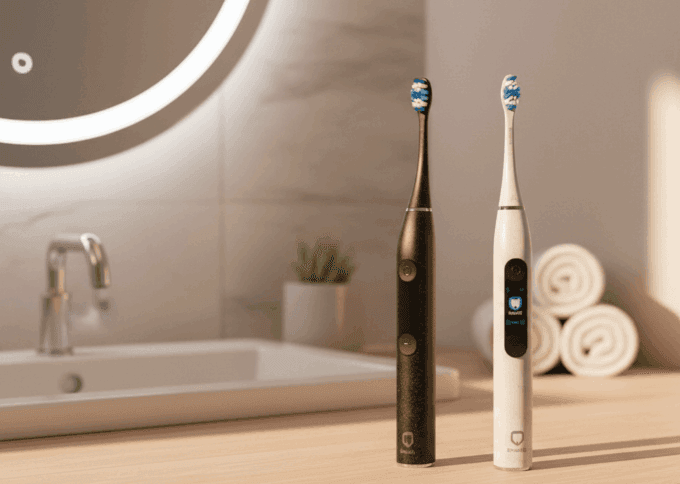
After a night of sleep, your mouth becomes a breeding ground for bacteria. Saliva production slows down, giving odor-causing and plaque-forming microbes the chance to thrive. A well-planned morning routine helps:
• Remove overnight bacterial buildup
• Prevent enamel erosion from acidic breakfast foods
• Refresh your breath for the day ahead
• Reinforce brushing habits and oral health consistency
Neglecting this step or rushing through it could impact both your smile’s appearance and your long-term dental condition.
Contrary to common belief, brushing before breakfast is better for your enamel. Overnight, your mouth becomes acidic, and brushing immediately after eating acidic foods (like fruit juice or toast) can wear down your enamel. Brushing first:
• Reduces bacteria before food contact
• Protects enamel from acidic erosion
• Prepares your teeth with fluoride for the meal ahead
Pro Tip: Use an AI-powered toothbrush like BrushO to ensure you cover all surfaces before breakfast—especially if you tend to brush groggily.
Choose a fluoride toothpaste to help remineralize enamel and protect against decay. For maximum efficiency:
• Use a soft-bristled or AI-monitored brush head
• Set your toothbrush to “fresh breath” or “sensitive” mode if you’re brushing pre-coffee
• Replace brush heads every 3 months—or track wear using the BrushO app
Up to 90% of morning breath originates from the tongue. Make this part of your daily routine:
• Use a built-in tongue scraper or a tongue-cleaning mode on smart brushes
• Gently clean from back to front
• Spend 10–15 seconds removing coating and odor-causing bacteria
BrushO offers dedicated tongue-cleaning tips and app reminders to make this step seamless.
If you’re using fluoride toothpaste, don’t rinse right away. Let the fluoride sit on your teeth for at least 30 minutes for maximum effect. You can:
• Spit out excess foam but skip water rinsing
• Rinse with an alcohol-free mouthwash after breakfast if needed for freshness
• Use BrushO’s app timer to delay rinsing for a healthier post-brushing effect
While many people reserve flossing for the evening, flossing in the morning:
• Removes plaque between teeth before it hardens
• Prevents food particles from breakfast sticking to pre-existing buildup
• Reinforces full-mouth cleanliness from the start of your day
For speed, use a floss pick or water flosser while your toothbrush charges wirelessly (BrushO supports Qi wireless charging for convenience).
BrushO’s smart toothbrush takes your morning brushing to the next level by providing:
• Real-Time Coverage Guidance: 6-zone, 16-surface monitoring to avoid missed areas
• Pressure Feedback: Alerts if you brush too hard or too soft
• Habit Scores: Track streaks, duration, and brushing angles
• Family Monitoring: Parents can review their kids’ brushing behavior before school
By turning your routine into an app-integrated habit, AI helps reinforce consistency—and ultimately, a healthier smile.
Think of your morning oral care like you do skincare or fitness—it’s not just maintenance, it’s prevention. Your smile is one of the first things people notice. Making brushing smarter and more personalized helps ensure you start your day with confidence, not cavities.
The perfect morning oral routine isn’t complicated—it’s consistent, complete, and tech-assisted. From brushing before breakfast to using AI feedback for pressure and zone guidance, your first brushing session of the day can set the tone for long-term dental health.
Let BrushO be your partner in this journey—because a smart smile starts with a smart routine.
Jan 21
Jan 21

Water that leaves a dental unit is not sterile, and it has not been sterile for decades. The narrow tubing that carries coolant to the handpiece and the air-water syringe provides an ideal surface for a biofilm that sheds organisms into every patient's mouth. Sterilisation of the instruments does...

A young adult presents with soreness of the gums, and the examination shows a striking change that is easily mistaken for severe periodontal disease: the mucosa is thickened, folded and studded with tiny yellow pustules that rupture to leave shallow ulcers resembling snail tracks. This is pyostom...

A patient who becomes cyanosed minutes after an apparently routine infiltration, yet keeps talking and breathing comfortably, presents a diagnostic trap. The saturation monitor reads in the eighties, supplemental oxygen changes nothing, and the chest sounds clear. This is the classic signature of...

Most patients with clicking, locking and jaw pain improve with reassurance, soft diet, splint therapy and physical measures. A minority do not, and their imaging shows a displaced disc with degenerative change, a shortened condyle or a persistent closed lock. For that group, two operations compet...

A slowly growing palatal swelling that the patient has noticed for two years, a minor salivary gland tumor that looks deceptively well demarcated, and a nerve that carries tumor cells far beyond the visible mass: this is the natural history of adenoid cystic carcinoma. It is uncommon, it is rarel...

Saliva is easy to overlook until its volume changes. An excess produces drooling that soils clothing and isolates a patient socially, while a painless enlargement of both parotid glands raises the question of systemic disease. Sialorrhea and sialadenosis sit at opposite ends of the same physiolog...

When caries in a primary molar reaches the pulp but the tooth can still be restored and the supporting bone is intact, pulpectomy offers a way to keep the tooth comfortable and functional until exfoliation. The procedure removes both the coronal and the radicular pulp and replaces it with a resor...

Disorders of the fibroblast growth factor receptor genes produce some of the most distinctive facial appearances in medicine, and the two extremes are instructive. Pfeiffer syndrome allows survival with staged craniofacial surgery, while thanatophoric dysplasia is almost always lethal in the neon...

A panoramic radiograph that shows a uniformly dense mandible or maxilla can indicate an entirely benign finding, such as a dense bone island or a torus, or it can be the first clue to a generalized skeletal disorder. Osteopetrosis and the broader group of osteosclerotic conditions differ greatly ...

A patient who cannot open the mouth more than a finger breadth, yet whose temporomandibular joint still moves on imaging, presents one of the most easily misdiagnosed problems in oral surgery. The restriction in such cases lies outside the joint, and the condition is termed pseudoankylosis. An el...

Construa uma rede de dados de saúde bucal rapidamente e com baixo custo de forma que todos possam construir.
Construa uma rede de dados de saúde bucal rapidamente e com baixo custo de forma que todos possam construir.


Address: RM 1427, 14/F RADIO CITY 505, HENNESSY RD CAUSEWAY BAY, HONG KONG
Code: 000000
Phone: +852-53758652
Email: customerservice@brusho.com