
Waking up with a dry, sticky mouth is not just uncomfortable — it is a warning sign that your oral environment is under attack. Nighttime dry mouth, also known as nocturnal xerostomia, dramatically increases the risk of cavities, gum disease, bad breath, and enamel erosion because saliva — your mouth’s natural defense system — slows down while you sleep. Simply drinking more water is not enough. True protection requires understanding the causes of dry mouth, managing saliva flow, protecting enamel, and using intelligent brushing tools like BrushO to reduce bacterial growth before bed. This article explains the science behind nighttime dry mouth and how to prevent long‑term damage with modern oral care strategies.
During sleep, your body naturally produces less saliva. Saliva is essential because it:
• Washes away food particles
• Neutralizes acids
• Controls harmful bacteria
• Repairs early enamel damage
When saliva drops, bacteria multiply rapidly. This creates an acidic environment that attacks enamel and irritates gums for 6–8 continuous hours.
• Faster cavity formation
• Gum inflammation and recession
• Thick tongue coating and bad breath
• Increased tooth sensitivity
• Higher risk of oral infections
Water cannot replace saliva’s protective role.
Drinking water only provides temporary moisture. It does not:
• Neutralize oral acids
• Control bacterial growth
• Restore enamel minerals
• Lubricate tissues for hours
Saliva contains enzymes, calcium, phosphate, and antibacterial proteins that water simply lacks. Once you fall asleep, water evaporates quickly, while bacteria keep producing acid all night.
• Bitter taste
• Coated tongue
• Sore gums
• Worse breath than before
Several factors contribute to nocturnal dry mouth:
Sleeping with an open mouth dries oral tissues and accelerates bacterial growth.
Antidepressants, antihistamines, blood pressure drugs, and sleep aids reduce saliva flow.
Low body hydration worsens saliva production.
Stomach acid entering the mouth irritates tissues and reduces saliva protection.
Stress hormones suppress saliva and weaken immune defense in the mouth.
Without saliva:
• Sugar stays on teeth longer
• Bacteria create more acid
• Enamel cannot repair itself
This leads to “sleep cavities” — decay that forms along the gumline and between teeth.
• Rapid enamel erosion
• New cavities despite brushing
• Gum bleeding and soreness
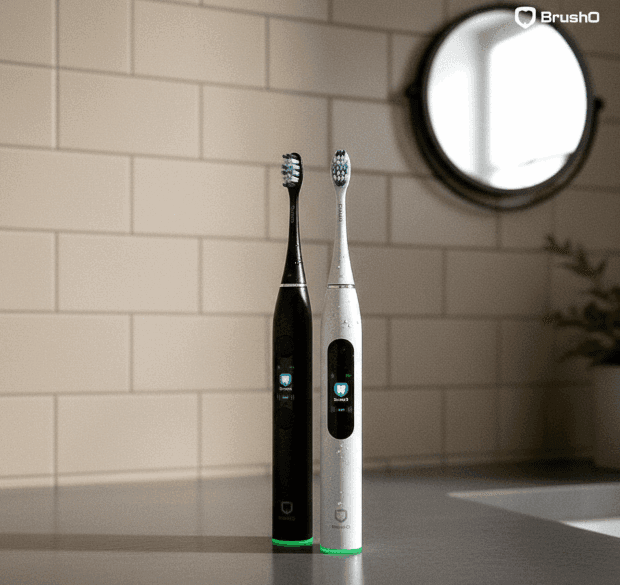
This is where BrushO makes a major difference. Night brushing is the most important brushing of the day. BrushO uses AI to ensure that your mouth enters the night with the lowest possible bacterial load.
• 6‑Zone × 16‑Surface tracking to remove plaque from every area
• Pressure sensors to protect weakened enamel
• Gum‑safe modes to prevent irritation
• App reports to reveal missed zones
• Habit reminders so nighttime brushing is never skipped
Reducing plaque before bed dramatically lowers overnight acid production.
1. Use BrushO before sleep for full‑mouth coverage
2. Floss to remove trapped bacteria
3. Use alcohol‑free fluoride rinse
4. Hydrate well before bed
5. Use a humidifier if you mouth‑breathe
6. Avoid sugar and acidic snacks at night
This creates a protective oral environment that lasts while you sleep.
Untreated dry mouth causes:
• Chronic gum disease
• Tooth loss
• Root decay
• Painful infections
• Expensive dental treatments
The earlier you manage it, the more enamel and gum tissue you save.
Nighttime dry mouth is not just discomfort — it is a serious risk factor for cavities, gum disease, and bad breath. Water alone cannot replace saliva’s protective power. The real solution is bacterial control, enamel protection, and smart brushing before bed. With BrushO’s AI‑powered guidance, you reduce the damage that dry mouth causes every night and protect your smile long‑term.
Feb 4
Jan 30

Saliva has moved from the byproduct of the examination to the fluid that the modern practice can read, and the diagnostics that the salivary sample supports now reach from the caries risk to the periodontal inflammation and beyond. The fluid is easy to collect, safe to handle, and rich in the pro...

The narrow alveolar ridge is the common obstacle that the implant plan meets in the healed posterior site, and the ridge split technique is the approach that widens the crest without the block graft and the second surgical site. The technique uses the viscoelastic property of the bone, and the co...

The resin-bonded bridge is the conservative alternative to the conventional fixed prosthesis, and its place in the modern practice has widened as the adhesive dentistry matured. The prosthesis replaces the missing tooth with the minimal removal of the enamel from the abutment, and the retention i...

The systemic antibiotic has a defined and a narrow place in the periodontal therapy, and the clinician who respects its limits uses it well while the clinician who reaches for it routinely erodes both the result and the antibiotic stewardship. The mechanical debridement remains the foundation of ...

The bond failure of the bracket is the interruption that the fixed orthodontic treatment can tolerate in the small number but not in the pattern, and the clinician who understands the cause reduces the frequency that the repeated rebonding records. The failure that recurs on the single tooth poin...

The prescription pad is one of the most common sources of the oral complaint that the patient brings to the dental office, and the clinician who does not think of the medication may spend the appointment treating the symptom that the drug created. The list of the agents that affect the mouth grow...

The intraoral scanner has moved from the novelty of the early adopters to the standard equipment of the modern prosthodontic practice, and the comparison with the conventional impression has become a daily question rather than an academic one. The scanner captures the surface of the teeth and the...

The endodontic retreatment is the second chance that the tooth receives when the initial treatment fails to resolve the infection or the symptoms, and the procedure is both more demanding and more rewarding than the primary treatment. The clinician who retreats the tooth encounters the filling ma...

The access preparation is the gateway of every root canal treatment, and it is the step at which the outcome of the case is most often decided, for good or for ill. A well-designed access straightens the canal system, removes the coronal obstruction, and allows the instruments and the irrigants t...

The restoration that the laboratory returns is only as good as the information that the clinician sends, and the communication between the dentist and the technician is the step that determines whether the crown, the veneer, or the bridge meets the expectation of the patient. The shade, the form,...

Construa uma rede de dados de saúde bucal rapidamente e com baixo custo de forma que todos possam construir.
Construa uma rede de dados de saúde bucal rapidamente e com baixo custo de forma que todos possam construir.


Address: RM 1427, 14/F RADIO CITY 505, HENNESSY RD CAUSEWAY BAY, HONG KONG
Code: 000000
Phone: +852-53758652
Email: customerservice@brusho.com