
From whitening strips to ultrasonic toothbrushes, today’s oral care products seem more advanced than ever. Yet millions still suffer from gum disease, plaque buildup, and cavities—why? The truth is that many modern tools focus on cosmetic results, not total oral health. In this article, we explore how tools alone fall short, the hidden dangers of poor technique and irregular habits, and how AI-powered toothbrushes like BrushO help users turn routines into results.
Just because teeth look clean doesn’t mean they’re truly healthy. Many modern tools focus on aesthetic benefits, not biological wellness.
• Whitening gels and toothpaste help remove surface stains—but do little for gum health or deep plaque.
• Electric toothbrushes may spin fast, but can’t correct poor brushing technique.
• Mouthwashes freshen breath temporarily but don’t replace brushing and flossing.
Most people equate a fresh mouth or white smile with good hygiene—but true oral health goes deeper.
Despite high-tech tools, many still face common brushing mistakes:
People tend to neglect molars, inner gum lines, and the backs of teeth. These become hotspots for tartar and decay.
Brushing too hard damages enamel and gums. Brushing too softly leaves plaque behind.
Skipping brushing sessions or brushing for under 2 minutes, weakens oral defenses.
People forget essential steps like flossing, tongue cleaning, and post-snack brushing—all critical for oral balance.
These gaps add up, and no fancy product can cover for poor daily execution.
Great tools help—but only if used correctly. Consistency, attention to technique, and full-mouth care are what really prevent disease.
• Technique > Speed: Two mindful minutes beat three rushed ones.
• Personalization Matters: Sensitive teeth? Deep-clean zones? Your routine should reflect those.
• Daily Consistency Wins: Regular care outperforms occasional whitening or rinses every time.
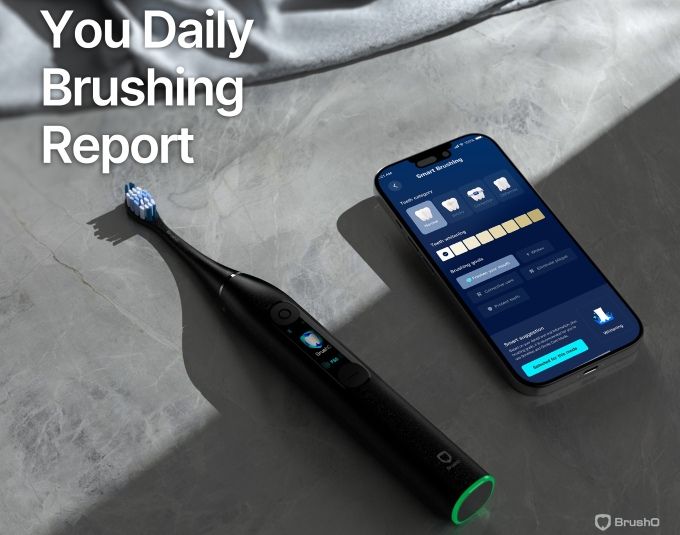
BrushO isn’t just another electric toothbrush—it’s a real-time AI-guided brushing system. It’s designed to optimize brushing behavior, not just speed it up.
• 6-Zone Coverage Tracking: Ensures you brush all surfaces, every time.
• Smart Pressure Sensors: Prevent over-brushing and gum recession.
• Customized Brushing Modes: Sensitive, whitening, and deep-clean options that fit your mouth’s needs.
• Real-Time Feedback: Know if you’re missing areas or brushing incorrectly—on the spot.
• Progress Tracking & Rewards: Stay motivated with habit streaks and $BRUSH token incentives.
🦷 With BrushO, brushing becomes intentional, measurable, and health-focused—not just cosmetic.
BrushO is an AI-powered smart toothbrush that transforms brushing into a personalized wellness routine. It provides zone-by-zone feedback, monitors pressure and timing, and rewards users with $BRUSH tokens for consistency. Designed for real health—not just cosmetic upgrades—BrushO helps every user brush better, smarter, and more effectively.
Jan 19
Jan 19

Squamous cell carcinoma is not a single, uniform disease, and two of its oral variants illustrate the extremes of its behavior. Verrucous carcinoma is a slow-growing, exophytic tumor that almost never metastasizes, while spindle cell carcinoma is an aggressive, sarcomatoid malignancy that can be ...

Most people expect a toothache to be the first sign of pulp disease, but some forms of pulpitis are surprisingly silent. A pulp polyp is the visible result of chronic hyperplastic pulpitis, a condition in which the dental pulp grows out of a large carious opening as a fleshy mass. Recognizing thi...

Dry mouth is not merely uncomfortable; it is a medical condition with real consequences for teeth, speech, swallowing and quality of life. When the salivary glands cannot produce enough saliva, medications called sialogogues can restore some of the missing fluid. Pilocarpine and cevimeline are th...

A blister in the mouth can be the first warning of a systemic autoimmune disease, and two disorders deserve particular attention in the dental chair: pemphigus vulgaris and mucous membrane pemphigoid. Both produce chronic oral ulceration, yet their immunologic targets, clinical behavior and long-...

When infection drains from a tooth, the body often creates a visible escape route, and the dentist must interpret these fistulous openings correctly. A parulis is the common gum boil that signals chronic periapical infection, while an oroantral fistula is a communication between the mouth and the...

Among the fibro-osseous lesions of the jaws, the ossifying fibroma holds a unique position because it is a true neoplasm, unlike the reactive cemento-osseous dysplasia discussed in an earlier article. It grows continuously, expands bone and requires surgical removal, and its cemental variant adds...

Not all keratocystic lesions of the jaw behave alike, and one of the most important distinctions in oral pathology separates the orthokeratinized odontogenic cyst from its better-known relative, the odontogenic keratocyst. Although the two lesions look similar under the microscope at first glance...

Periodontal disease is usually a slowly progressive infection, but a rare form called necrotizing ulcerative periodontitis destroys tissue with alarming speed. Unlike ordinary periodontitis, this condition produces necrotic, cratered papillae, deep pocketing and rapid bone loss, and it appears al...

Every parent has met the child who refuses to eat because of painful mouth sores, and most of these children have one of two viral illnesses: herpangina or hand, foot and mouth disease. Both are caused by enteroviruses, both produce fever and oral ulcers, and both are overwhelmingly common in you...

Cementoosseous dysplasia is one of the most common fibro-osseous lesions found on dental radiographs, yet it is also one of the most frequently misdiagnosed. The lesion replaces normal bone with cellular fibrous tissue and cementum-like material, and it appears in several forms that range from a ...

Construa uma rede de dados de saúde bucal rapidamente e com baixo custo de forma que todos possam construir.
Construa uma rede de dados de saúde bucal rapidamente e com baixo custo de forma que todos possam construir.


Address: RM 1427, 14/F RADIO CITY 505, HENNESSY RD CAUSEWAY BAY, HONG KONG
Code: 000000
Phone: +852-53758652
Email: customerservice@brusho.com