
With the BrushO AI-Powered Mining Toothbrush, you can improve your oral health while effortlessly earning rewards — this is the power of BrushO’s Brush and Earn mechanism. But how can you maximize your Brush and Earn rewards? Let’s break it down for you.
As the name suggests, “Brush” is at the core of this mechanism — your brushing habits directly determine how many tokens you can earn. During the 90-day validity period of the brush head, your rewards are influenced by:
Your brushing score reflects how well you brush your teeth — helping you maintain optimal oral health while contributing high-quality data to the ecosystem. It is assessed based on three key factors:
Yes! However, missing a brushing session or failing to sync your data for an extended period will reduce your rewards.
Syncing your data is simple — after pairing your toothbrush with the BrushO app, just bring your toothbrush close to your phone to upload the data.
Your BrushO AI-Powered Mining Toothbrush can store up to 14 days of brushing data. As long as you sync within this period, you’ll still receive your Brush and Earn rewards, but the sooner you upload, the sooner you get your rewards!
Absolutely! You can further increase your earnings by actively participating in the BrushO ecosystem.
(1) Staking Tokens for Higher Rewards
Staking $BRUSH is a way to show your commitment to the BrushO ecosystem — and earn more rewards in return.
For details on staking multipliers and staking reward formulas, please refer to the BrushO Whitepaper:
(2) Becoming an Early Adopter
Join BrushO now and become an early adopter!
The total daily reward pool is fixed, meaning the fewer participants there are, the larger your individual share of rewards will be. Early adopters benefit the most!
Yes! BrushO ensures that rewards are distributed fairly by calculating earnings based on multiple factors — including all the elements mentioned above.
For the exact Brush and Earn reward formula, please refer to the BrushO Whitepaper:
4.4.2 User Brushing Rewards | BrushO Network Docs
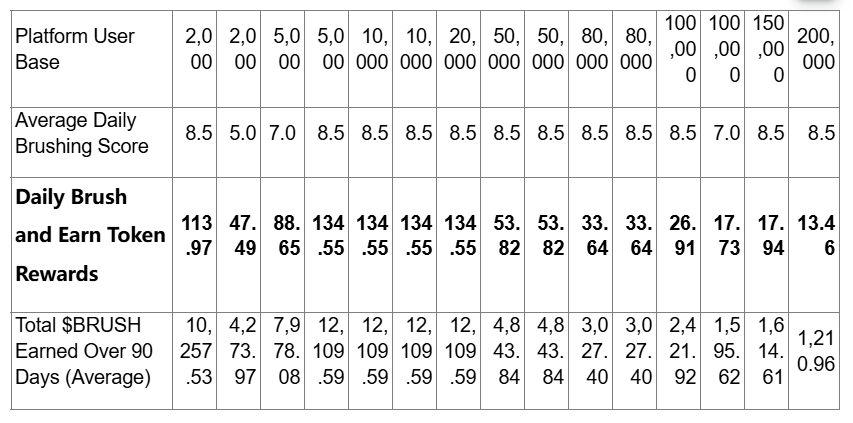
Below is a Brush and Earn reward estimation table. You can use it to predict your potential daily earnings. As shown in the table, joining early gives you the highest rewards. And if the token price rises, your earnings will continue to grow!
BrushO(https://brusho.io/) is a decentralized global oral health data platform, consisting of the BrushO AI-Powered Mining Toothbrush and the BrushO Network. BrushO empowers users to significantly improve their oral care routine while simultaneously establishing their own Web3 oral health identity. Users accumulate personal oral health data assets, contributing to a global oral health data network. This network provides a valuable data gateway for the entire oral health industry, benefiting both individuals and businesses across the sector.Through user authorization, BrushO transforms the oral health industry by restructuring production relationships while safeguarding user privacy, driving industry upgrades, and raising global oral health standards.
BrushO Website:https://brusho.io/
BrushO Telegram:https://t.me/BrushOcommunity
Feb 14
Feb 18

Squamous cell carcinoma is not a single, uniform disease, and two of its oral variants illustrate the extremes of its behavior. Verrucous carcinoma is a slow-growing, exophytic tumor that almost never metastasizes, while spindle cell carcinoma is an aggressive, sarcomatoid malignancy that can be ...

Most people expect a toothache to be the first sign of pulp disease, but some forms of pulpitis are surprisingly silent. A pulp polyp is the visible result of chronic hyperplastic pulpitis, a condition in which the dental pulp grows out of a large carious opening as a fleshy mass. Recognizing thi...

Dry mouth is not merely uncomfortable; it is a medical condition with real consequences for teeth, speech, swallowing and quality of life. When the salivary glands cannot produce enough saliva, medications called sialogogues can restore some of the missing fluid. Pilocarpine and cevimeline are th...

A blister in the mouth can be the first warning of a systemic autoimmune disease, and two disorders deserve particular attention in the dental chair: pemphigus vulgaris and mucous membrane pemphigoid. Both produce chronic oral ulceration, yet their immunologic targets, clinical behavior and long-...

When infection drains from a tooth, the body often creates a visible escape route, and the dentist must interpret these fistulous openings correctly. A parulis is the common gum boil that signals chronic periapical infection, while an oroantral fistula is a communication between the mouth and the...

Among the fibro-osseous lesions of the jaws, the ossifying fibroma holds a unique position because it is a true neoplasm, unlike the reactive cemento-osseous dysplasia discussed in an earlier article. It grows continuously, expands bone and requires surgical removal, and its cemental variant adds...

Not all keratocystic lesions of the jaw behave alike, and one of the most important distinctions in oral pathology separates the orthokeratinized odontogenic cyst from its better-known relative, the odontogenic keratocyst. Although the two lesions look similar under the microscope at first glance...

Periodontal disease is usually a slowly progressive infection, but a rare form called necrotizing ulcerative periodontitis destroys tissue with alarming speed. Unlike ordinary periodontitis, this condition produces necrotic, cratered papillae, deep pocketing and rapid bone loss, and it appears al...

Every parent has met the child who refuses to eat because of painful mouth sores, and most of these children have one of two viral illnesses: herpangina or hand, foot and mouth disease. Both are caused by enteroviruses, both produce fever and oral ulcers, and both are overwhelmingly common in you...

Cementoosseous dysplasia is one of the most common fibro-osseous lesions found on dental radiographs, yet it is also one of the most frequently misdiagnosed. The lesion replaces normal bone with cellular fibrous tissue and cementum-like material, and it appears in several forms that range from a ...

Быстро и недорого построить сеть данных о здоровье зубов, способную создавать каждый.


Address: RM 1427, 14/F RADIO CITY 505, HENNESSY RD CAUSEWAY BAY, HONG KONG
Code: 000000
Phone: +852-53758652
Email: customerservice@brusho.com