
Building a consistent dental routine isn’t just about remembering to brush twice a day—it’s about creating habits rooted in science, personalization, and long-term motivation. Many people start strong and quickly fall off track due to a lack of feedback, poor technique, or a routine that feels tedious. But with the right structure, tools, and mindset, your dental care can become second nature. This guide will walk you through how to build a dental routine that sticks—for good.
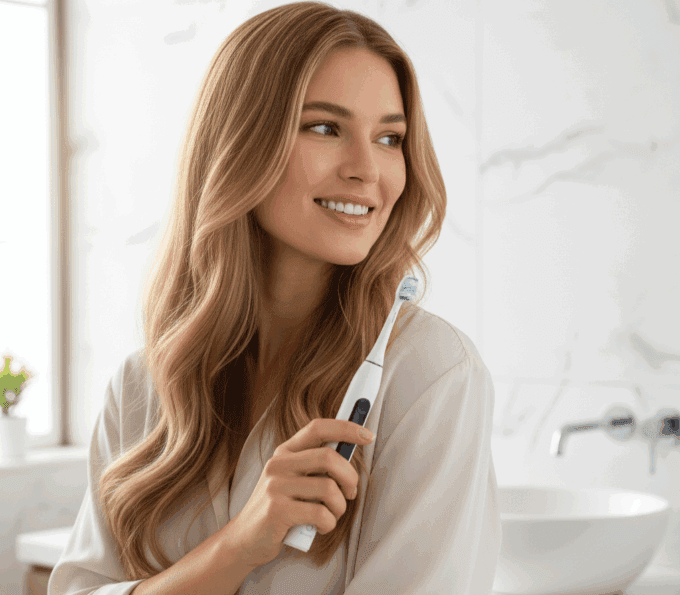
Let’s face it—most people don’t struggle with knowing what to do (brush, floss, rinse), but rather with doing it consistently. The biggest reasons dental routines fail include:
• Lack of Immediate Results: Unlike skincare or fitness, dental results take time.
• Repetitiveness: Brushing can feel like a chore when it’s not engaging.
• No Feedback Loop: Most routines lack feedback, leaving you unsure if you’re improving or regressing.
• Lifestyle Interruptions: Travel, fatigue, stress, or illness easily break routines.
These barriers can be overcome with a combination of habit science and smart technology.
Do you want whiter teeth? Healthier gums? Less sensitivity? Tailor your routine toward a goal—it increases motivation.
Everyone’s oral health status is different. Factors like gum recession, crowding, enamel thickness, or past dental treatments affect the kind of routine you need. Consult your dentist and understand your risk factors.
• Twice daily for 2 minutes using fluoride toothpaste.
• Divide the mouth into 6 zones: upper/lower, outer/inner/chewing surfaces.
• Don’t forget the tongue—it harbors bacteria.
• Floss once a day to remove plaque between teeth.
• Use floss picks or water flossers if string floss is challenging.
• Use an alcohol-free mouthwash tailored to your needs (antibacterial, whitening, sensitivity).
Attach brushing to an existing routine (e.g., right after coffee or shower). This creates a mental trigger.
Brush at the same time each morning and evening. Our brains form habits faster with predictable cues.
Habit-tracking apps or smart toothbrush dashboards (like BrushO) give visual feedback and reinforce progress.
It takes 21 days to build a habit and 90 days to make it a lifestyle. Stick with it even when motivation dips.
AI-powered brushes like BrushO dramatically improve adherence and technique through:
• Real-time feedback on pressure, duration, and coverage.
• 6-zone and 16-surface analysis to ensure complete cleaning.
• Gamified brushing reports to track improvement.
• Rewards for consistency through the BrushO points system.
This kind of smart integration keeps brushing engaging, measurable, and rewarding.
A successful dental routine evolves with your needs:
• Braces or aligners? You’ll need extra cleaning tools like interdental brushes.
• Gum issues? Switch to a soft-bristled brush and anti-inflammatory mouthwash.
• Pregnancy or aging? These life stages require more frequent dental visits.
BrushO adapts to these changes by offering personalized brushing plans and real-time alerts to adjust your technique.
• Set reminders or alarms until brushing becomes automatic.
• Involve family or partners—especially useful for kids and the elderly.
• Schedule bi-annual checkups and cleanings with your dentist.
A dental routine that lasts isn’t about willpower—it’s about structure, personalization, and feedback. By combining science-backed habits with smart technology like BrushO, you can transform your daily oral care into a sustainable, effective, and even enjoyable experience. Start small, stay consistent, and let your smile show the results. BrushO is a cutting-edge AI-powered toothbrush designed to deliver fully smart brushing through real-time feedback, pressure sensors, and brushing analytics. With customizable modes and a rewards system, BrushO ensures every brushing session supports long-term oral health.

Water that leaves a dental unit is not sterile, and it has not been sterile for decades. The narrow tubing that carries coolant to the handpiece and the air-water syringe provides an ideal surface for a biofilm that sheds organisms into every patient's mouth. Sterilisation of the instruments does...

A young adult presents with soreness of the gums, and the examination shows a striking change that is easily mistaken for severe periodontal disease: the mucosa is thickened, folded and studded with tiny yellow pustules that rupture to leave shallow ulcers resembling snail tracks. This is pyostom...

A patient who becomes cyanosed minutes after an apparently routine infiltration, yet keeps talking and breathing comfortably, presents a diagnostic trap. The saturation monitor reads in the eighties, supplemental oxygen changes nothing, and the chest sounds clear. This is the classic signature of...

Most patients with clicking, locking and jaw pain improve with reassurance, soft diet, splint therapy and physical measures. A minority do not, and their imaging shows a displaced disc with degenerative change, a shortened condyle or a persistent closed lock. For that group, two operations compet...

A slowly growing palatal swelling that the patient has noticed for two years, a minor salivary gland tumor that looks deceptively well demarcated, and a nerve that carries tumor cells far beyond the visible mass: this is the natural history of adenoid cystic carcinoma. It is uncommon, it is rarel...

Saliva is easy to overlook until its volume changes. An excess produces drooling that soils clothing and isolates a patient socially, while a painless enlargement of both parotid glands raises the question of systemic disease. Sialorrhea and sialadenosis sit at opposite ends of the same physiolog...

When caries in a primary molar reaches the pulp but the tooth can still be restored and the supporting bone is intact, pulpectomy offers a way to keep the tooth comfortable and functional until exfoliation. The procedure removes both the coronal and the radicular pulp and replaces it with a resor...

Disorders of the fibroblast growth factor receptor genes produce some of the most distinctive facial appearances in medicine, and the two extremes are instructive. Pfeiffer syndrome allows survival with staged craniofacial surgery, while thanatophoric dysplasia is almost always lethal in the neon...

A panoramic radiograph that shows a uniformly dense mandible or maxilla can indicate an entirely benign finding, such as a dense bone island or a torus, or it can be the first clue to a generalized skeletal disorder. Osteopetrosis and the broader group of osteosclerotic conditions differ greatly ...

A patient who cannot open the mouth more than a finger breadth, yet whose temporomandibular joint still moves on imaging, presents one of the most easily misdiagnosed problems in oral surgery. The restriction in such cases lies outside the joint, and the condition is termed pseudoankylosis. An el...

Быстро и недорого построить сеть данных о здоровье зубов, способную создавать каждый.


Address: RM 1427, 14/F RADIO CITY 505, HENNESSY RD CAUSEWAY BAY, HONG KONG
Code: 000000
Phone: +852-53758652
Email: customerservice@brusho.com