The Difference Between Smart Toothbrushes and Regular Ones
Jan 20

Jan 20
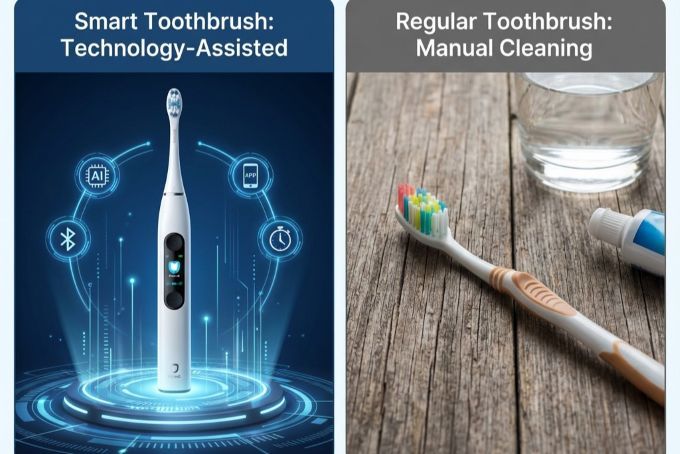
At first glance, smart toothbrushes and regular toothbrushes may seem to serve the same purpose: cleaning your teeth. However, the way they approach oral care is fundamentally different. Traditional toothbrushes depend entirely on user technique, consistency, and awareness, while smart toothbrushes actively guide, monitor, and improve brushing behavior through technology. Understanding the difference between smart toothbrushes and regular ones is essential for anyone looking to improve long-term oral health. This article explores how these two types of toothbrushes differ in design, functionality, effectiveness, and habit formation—helping you decide which approach best supports healthier brushing.
 

The Difference Between Smart Toothbrushes and Regular Ones

1. Brushing Guidance: Manual Technique vs Intelligent Assistance

The most fundamental difference between smart toothbrushes and regular ones lies in brushing guidance. A regular toothbrush—whether manual or basic electric—relies entirely on the user’s knowledge and discipline. Proper brushing time, angle, pressure, and coverage are all left to personal judgment.
In contrast, a smart toothbrush actively assists the user. Equipped with motion sensors, pressure sensors, and AI algorithms, a smart toothbrush provides real-time brushing feedback. This guidance helps users maintain correct pressure, brush for the recommended duration, and cover all areas of the mouth more evenly.

2. Pressure Control and Gum Protection

Excessive brushing pressure is a common cause of gum recession and enamel wear. Regular toothbrushes offer no objective way to detect overbrushing, making it easy for users to unknowingly damage their gums over time.
A smart toothbrush addresses this issue through built-in pressure sensors. When excessive force is detected, the toothbrush can alert the user through visual, tactile, or speed-adjustment feedback. This pressure-aware design significantly improves gum protection and supports healthier brushing habits across different age groups.

3. Coverage Awareness and Cleaning Accuracy

With a regular toothbrush, users often assume their teeth are clean once brushing time is complete. However, research shows that missed areas—especially molars and gum lines—are common.
Smart toothbrushes track brushing movement and orientation to analyze coverage across different sections of the mouth. By visualizing cleaned and missed areas through an app or display, smart toothbrushes help users improve cleaning accuracy over time. This data-driven approach leads to more consistent and effective plaque removal compared to regular brushing methods.

4. Habit Formation and Behavioral Feedback

Regular toothbrushes offer no feedback beyond the physical sensation of brushing. As a result, users receive no insight into whether their brushing technique improves or declines over time.
Smart toothbrushes, on the other hand, focus heavily on habit formation. By providing brushing scores, progress reports, and personalized recommendations, a smart toothbrush transforms brushing into a measurable and improvable routine. This behavioral feedback plays a key role in encouraging consistency, especially for children and users struggling with long-term oral care habits.

5. Personalization and User Adaptability

Another major difference between smart toothbrushes and regular ones is personalization. Traditional toothbrushes apply the same brushing experience to everyone, regardless of age, gum sensitivity, or oral health condition.
Smart toothbrushes allow users to adjust brushing modes, intensity levels, and duration. Advanced AI smart toothbrushes can even adapt recommendations based on individual brushing behavior. This adaptability makes smart toothbrushes suitable for a wide range of users, from children to adults with sensitive gums.

6. Data, Technology, and Long-Term Oral Health Insights

Regular toothbrushes provide no data. Once brushing ends, there is no record of performance, improvement, or decline.
Smart toothbrushes generate brushing data that can be analyzed over time to identify patterns and areas for improvement. When handled responsibly with encryption and privacy protection, this data enables users to make informed decisions about their oral care routines. Over the long term, these insights can support better preventive care and healthier outcomes.

7. Convenience and Everyday Usability

While regular toothbrushes are simple and require no setup, they also offer limited functionality. Smart toothbrushes integrate modern conveniences such as rechargeable batteries, wireless charging, waterproof designs, and clear visual indicators.
Despite their advanced technology, modern smart toothbrushes are designed for everyday ease of use. Once set up, they seamlessly integrate into daily routines while offering a significantly more informed brushing experience than regular toothbrushes.

Final Thoughts: Which Toothbrush Makes a Real Difference?

The difference between smart toothbrushes and regular ones goes far beyond technology. It reflects a shift from passive cleaning to active oral care guidance. Regular toothbrushes depend entirely on user effort, while smart toothbrushes support users through feedback, personalization, and data-driven insights.
For individuals and families seeking to improve brushing habits, protect gums, and maintain better long-term oral health, smart toothbrushes represent a more comprehensive and future-oriented approach to daily oral care.

Последние записи

Dental Unit Waterline Biofilm: Autoclave Failures and Prion Concerns

Dental Unit Waterline Biofilm: Autoclave Failures and Prion Concerns

Water that leaves a dental unit is not sterile, and it has not been sterile for decades. The narrow tubing that carries coolant to the handpiece and the air-water syringe provides an ideal surface for a biofilm that sheds organisms into every patient's mouth. Sterilisation of the instruments does...

Pyostomatitis Vegetans: Diagnosing a Rare Mucosal Manifestation of Bowel Disease

Pyostomatitis Vegetans: Diagnosing a Rare Mucosal Manifestation of Bowel Disease

A young adult presents with soreness of the gums, and the examination shows a striking change that is easily mistaken for severe periodontal disease: the mucosa is thickened, folded and studded with tiny yellow pustules that rupture to leave shallow ulcers resembling snail tracks. This is pyostom...

Prilocaine-Induced Methemoglobinemia: Emergency Recognition in Dentistry

Prilocaine-Induced Methemoglobinemia: Emergency Recognition in Dentistry

A patient who becomes cyanosed minutes after an apparently routine infiltration, yet keeps talking and breathing comfortably, presents a diagnostic trap. The saturation monitor reads in the eighties, supplemental oxygen changes nothing, and the chest sounds clear. This is the classic signature of...

Eminoplasty and Condylotomy for Refractory Temporomandibular Internal Derangement

Eminoplasty and Condylotomy for Refractory Temporomandibular Internal Derangement

Most patients with clicking, locking and jaw pain improve with reassurance, soft diet, splint therapy and physical measures. A minority do not, and their imaging shows a displaced disc with degenerative change, a shortened condyle or a persistent closed lock. For that group, two operations compet...

Adenoid Cystic Carcinoma of Salivary Glands: Perineural Spread Patterns

Adenoid Cystic Carcinoma of Salivary Glands: Perineural Spread Patterns

A slowly growing palatal swelling that the patient has noticed for two years, a minor salivary gland tumor that looks deceptively well demarcated, and a nerve that carries tumor cells far beyond the visible mass: this is the natural history of adenoid cystic carcinoma. It is uncommon, it is rarel...

Sialorrhea and Sialadenosis: Salivary Flow Disorders

Sialorrhea and Sialadenosis: Salivary Flow Disorders

Saliva is easy to overlook until its volume changes. An excess produces drooling that soils clothing and isolates a patient socially, while a painless enlargement of both parotid glands raises the question of systemic disease. Sialorrhea and sialadenosis sit at opposite ends of the same physiolog...

Pulpectomy in Primary Molars: Technique and Outcomes

Pulpectomy in Primary Molars: Technique and Outcomes

When caries in a primary molar reaches the pulp but the tooth can still be restored and the supporting bone is intact, pulpectomy offers a way to keep the tooth comfortable and functional until exfoliation. The procedure removes both the coronal and the radicular pulp and replaces it with a resor...

Pfeiffer and Thanatophoric Dysplasia: Craniofacial Features

Pfeiffer and Thanatophoric Dysplasia: Craniofacial Features

Disorders of the fibroblast growth factor receptor genes produce some of the most distinctive facial appearances in medicine, and the two extremes are instructive. Pfeiffer syndrome allows survival with staged craniofacial surgery, while thanatophoric dysplasia is almost always lethal in the neon...

Osteopetrosis and Osteosclerosis: Radiographic Jaw Findings

Osteopetrosis and Osteosclerosis: Radiographic Jaw Findings

A panoramic radiograph that shows a uniformly dense mandible or maxilla can indicate an entirely benign finding, such as a dense bone island or a torus, or it can be the first clue to a generalized skeletal disorder. Osteopetrosis and the broader group of osteosclerotic conditions differ greatly ...

Coronoidectomy and Pseudoankylosis: Restricted Jaw Opening

Coronoidectomy and Pseudoankylosis: Restricted Jaw Opening

A patient who cannot open the mouth more than a finger breadth, yet whose temporomandibular joint still moves on imaging, presents one of the most easily misdiagnosed problems in oral surgery. The restriction in such cases lies outside the joint, and the condition is termed pseudoankylosis. An el...
