
Delaying a dental visit isn’t automatically harmful—but the safety margin depends on your risk profile, your daily plaque control, and whether silent problems are already developing. Cavities between teeth, early gum disease, enamel erosion, and bite-related wear often progress with little to no pain, which is exactly why routine checkups matter. A short delay may be reasonable if your gums are healthy, you have low cavity risk, and your home care is consistent and thorough. However, repeated postponement raises the odds that plaque turns into tartar, gum inflammation deepens below the gumline, and small areas of decay become larger (and more expensive) to treat. This guide explains what dental visits actually prevent, how long you can realistically stretch intervals, the warning signs that mean “do not delay,” and how data-driven brushing tools like BrushO can help you maintain a dentist-level standard of consistency between appointments.
A dental visit is not just a polish. It’s a screening and measurement checkpoint that home care can’t replicate. Dentists and hygienists can detect issues that are invisible or symptom-free early on, including:
• Interproximal cavities (between teeth) that you won’t see in the mirror
• Early gum disease developing under the gumline
• Enamel erosion from acids or reflux
• Bite and wear changes from clenching, grinding, or misalignment
• Tartar (calculus) deposits that brushing cannot remove once hardened
If you delay too long, these problems don’t pause—they simply become harder to treat.
A short delay may be relatively low risk (not “risk-free”) if most of these are true:
• You rarely get cavities and have no recent dental work
• Your gums don’t bleed when brushing or flossing
• You floss (or clean between teeth) consistently
• You don’t have frequent snacking/sugary drinks
• You don’t have chronic dry mouth, smoking/vaping habits, or untreated reflux
• You’re not currently experiencing sensitivity, pain, swelling, or persistent bad breath
In this situation, postponing a routine checkup by a few months is often less likely to cause sudden harm—but only if your daily plaque removal stays strong.
The main danger of delaying is that many dental problems are quiet at first.
Plaque left along the gumline can mineralize into tartar. Once tartar forms, it creates a rough surface that retains even more plaque and bacteria—raising the risk of gingivitis and, later, periodontal disease.
Decay often starts as microscopic demineralization. It may not hurt until it gets closer to the nerve, at which point treatment may shift from a simple filling to a deeper restoration.
Early gum inflammation can look mild, but the real issue may be under the gumline. Periodontal problems can advance with minimal discomfort until they become harder to reverse.
Grinding and clenching can flatten biting surfaces, trigger sensitivity, and stress restorations. Without checkups, wear patterns can go unnoticed until they cause pain or fractures.
Pain is a late signal in dentistry. Many conditions are painless until they’re advanced:
• early cavities
• early gum disease
• enamel erosion
• bite stress and wear
If you rely on pain as your indicator, you’re essentially waiting for the problem to become more complicated.
There isn’t one perfect schedule for everyone, but the core rule is simple: The higher your risk, the shorter your safe interval.
You’re more likely to need tighter intervals if you have:
• a history of cavities
• bleeding gums or past gum treatment
• orthodontic retainers/aligners
• dry mouth (mouth breathing, medications, dehydration)
• smoking or vaping habits
• reflux, frequent acidic drinks, or frequent snacking
• pregnancy or hormonal shifts that affect gums
• diabetes or immune-related conditions
If any of these apply, delaying routine visits tends to carry a bigger downside.
Do not “wait it out” if you notice any of the following:
• gums bleeding when brushing or flossing
• persistent bad breath that returns quickly
• sensitivity to cold, sweets, or brushing
• a dull ache or pressure that comes and goes
• swelling, a pimple-like bump, or bad taste near a tooth
• gum recession or teeth looking “longer”
• jaw pain, clicking, or frequent morning headaches
• rough deposits near the gumline that don’t brush off
These are often signs that something is already in motion.
If you want more flexibility between dental visits, your daily routine has to be consistently high quality, not just “twice a day.”
Focus on:
• gumline cleaning (where plaque triggers inflammation fastest)
• even coverage across back molars and inner surfaces
• gentle but effective pressure (too hard can worsen recession; too light leaves plaque)
• between-teeth cleaning (floss, interdental brushes, or water flosser)
The most common reason people get surprised at a checkup is predictable: they brush regularly—but miss the same zones every day.
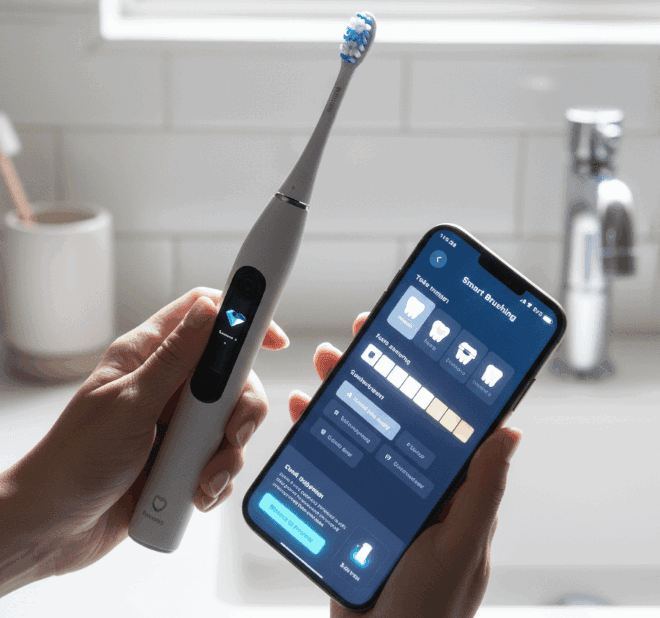
BrushO helps close the gap between “I brush daily” and “I brush effectively” by making the invisible parts measurable:
• coverage awareness so you don’t repeatedly miss the same spots
• pressure monitoring to protect gum tissue while still removing plaque
• habit reinforcement so consistency doesn’t collapse during busy weeks
• session feedback that turns brushing into a repeatable, high-standard routine
If you’re going to delay a visit, the best strategy is to make home care more precise, not merely more frequent.
You can sometimes delay a dental visit without immediate harm—but only if your cavity and gum risk are low and your daily plaque control is genuinely thorough. The bigger risk isn’t what you feel today; it’s what can progress quietly: tartar buildup, between-teeth decay, early gum disease, and enamel wear. If you’re postponing, treat your routine like prevention medicine—consistent, complete, and gumline-focused—with tools (like BrushO) that help you avoid the “same missed spots” pattern that leads to unpleasant surprises.
Feb 18
Feb 18

Water that leaves a dental unit is not sterile, and it has not been sterile for decades. The narrow tubing that carries coolant to the handpiece and the air-water syringe provides an ideal surface for a biofilm that sheds organisms into every patient's mouth. Sterilisation of the instruments does...

A young adult presents with soreness of the gums, and the examination shows a striking change that is easily mistaken for severe periodontal disease: the mucosa is thickened, folded and studded with tiny yellow pustules that rupture to leave shallow ulcers resembling snail tracks. This is pyostom...

A patient who becomes cyanosed minutes after an apparently routine infiltration, yet keeps talking and breathing comfortably, presents a diagnostic trap. The saturation monitor reads in the eighties, supplemental oxygen changes nothing, and the chest sounds clear. This is the classic signature of...

Most patients with clicking, locking and jaw pain improve with reassurance, soft diet, splint therapy and physical measures. A minority do not, and their imaging shows a displaced disc with degenerative change, a shortened condyle or a persistent closed lock. For that group, two operations compet...

A slowly growing palatal swelling that the patient has noticed for two years, a minor salivary gland tumor that looks deceptively well demarcated, and a nerve that carries tumor cells far beyond the visible mass: this is the natural history of adenoid cystic carcinoma. It is uncommon, it is rarel...

Saliva is easy to overlook until its volume changes. An excess produces drooling that soils clothing and isolates a patient socially, while a painless enlargement of both parotid glands raises the question of systemic disease. Sialorrhea and sialadenosis sit at opposite ends of the same physiolog...

When caries in a primary molar reaches the pulp but the tooth can still be restored and the supporting bone is intact, pulpectomy offers a way to keep the tooth comfortable and functional until exfoliation. The procedure removes both the coronal and the radicular pulp and replaces it with a resor...

Disorders of the fibroblast growth factor receptor genes produce some of the most distinctive facial appearances in medicine, and the two extremes are instructive. Pfeiffer syndrome allows survival with staged craniofacial surgery, while thanatophoric dysplasia is almost always lethal in the neon...

A panoramic radiograph that shows a uniformly dense mandible or maxilla can indicate an entirely benign finding, such as a dense bone island or a torus, or it can be the first clue to a generalized skeletal disorder. Osteopetrosis and the broader group of osteosclerotic conditions differ greatly ...

A patient who cannot open the mouth more than a finger breadth, yet whose temporomandibular joint still moves on imaging, presents one of the most easily misdiagnosed problems in oral surgery. The restriction in such cases lies outside the joint, and the condition is termed pseudoankylosis. An el...

สร้างเครือข่ายข้อมูลสุขภาพช่องปากอย่างรวดเร็วและต้นทุนต่ำในวิธีที่ทุกคนสามารถสร้างได้


Address: RM 1427, 14/F RADIO CITY 505, HENNESSY RD CAUSEWAY BAY, HONG KONG
Code: 000000
Phone: +852-53758652
Email: customerservice@brusho.com