
Most people don’t give much thought to where or how they store their toothbrush — but improper storage can lead to bacterial buildup, mold growth, and even decreased brush performance. In this article, we’ll explain the best ways to store your toothbrush to keep it clean, hygienic, and long-lasting. Plus, we’ll show how an AI-powered electric toothbrush like BrushO is designed to support proper storage and hygiene without extra effort.
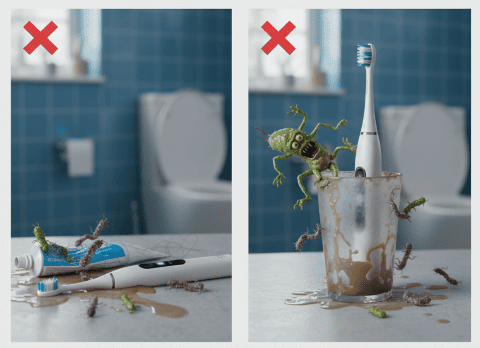
Most of us brush and rinse, then toss the brush back into a cup or bathroom counter without a second thought. But how you store your toothbrush can significantly affect your oral health. Toothbrushes can harbor harmful bacteria, especially when stored in moist, enclosed, or shared environments.
Poor storage habits can lead to:
Germ transmission
Mold or mildew growth
Premature wear of bristles
Contamination from nearby sinks or toilets
Here’s what dentists and experts recommend when it comes to daily storage:
Avoid keeping your toothbrush in drawers, sealed boxes, or dark cabinets. A toothbrush should be stored vertically in a well-ventilated holder to allow water to drip off and air to circulate. This prevents mold and bacterial growth.
Pro Tip: BrushO toothbrushes are designed with advanced water-resistant casing and quick-drying brush heads to support hygienic drying.
Toothbrushes should be stored at least 3 feet away from your toilet to prevent airborne particles (yes, the infamous “toilet plume”). Also, avoid placing it too close to the sink where dirty water might splash.
Make sure toothbrush heads don’t touch each other in multi-user households. Contact between bristles can transfer bacteria.
If you’re using BrushO’s replaceable brush head system, each family member can have their own personalized head, helping prevent cross-contamination.
A closed or airtight case may seem hygienic, but it actually traps moisture, encouraging bacteria. Choose open or vented holders.
Tip for Travelers: While BrushO doesn’t currently offer a travel case, you can use a breathable toothbrush sleeve or silicone cap with air vents.
Toothbrush holders often accumulate grime, toothpaste residue, and water stains. Clean it weekly with soap and hot water to prevent bacterial buildup.
Electric toothbrushes like BrushO often come with charging docks. Here’s how to store them safely:
Avoid laying the brush flat, which can trap water around the base. BrushO supports wireless QI charging, so storing it upright ensures efficient drying and charging.
Every few days, detach the head to let the internal grooves dry. BrushO’s snap-on design makes this effortless.
Wipe the base weekly with a dry cloth. If there’s buildup, use a slightly damp cloth but avoid soaking.
Proper storage prolongs life, but you still need to replace your brush head every 3 months, or sooner if the bristles are frayed. Dirty storage = faster wear.
✅ With BrushO’s lifetime free brush head program, users can redeem a new brush head regularly by brushing daily and earning points. It’s a smart incentive to keep both your brush and habits clean.
Taking a few extra seconds to store your toothbrush properly can protect your mouth from harmful bacteria and make your electric toothbrush last longer. With the help of innovative smart toothbrushes like BrushO, proper storage and hygiene are built into the product design.
By brushing smarter — and storing smarter — you’re one step closer to better oral health.

The xerostomia is the symptom that the patient describes as the dry mouth, and the Sjogren syndrome is the systemic autoimmune condition that the clinician identifies as one of the causes that the symptom reveals. The dry mouth that the patient reports may follow the medication, the radiation, th...

The sinus lift is the augmentation procedure that the clinician performs to create the bone height that the posterior maxilla requires for the implant, and the choice between the lateral window and the transcrestal approach determines the surgical trauma, the healing, and the implant that the sit...

Post-extraction bleeding is one of the most common and most distressing experiences after a tooth extraction. For most patients, a small amount of oozing from the extraction site for 24 to 48 hours after the procedure is completely normal. However, when bleeding becomes excessive, prolonged, or d...

The skeletal class III malocclusion is the condition that the clinician treats with the orthognathic surgery or the camouflage orthodontic treatment, and the decision between the two paths determines the function, the aesthetics, and the stability that the patient receives. The orthognathic surge...

Interproximal enamel reduction — commonly referred to as IPR, slenderizing, stripping, or contouring — is the controlled removal of small amounts of enamel from the proximal surfaces of teeth. Despite sounding more invasive than it is, IPR is one of the most widely used and clinically safe proced...

The gingival graft is the surgical procedure that the periodontist performs to restore the keratinized tissue and to cover the exposed root, and the choice between the free gingival graft and the connective tissue graft determines the outcome that the patient receives. The free gingival graft har...

Denture adhesives — commonly known as fixatives or denture creams — are among the most widely used adjuncts in prosthodontic care. Millions of complete and partial denture wearers use some form of adhesive daily, often without a clear understanding of what these products do, when they should be u...

When a young patient presents with an immature tooth that has lost its vitality — typically due to trauma or deep caries — the endodontist faces one of the most consequential decisions in paediatric endodontics. The permanent root has not finished forming, the apex remains open, and the tooth is ...

The ankyloglossia is the condition that the lingual frenulum restricts the movement of the tongue, and the release of the frenulum in the infant is the procedure that the clinician performs to restore the function that the feeding and the speech require. The assessment that the clinician performs...

Dental amalgam fillings have been in clinical use since the mid-19th century, making them one of the most historically established restorative materials. In 2026, the conversation around amalgam replacement has shifted from a simple material preference debate to a nuanced clinical assessment of w...

Xây dựng mạng dữ liệu sức khỏe răng miệng nhanh chóng và chi phí thấp theo cách mọi người đều có thể tham gia.
Xây dựng mạng dữ liệu sức khỏe răng miệng nhanh chóng và chi phí thấp theo cách mọi người đều có thể tham gia.


Address: RM 1427, 14/F RADIO CITY 505, HENNESSY RD CAUSEWAY BAY, HONG KONG
Code: 000000
Phone: +852-53758652
Email: customerservice@brusho.com