
Confidence starts with a smile—but what happens when oral health problems make you hesitate to show it? From bad breath and discolored teeth to gum issues and missing teeth, oral problems can affect how you see yourself and how others perceive you. Fortunately, building healthy oral habits doesn’t just improve your teeth—it boosts your self-image and confidence. In this article, we’ll explore how oral health and self-esteem are deeply connected, and how smart brushing tools like BrushO help rebuild that connection with AI-driven care, motivation, and long-term results.
A bright, healthy smile is one of the first things people notice. Studies show that individuals with cleaner, well-maintained teeth are often perceived as more trustworthy, successful, and attractive. On the flip side, those struggling with oral issues may:
• Avoid smiling or laughing in public
• Feel self-conscious in social or professional settings
• Experience anxiety about bad breath or tooth appearance
• Develop lower self-esteem over time
This emotional impact is especially strong in teenagers and young adults, whose identities are still forming—and in older adults who may have experienced tooth loss or gum problems.
Several oral conditions directly impact how people feel about themselves:
• Tooth Discoloration: Yellow or stained teeth can make people hesitant to smile.
• Bad Breath: Halitosis causes social anxiety and avoidance.
• Crooked Teeth or Gaps: Misaligned teeth often lead to shyness or embarrassment.
• Gum Inflammation or Recession: Visible gum issues can signal neglect, even when unintentional.
• Missing Teeth: Gaps from tooth loss dramatically affect facial expression and confidence.
These issues, if left untreated, may create a negative cycle: poor oral health leads to embarrassment, which discourages people from seeking help, leading to further decline.
Brushing isn’t just a hygiene routine—it’s a form of self-care. Establishing and maintaining proper brushing habits can reverse oral problems and improve confidence:
• Whiter Teeth: Consistent brushing helps reduce staining and brightens smiles.
• Fresh Breath: Removing plaque and bacteria improves breath and reduces social worry.
• Healthier Gums: Regular care prevents gum bleeding and swelling, helping your smile appear healthier and more vibrant.
• Empowerment: Taking control of your health builds a sense of pride and autonomy.
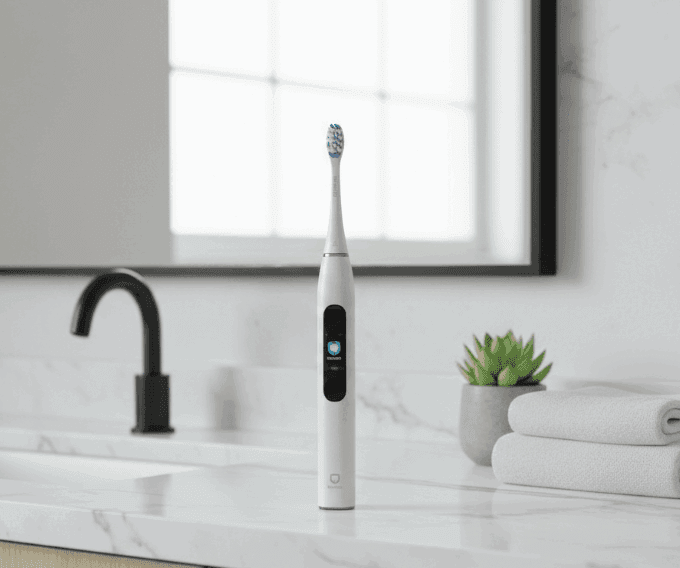
BrushO, an AI-powered smart toothbrush, helps users take their oral care—and confidence—to the next level:
BrushO’s smart sensors track pressure, coverage, and duration to guide users toward a more complete clean. No more missed spots or uneven brushing.
With features like brushing scores, streaks, and $BRUSH token rewards, users feel more motivated and accomplished—transforming brushing from a chore into a daily win.
The BrushO app provides brushing history and improvement metrics. Seeing visible progress can boost user satisfaction and personal pride.
From whitening to sensitive mode, BrushO adapts to different oral needs—helping users achieve the smile they’re proud to show off.
You don’t have to wait for a dental emergency to start caring for your smile. By investing in smart oral care tools and building healthier brushing habits, you’re not only protecting your teeth—but you’re also nurturing your self-confidence. Your smile is a reflection of how you feel inside. Make it one you’re proud to share, every day.
BrushO is an AI-powered smart toothbrush system designed to elevate everyday brushing into a personalized wellness ritual. With real-time feedback, habit tracking, and $BRUSH token rewards, BrushO empowers users to improve their oral health—and their self-confidence—with every brush.
Jan 13
Jan 13

Thumb sucking and pacifier use are normal self-soothing behaviors in infancy, and most children give them up on their own by school age. The dental problem arises when the habit continues past the eruption of the permanent front teeth, because the persistent pressure reshapes the growing jaw and ...

Most people never think about the shape of their tooth roots, but root morphology determines how a tooth is treated when disease strikes. Taurodontism and dilaceration are two developmental anomalies that change root anatomy in distinctive ways, and both have major implications for endodontics, e...

Dental injuries are among the most common sports-related injuries, and a mouthguard is the simplest piece of equipment an athlete can wear. Yet many players still train without one, often because they have never been told which type to choose or how a well-fitted guard feels. Understanding the pr...

Piezoelectric surgery has changed the way oral surgeons cut bone. Instead of a rotating bur, a piezotome uses ultrasonic vibrations to cut mineralized tissue while leaving soft tissue largely untouched. The technique is now routine for osteotomies, sinus lifts and delicate procedures where precis...

Children's teeth vary naturally in size, but some variations are large enough to affect function, appearance and future orthodontic care. Microdontia means teeth that are smaller than normal, and macrodontia means teeth that are larger than normal, and both can appear as isolated findings or as p...

Two patients can have identical teeth and completely different treatment outcomes, and the reason is often hiding in the gums. Gingival biotype describes the thickness and morphology of the soft tissue around the teeth, and it influences how the gum reacts to surgery, implants, braces and even si...

Guided bone regeneration, or GBR, is the standard method for rebuilding bone before and around dental implants. The concept is simple: a membrane creates a protected space that allows bone-forming cells to grow while excluding competing soft tissue. Choosing a resorbable membrane changes the prot...

Periodontal disease destroys not only the gum but the bone and ligament that anchor teeth, and the goal of regenerative treatment is to rebuild all three. Emdogain, an enamel matrix derivative, has become one of the most studied biological agents for this task, and its results improve further whe...

A chipped tooth is one of the most common dental emergencies, affecting children and adults alike through falls, sports, biting on hard objects and even normal wear. The right repair depends less on the size of the fragment and more on which layer of the tooth is exposed. Bonding, veneers and cro...

A knocked-out tooth is one of the few dental emergencies where minutes decide the outcome. When a permanent tooth is completely displaced from its socket, immediate and correct handling can save it, while delays or mistakes can condemn it to loss. The steps are simple enough for any parent, coach...


Address: RM 1427, 14/F RADIO CITY 505, HENNESSY RD CAUSEWAY BAY, HONG KONG
Code: 000000
Phone: +852-53758652
Email: customerservice@brusho.com
