The Difference Between Smart Toothbrushes and Regular Ones
Jan 20

Jan 20
At first glance, smart toothbrushes and regular toothbrushes may seem to serve the same purpose: cleaning your teeth. However, the way they approach oral care is fundamentally different. Traditional toothbrushes depend entirely on user technique, consistency, and awareness, while smart toothbrushes actively guide, monitor, and improve brushing behavior through technology. Understanding the difference between smart toothbrushes and regular ones is essential for anyone looking to improve long-term oral health. This article explores how these two types of toothbrushes differ in design, functionality, effectiveness, and habit formation—helping you decide which approach best supports healthier brushing.
 

The Difference Between Smart Toothbrushes and Regular Ones

1. Brushing Guidance: Manual Technique vs Intelligent Assistance

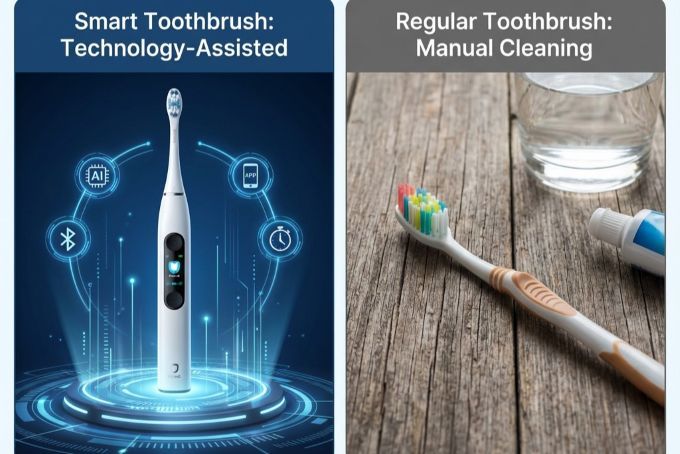
The most fundamental difference between smart toothbrushes and regular ones lies in brushing guidance. A regular toothbrush—whether manual or basic electric—relies entirely on the user’s knowledge and discipline. Proper brushing time, angle, pressure, and coverage are all left to personal judgment.
In contrast, a smart toothbrush actively assists the user. Equipped with motion sensors, pressure sensors, and AI algorithms, a smart toothbrush provides real-time brushing feedback. This guidance helps users maintain correct pressure, brush for the recommended duration, and cover all areas of the mouth more evenly.

2. Pressure Control and Gum Protection

Excessive brushing pressure is a common cause of gum recession and enamel wear. Regular toothbrushes offer no objective way to detect overbrushing, making it easy for users to unknowingly damage their gums over time.
A smart toothbrush addresses this issue through built-in pressure sensors. When excessive force is detected, the toothbrush can alert the user through visual, tactile, or speed-adjustment feedback. This pressure-aware design significantly improves gum protection and supports healthier brushing habits across different age groups.

3. Coverage Awareness and Cleaning Accuracy

With a regular toothbrush, users often assume their teeth are clean once brushing time is complete. However, research shows that missed areas—especially molars and gum lines—are common.
Smart toothbrushes track brushing movement and orientation to analyze coverage across different sections of the mouth. By visualizing cleaned and missed areas through an app or display, smart toothbrushes help users improve cleaning accuracy over time. This data-driven approach leads to more consistent and effective plaque removal compared to regular brushing methods.

4. Habit Formation and Behavioral Feedback

Regular toothbrushes offer no feedback beyond the physical sensation of brushing. As a result, users receive no insight into whether their brushing technique improves or declines over time.
Smart toothbrushes, on the other hand, focus heavily on habit formation. By providing brushing scores, progress reports, and personalized recommendations, a smart toothbrush transforms brushing into a measurable and improvable routine. This behavioral feedback plays a key role in encouraging consistency, especially for children and users struggling with long-term oral care habits.

5. Personalization and User Adaptability

Another major difference between smart toothbrushes and regular ones is personalization. Traditional toothbrushes apply the same brushing experience to everyone, regardless of age, gum sensitivity, or oral health condition.
Smart toothbrushes allow users to adjust brushing modes, intensity levels, and duration. Advanced AI smart toothbrushes can even adapt recommendations based on individual brushing behavior. This adaptability makes smart toothbrushes suitable for a wide range of users, from children to adults with sensitive gums.

6. Data, Technology, and Long-Term Oral Health Insights

Regular toothbrushes provide no data. Once brushing ends, there is no record of performance, improvement, or decline.
Smart toothbrushes generate brushing data that can be analyzed over time to identify patterns and areas for improvement. When handled responsibly with encryption and privacy protection, this data enables users to make informed decisions about their oral care routines. Over the long term, these insights can support better preventive care and healthier outcomes.

7. Convenience and Everyday Usability

While regular toothbrushes are simple and require no setup, they also offer limited functionality. Smart toothbrushes integrate modern conveniences such as rechargeable batteries, wireless charging, waterproof designs, and clear visual indicators.
Despite their advanced technology, modern smart toothbrushes are designed for everyday ease of use. Once set up, they seamlessly integrate into daily routines while offering a significantly more informed brushing experience than regular toothbrushes.

Final Thoughts: Which Toothbrush Makes a Real Difference?

The difference between smart toothbrushes and regular ones goes far beyond technology. It reflects a shift from passive cleaning to active oral care guidance. Regular toothbrushes depend entirely on user effort, while smart toothbrushes support users through feedback, personalization, and data-driven insights.
For individuals and families seeking to improve brushing habits, protect gums, and maintain better long-term oral health, smart toothbrushes represent a more comprehensive and future-oriented approach to daily oral care.

最近發文

Weekly brushing trends can reveal missed molar habits

Weekly brushing trends can reveal missed molar habits

Missed molars often do not show up as a single obvious bad session. They appear as a repeated weekly pattern of shortened posterior coverage, rushed transitions, or one-sided neglect. Weekly trend review makes those back-tooth habits visible early enough to fix calmly.

Sparkling water at night can prolong acid contact

Sparkling water at night can prolong acid contact

Sparkling water can look harmless at night because it has no sugar, but the fizz and acidity can keep teeth in a lower-pH environment longer when saliva is already slowing down. The practical issue is timing, frequency, and what else happens before bed.

Sore throats can lead to rougher tongue coating

Sore throats can lead to rougher tongue coating

A sore throat often changes how people swallow, breathe, hydrate, and clean the mouth, and those shifts can leave the tongue feeling rougher and more coated. The coating is usually a sign that saliva flow, debris clearance, and daily cleaning have become less efficient.

Seed shells can lodge under swollen gum edges

Seed shells can lodge under swollen gum edges

Tiny seed shells can slide into irritated gum margins and stay there longer than people expect, especially when the tissue is already puffy. The discomfort often looks mysterious at first, but the pattern is usually very local and very mechanical.

Root surfaces lose enamel from the very start

Root surfaces lose enamel from the very start

Root surfaces never begin with enamel. They are protected by cementum, which is softer and more vulnerable when gum recession exposes it to brushing pressure, dryness, and acid. That material difference explains why exposed roots can feel sensitive and wear faster.

Morning mints can mask a low saliva problem

Morning mints can mask a low saliva problem

Morning mints can cover dry breath for a few minutes, but they do not fix the low saliva pattern that often caused the odor in the first place. When dryness keeps returning, the smarter move is to notice the whole morning mouth pattern rather than chase it with stronger flavor.

Molar fissures trap more than the eye sees

Molar fissures trap more than the eye sees

Molar fissures look like tiny surface lines, but their narrow shape can trap plaque, sugars, softened starches, and acids deeper than the eye can judge. The real challenge is that back tooth grooves can stay active between brushings even when the chewing surface appears clean.

Live zone prompts can steady rushed evening brushing

Live zone prompts can steady rushed evening brushing

Evening brushing often becomes rushed by fatigue, distractions, and the false sense that the day is already over. Live zone prompts help by guiding attention through the mouth in real time, keeping timing, coverage, and pressure from drifting when self-monitoring is weakest.

Chewy vitamins can keep sugar on molar grooves

Chewy vitamins can keep sugar on molar grooves

Chewy vitamins can look harmless because they are sold as part of a health routine, but their sticky texture and sugar content can linger in molar grooves long after swallowing. The cavity issue is usually about retention time, bedtime timing, and repeated contact on hard to clean back teeth.

Accessory canals can spread root irritation sideways

Accessory canals can spread root irritation sideways

Accessory canals are tiny side pathways branching from the main root canal system, and they help explain why irritation inside a tooth does not stay confined to one straight line. When inflammation reaches these routes, discomfort can spread into nearby ligament or bone in less obvious patterns.
