
BrushO, a community-driven platform for better oral health, believes in rewarding everyone who contributes. Nodes play a key role, earning various rewards and potentially much more. Curious how to become a node and maximize your $BRUSH token rewards? We’ll break down the basics of nodes and how they’re rewarded.
Nodes are crucial partners in the BrushO ecosystem, essentially acting as distributors for BrushO’s smart oral health hardware. Their primary responsibility is to promote and sell BrushO’s hardware globally, thereby efficiently building a worldwide oral health data network.
Simply stake a certain amount of $BRUSH or make a bulk purchase of BrushO toothbrushes to become a BrushO node. (Staking is currently unavailable and will be activated upon the official launch of $BRUSH. Early node recruitment offers the most favorable policies. Contact BrushO official customer service for details.)
Yes, the more BrushO toothbrushes you promote and sell, the more rewards you will earn.
As a BrushO Node, you have two primary methods for promoting and selling BrushO toothbrushes. You can choose one method or utilize both:
Bulk Purchase and Sales: You can purchase BrushO toothbrushes in bulk, taking advantage of bulk purchasing discounts, and then sell the devices to customers through your own sales channels.
Referral Sales: Attract new users to purchase toothbrushes on the BrushO official website by sharing your unique referral link or code. You will receive a commission for each referral purchase. Your referred customers will also enjoy exclusive pricing benefits.
In essence, you can either wholesale the devices for direct sales or earn commissions by referring customers to purchase from the official website, both of which offer multiple incentives for Node device sales.
The minimum purchase quantity for bulk orders is 100 units. The global official retail price for a BrushO AI-Powered Mining Toothbrush set is $199, which includes:
The unit price of the toothbrushes decreases as your purchase quantity increases, resulting in a larger profit margin. For specific bulk purchase discount details, please contact BrushO official customer service.
This is determined by your Node Growth Value. Your Node Growth Value is based on the number of BrushO oral health hardware units you promote and sell. Whether through Bulk Purchase and Sales or Referral Sales, a higher quantity of devices results in a higher Growth Value and, consequently, an increased commission rate.
The specific formula for calculating Node Growth Value is:
Node Growth Value (Gv) = Units Sold via Bulk Purchase * 1 + Units Activated via Referral Sales * 1 — Units Returned * 1
The formula for calculating the commission rate based on Node Growth Value is:
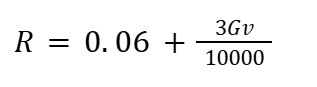
Where R represents the commission rate, with a maximum commission rate of 45%, and Gv represents the Node Growth Value.
A higher Growth Value leads to a higher commission rate, increasing your earnings from Referral Sales.
Commissions are disbursed after your referred order reaches ‘completed’ status. An order is considered completed under any of the following conditions:
Upon order completion, commissions will be disbursed in either USD or USDT.
In addition to pricing discounts and commissions, Nodes can also receive:
Device activation rewards are primarily influenced by the following factors:
The more activations and the higher the proportion, the greater the rewards!
You can use the following table to make a simple estimate of the node activation rewards you can receive:
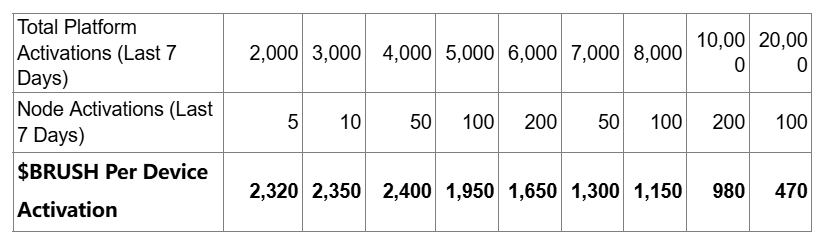
Your staking multiplier and node growth multiplier will provide additional boosts to device activation rewards.
For the calculation formula for node device activation rewards, please refer to the whitepaper.
The core influencing factor for node continuous rewards is the number of Brush and Earn rewards earned by the activated toothbrushes under the node. Specifically, it is categorized into toothbrushes activated within 180 days, between 180 and 365 days, and those activated over 365 days. The closer the activation time, the higher the reward weight.
In simple terms, continuously driving new device activations is the key to maximizing your node continuous rewards!
You can use the following table to make a simple estimate of the node continuous rewards you can receive:
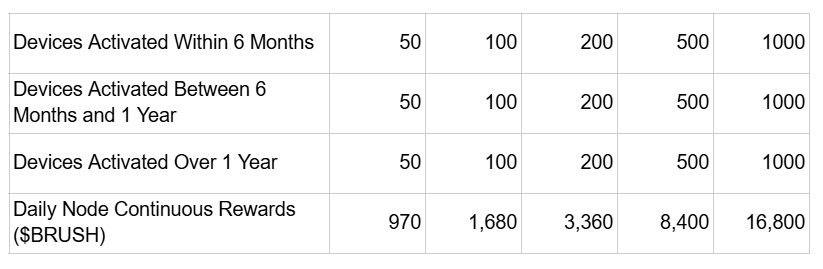
Your staking multiplier and node growth multiplier will provide additional boosts to node continuous rewards.
For the calculation formula for node continuous rewards, please refer to the whitepaper.
Equipment Activation Rewards for Nodes are disbursed in two installments: 50% on the day of activation, and the remaining 50% will be released linearly over the following 25 weeks, with 1/25th disbursed weekly (approximately every Monday at 02:00 AM UTC).
Continuous Rewards for Nodes are calculated daily, with the calculation period spanning from 02:00 AM UTC each day to 02:00 AM UTC the following day. For example, at 02:00 AM UTC on the 19th, the Continuous Rewards data for the period from 02:00 AM UTC on the 17th to 02:00 AM UTC on the 18th will be calculated.
Your Continuous Rewards will be disbursed weekly, approximately every Monday at 02:00 AM UTC.
Nodes may also be eligible for the following rewards:
This distinction exists because becoming a Node requires staking a specific amount of tokens. However, the calculation formula for staking rewards is the same, therefore the staking rewards are identical.
If you are a non-Node user, you can choose either Node Staking or Regular Staking.
If you have become a Node, you can only choose Regular Staking.
For detailed staking rules, please refer to the whitepaper.
No. If you relinquish your Node status, all rewards (including Equipment Activation Rewards and Continuous Rewards) will cease to be calculated and disbursed, except for any undisbursed Equipment Activation Rewards from already activated devices.
If you subsequently regain Node status:
Upon relinquishing your Node status and requesting to unstake your Node Staking, your Node status will be immediately revoked. To maintain the stability of the BrushO ecosystem, your $BRUSH will begin to unlock after the staking lock-up period (180 days) has elapsed. The unlocking process will span 180 days, with 1/180th released daily.
No, it does not. Regular Staking and Node Staking are independent, and the rewards from Regular Staking are unaffected. Additionally, Regular Staking can be unstaked at any time, with a linear unlock period of 7 days, releasing 1/7th daily.
BrushO is redefining oral health with AI-powered smart brushing and Web3 integration. Our ecosystem allows users to track brushing habits, receive real-time feedback, and own their health data securely. Through the Web3 Oral Health ID, users can control and even monetize their brushing data with $BRUSH rewards.
By combining AI, blockchain, and decentralized technology, BrushO is leading the future of smarter, healthier oral care.
🌐 Website: www.brusho.io
📩 Community: www.t.me/brushocommunity
Feb 28
Mar 7

Squamous cell carcinoma is not a single, uniform disease, and two of its oral variants illustrate the extremes of its behavior. Verrucous carcinoma is a slow-growing, exophytic tumor that almost never metastasizes, while spindle cell carcinoma is an aggressive, sarcomatoid malignancy that can be ...

Most people expect a toothache to be the first sign of pulp disease, but some forms of pulpitis are surprisingly silent. A pulp polyp is the visible result of chronic hyperplastic pulpitis, a condition in which the dental pulp grows out of a large carious opening as a fleshy mass. Recognizing thi...

Dry mouth is not merely uncomfortable; it is a medical condition with real consequences for teeth, speech, swallowing and quality of life. When the salivary glands cannot produce enough saliva, medications called sialogogues can restore some of the missing fluid. Pilocarpine and cevimeline are th...

A blister in the mouth can be the first warning of a systemic autoimmune disease, and two disorders deserve particular attention in the dental chair: pemphigus vulgaris and mucous membrane pemphigoid. Both produce chronic oral ulceration, yet their immunologic targets, clinical behavior and long-...

When infection drains from a tooth, the body often creates a visible escape route, and the dentist must interpret these fistulous openings correctly. A parulis is the common gum boil that signals chronic periapical infection, while an oroantral fistula is a communication between the mouth and the...

Among the fibro-osseous lesions of the jaws, the ossifying fibroma holds a unique position because it is a true neoplasm, unlike the reactive cemento-osseous dysplasia discussed in an earlier article. It grows continuously, expands bone and requires surgical removal, and its cemental variant adds...

Not all keratocystic lesions of the jaw behave alike, and one of the most important distinctions in oral pathology separates the orthokeratinized odontogenic cyst from its better-known relative, the odontogenic keratocyst. Although the two lesions look similar under the microscope at first glance...

Periodontal disease is usually a slowly progressive infection, but a rare form called necrotizing ulcerative periodontitis destroys tissue with alarming speed. Unlike ordinary periodontitis, this condition produces necrotic, cratered papillae, deep pocketing and rapid bone loss, and it appears al...

Every parent has met the child who refuses to eat because of painful mouth sores, and most of these children have one of two viral illnesses: herpangina or hand, foot and mouth disease. Both are caused by enteroviruses, both produce fever and oral ulcers, and both are overwhelmingly common in you...

Cementoosseous dysplasia is one of the most common fibro-osseous lesions found on dental radiographs, yet it is also one of the most frequently misdiagnosed. The lesion replaces normal bone with cellular fibrous tissue and cementum-like material, and it appears in several forms that range from a ...

সবাই যেন নিজের মতো করে গড়তে পারে – এমনভাবে দ্রুত ও কম খরচে ওরাল হেলথ ডেটা নেটওয়ার্ক তৈরি করুন।
সবাই যেন নিজের মতো করে গড়তে পারে – এমনভাবে দ্রুত ও কম খরচে ওরাল হেলথ ডেটা নেটওয়ার্ক তৈরি করুন।


Address: RM 1427, 14/F RADIO CITY 505, HENNESSY RD CAUSEWAY BAY, HONG KONG
Code: 000000
Phone: +852-53758652
Email: customerservice@brusho.com