Top Benefits of Using a Smart Toothbrush for Sensitive Teeth
Jan 23

Jan 23
Sensitive teeth can make everyday activities like eating and brushing uncomfortable. A smart toothbrush—with features like pressure sensors, personalized brushing modes, and real‑time feedback—can help improve brushing habits, protect enamel and gums, and reduce sensitivity over time. This article explores the key benefits of using a smart toothbrush specifically for sensitive teeth.


Introduction: Why Sensitive Teeth Need Special Care

Tooth sensitivity, often caused by enamel erosion, gum recession, or aggressive brushing, affects millions of people globally. When dentin—the layer beneath enamel—becomes exposed, it can trigger sharp discomfort from hot, cold, sweet, or acidic foods. Traditional toothbrushes may not provide sufficient protection or guidance to address these issues properly.
This is where smart toothbrush technology becomes especially valuable. Smart toothbrushes are electric toothbrushes equipped with advanced sensors, connectivity, and app integration that help users brush more effectively. They offer science‑backed advantages that go beyond what manual or basic electric brushes can provide.

1. Gentle Cleaning That Protects Sensitive Teeth

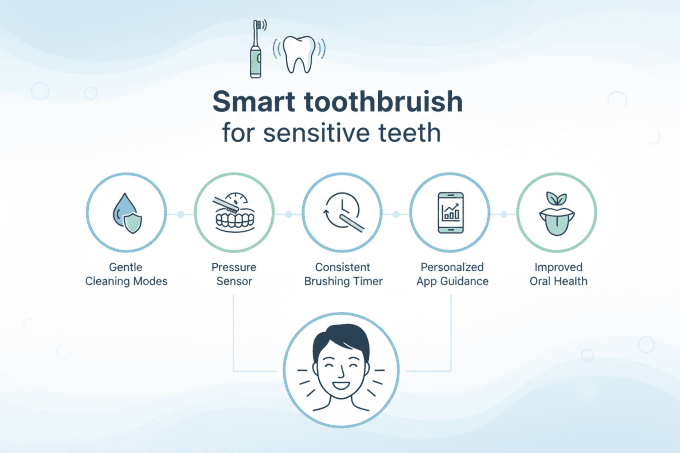
One of the most important benefits of using a smart toothbrush for sensitive teeth is its gentle yet effective cleaning action. Unlike hard manual brushing—which can worsen sensitivity by stripping enamel and irritating gums—smart toothbrushes use advanced motion technology to remove plaque without excessive force. Many models also include dedicated “sensitive” or “gentle” brushing modes tailored for users who need milder brushing power and reduced vibration intensity.
This gentle approach helps maintain enamel integrity while still achieving a thorough clean, reducing the risk of irritation and discomfort common among those with sensitive teeth.

2. Pressure Sensors Prevent Over‑Brushing

Excessive brushing pressure is a common cause of gum recession and enamel wear—two major contributors to sensitivity. Smart toothbrushes typically include built‑in pressure sensors that alert you when you are brushing too hard. These real‑time alerts, often communicated through gentle vibration or app notifications, help you maintain the ideal brushing force, protecting your gums and enamel over time.
By preventing over‑brushing, these sensors help reduce the progression of sensitivity and promote healthier brushing habits.

3. Personalized Brushing Modes for Tailored Oral Care

Unlike traditional brushes with one uniform setting, smart toothbrushes offer multiple brushing modes such as sensitive, gum care, deep clean, or daily clean. For individuals with sensitive teeth, switching to a sensitive mode ensures that strokes are softer and less abrasive, focusing on comfort without compromising hygiene.
This personalized capability means smarter brushing that adapts to your needs, rather than a one‑size‑fits‑all approach.

4. Real‑Time Feedback Encourages Better Brushing Technique

Smart toothbrushes provide real‑time feedback through companion apps that guide you on your brushing technique. These apps use data from built‑in motion trackers, timers, and pressure sensors to show whether you are brushing too hard, missing areas, or not brushing long enough. With this guidance, users can make immediate adjustments, leading to healthier and more effective brushing habits.
Over time, this feedback loop improves brushing consistency and helps prevent issues that lead to tooth sensitivity, such as uneven plaque removal or missed regions prone to decay.

5. Coverage Tracking Ensures Even Cleaning

Missing certain areas of your mouth while brushing can leave plaque behind, contributing to gum irritation and sensitivity. Smart toothbrushes often track which areas have been brushed and for how long, ensuring full mouth coverage. This advanced tracking helps you brush thoroughly and evenly, which is essential for maintaining healthy teeth and minimizing the risk of sensitivity‑related conditions.

6. Long‑Term Habit Tracking and Motivation

Many smart toothbrushes sync with mobile apps to track brushing behavior over weeks and months. This habit tracking not only shows progress but also motivates users to stay consistent. Some apps even provide rewards, streaks, or gamified elements that make sticking to a good brushing routine easier—and more engaging.
This long‑term focus encourages healthier daily habits, further reducing the risk and discomfort associated with sensitive teeth.

7. Enhanced Gum Health and Reduced Inflammation

For many people, tooth sensitivity is closely linked with gum health. Smart toothbrushes help by gently stimulating gums and reminding users to brush along the gum line without applying too much force. With improved gum care and reduced inflammation, the overall oral environment becomes healthier, which can decrease sensitivity triggers.
 

Conclusion: Smart Toothbrushes Make Sensitive Teeth Easier to Manage

A smart toothbrush is more than just a high‑tech gadget—it’s a scientifically supported tool that can make a real difference for people with sensitive teeth. From gentle brushing modes and pressure sensors to real‑time feedback and long‑term habit tracking, these devices empower users with precise, adaptive oral care.
By combining expert‑guided brush technology with personalized insights and data‑driven coaching, smart toothbrushes help you protect enamel, minimize discomfort, and build better habits for a lifetime of healthier smiles.

Aktuelle Beiträge

Weekly brushing trends can reveal missed molar habits

Weekly brushing trends can reveal missed molar habits

Missed molars often do not show up as a single obvious bad session. They appear as a repeated weekly pattern of shortened posterior coverage, rushed transitions, or one-sided neglect. Weekly trend review makes those back-tooth habits visible early enough to fix calmly.

Sparkling water at night can prolong acid contact

Sparkling water at night can prolong acid contact

Sparkling water can look harmless at night because it has no sugar, but the fizz and acidity can keep teeth in a lower-pH environment longer when saliva is already slowing down. The practical issue is timing, frequency, and what else happens before bed.

Sore throats can lead to rougher tongue coating

Sore throats can lead to rougher tongue coating

A sore throat often changes how people swallow, breathe, hydrate, and clean the mouth, and those shifts can leave the tongue feeling rougher and more coated. The coating is usually a sign that saliva flow, debris clearance, and daily cleaning have become less efficient.

Seed shells can lodge under swollen gum edges

Seed shells can lodge under swollen gum edges

Tiny seed shells can slide into irritated gum margins and stay there longer than people expect, especially when the tissue is already puffy. The discomfort often looks mysterious at first, but the pattern is usually very local and very mechanical.

Root surfaces lose enamel from the very start

Root surfaces lose enamel from the very start

Root surfaces never begin with enamel. They are protected by cementum, which is softer and more vulnerable when gum recession exposes it to brushing pressure, dryness, and acid. That material difference explains why exposed roots can feel sensitive and wear faster.

Morning mints can mask a low saliva problem

Morning mints can mask a low saliva problem

Morning mints can cover dry breath for a few minutes, but they do not fix the low saliva pattern that often caused the odor in the first place. When dryness keeps returning, the smarter move is to notice the whole morning mouth pattern rather than chase it with stronger flavor.

Molar fissures trap more than the eye sees

Molar fissures trap more than the eye sees

Molar fissures look like tiny surface lines, but their narrow shape can trap plaque, sugars, softened starches, and acids deeper than the eye can judge. The real challenge is that back tooth grooves can stay active between brushings even when the chewing surface appears clean.

Live zone prompts can steady rushed evening brushing

Live zone prompts can steady rushed evening brushing

Evening brushing often becomes rushed by fatigue, distractions, and the false sense that the day is already over. Live zone prompts help by guiding attention through the mouth in real time, keeping timing, coverage, and pressure from drifting when self-monitoring is weakest.

Chewy vitamins can keep sugar on molar grooves

Chewy vitamins can keep sugar on molar grooves

Chewy vitamins can look harmless because they are sold as part of a health routine, but their sticky texture and sugar content can linger in molar grooves long after swallowing. The cavity issue is usually about retention time, bedtime timing, and repeated contact on hard to clean back teeth.

Accessory canals can spread root irritation sideways

Accessory canals can spread root irritation sideways

Accessory canals are tiny side pathways branching from the main root canal system, and they help explain why irritation inside a tooth does not stay confined to one straight line. When inflammation reaches these routes, discomfort can spread into nearby ligament or bone in less obvious patterns.
