
Once overlooked as a basic hygiene task, oral care is now experiencing a glow-up—emerging as the next big trend in personal wellness, much like skincare did years ago. With advances in smart technology, aesthetic packaging, and social media influence, brushing your teeth is no longer a chore—it’s a ritual. Like skincare, modern oral care is now about prevention, personalization, and daily consistency. With tools like BrushO, oral hygiene is evolving into a beauty and health statement.
Skincare evolved from “washing your face” to a multi-step, mindful ritual with cleansers, toners, serums, and moisturizers. Why? Because people realized that consistent, intentional care could preserve youth, prevent damage, and enhance confidence.
• Cleansing = Brushing
• Toning = Rinsing / Tongue Scraping
• Serum = Whitening / Desensitizing products
• Moisturizing = Saliva-stimulating or hydration-focused routines
Oral care is moving beyond ‘just brushing’ into self-care—and the market is responding.
A radiant smile is now as important as clear skin. In the age of selfies and Zoom calls, oral aesthetics matter.
Much like skincare, oral care has become shareable content: “What toothbrush do you use?” “What’s your whitening routine?” “How do you get fresh breath all day?”
People now seek routines that make them feel good, not just look good. Brushing is becoming part of morning and nighttime wellness rituals.
Just as skincare relies on skin type and sensitivity, oral care is moving toward customized brushing routines, real-time feedback, and data tracking.
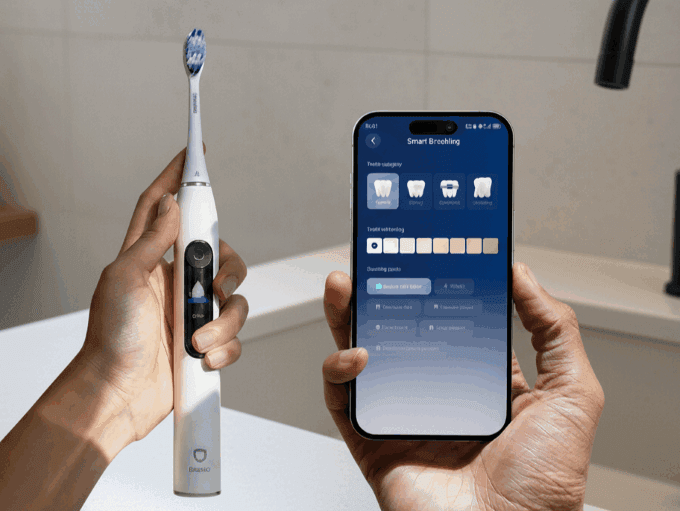
Like upgrading from a drugstore cleanser to a smart serum, BrushO is your next-gen upgrade for brushing. Here’s how it brings skincare-level luxury and effectiveness to your mouth:
Smart sensors analyze your brushing style, pressure, and coverage. Get feedback tailored to your needs.
Daily brushing reports help build consistency—just like skincare journaling or app reminders.
Whitening mode, sensitive mode, deep clean—choose based on your “oral skin type.”
BrushO doesn’t just clean—it supports long-term health and visible beauty.
Modern design meets high-tech elegance—because like skincare bottles, toothbrushes now sit proudly on the vanity.
Just as a skincare routine may include cleansing, treating, and moisturizing, your oral care ritual should be layered too:
1. Brush with intention (2 minutes, all zones)
2. Use a smart toothbrush for accurate pressure and coverage
3. Clean your tongue to fight bad breath
4. Rinse or floss to complete the cleanse
5. Stay consistent morning and night
Oral care is no longer just about preventing cavities—it’s about feeling fresh, looking confident, and embracing wellness. Just like skincare, your brushing routine should reflect who you are, what you value, and how you care for yourself. With smart devices like BrushO, you’re not just cleaning your teeth—you’re creating a daily ritual of beauty, precision, and self-respect. Because your mouth deserves as much love as your skin. BrushO is an AI-powered smart toothbrush designed to bring precision, personalization, and pleasure to oral care. With real-time brushing feedback, habit tracking, multiple brushing modes, and $BRUSH token rewards, BrushO transforms your daily brushing into a self-care ritual that fits your lifestyle and your smile.

Evidence-based dentistry (EBD) represents a fundamental paradigm shift in how dental professionals approach clinical decision making. Rather than relying solely on tradition, anecdotal experience, or expert opinion, EBD provides a systematic framework for integrating the best available scientific ev

Xerostomia, the subjective sensation of oral dryness, and hyposalivation, the objective reduction in salivary flow, represent one of the most common yet underrecognized complaints encountered in dental practice. Affecting an estimated 20-30% of the general population and up to 40% of older adults, t

Orofacial myofunctional therapy (OMT) has emerged as a critical adjunctive intervention in modern dentistry, bridging the gap between orthodontics, sleep medicine, and pediatric airway management. This therapeutic approach targets the neuromuscular re-education of the orofacial musculature, addressi

Evidence-based dentistry (EBD) represents a fundamental paradigm shift in how dental professionals approach clinical decision making. Rather than relying solely on tradition, anecdotal experience, or expert opinion, EBD provides a systematic framework for integrating the best available scientific ev

The contemporary dental practice operates at the intersection of healthcare delivery and small business management, requiring practitioners to master competencies far beyond clinical excellence. Success in today's competitive landscape demands sophisticated understanding of practice economics, strat

Cleft lip and palate (CLP) represents the most common congenital craniofacial anomaly, occurring in approximately 1 in 700 live births worldwide, with significant variation across ethnic groups. The condition results from failure of fusion of the facial processes during early embryogenesis, specific

The transition from metal-ceramic to all-ceramic restorations represents one of the most significant material shifts in restorative dentistry over the past three decades. Driven by aesthetic demands, concerns about metal hypersensitivity, and remarkable advances in ceramic materials and CAD/CAM tech

Tooth extraction initiates a cascade of biological events that inevitably results in alveolar ridge remodeling—a process characterized by dimensional changes in both the horizontal and vertical planes that can compromise subsequent implant placement. The clinical significance of post-extraction ridg

Infection control has always been fundamental to safe dental practice, but the COVID-19 pandemic brought unprecedented scrutiny to dental infection prevention protocols. The recognition that SARS-CoV-2 transmits primarily through respiratory droplets and aerosols—and that dental procedures generate

Forensic odontology occupies a unique position at the intersection of dentistry, forensic science, and the legal system. The discipline applies dental knowledge to the identification of human remains, the analysis of bite mark evidence, and the estimation of age in both living and deceased individua

Build an oral health data network quickly and at low cost in a way that everyone can build.


Address: RM 1427, 14/F RADIO CITY 505, HENNESSY RD CAUSEWAY BAY, HONG KONG
Code: 000000
Phone: +852-53758652
Email: customerservice@brusho.com