
Brushing your teeth may feel like second nature—but staying consistent every single day? That’s where most of us fall short. BrushO changes that by turning your daily brushing into a habit worth celebrating. With its AI-powered tracking and a built-in points-based rewards system, BrushO motivates users to brush better, not just more often.
This blog takes you inside how the system works, why it’s so effective at helping people build long-term brushing habits, and how it aligns with BrushO’s larger mission: making oral care more rewarding, sustainable, and user-centric. Whether you’re a busy professional, a parent teaching your child to brush, or just someone who loves tech, BrushO’s approach has something valuable for you.
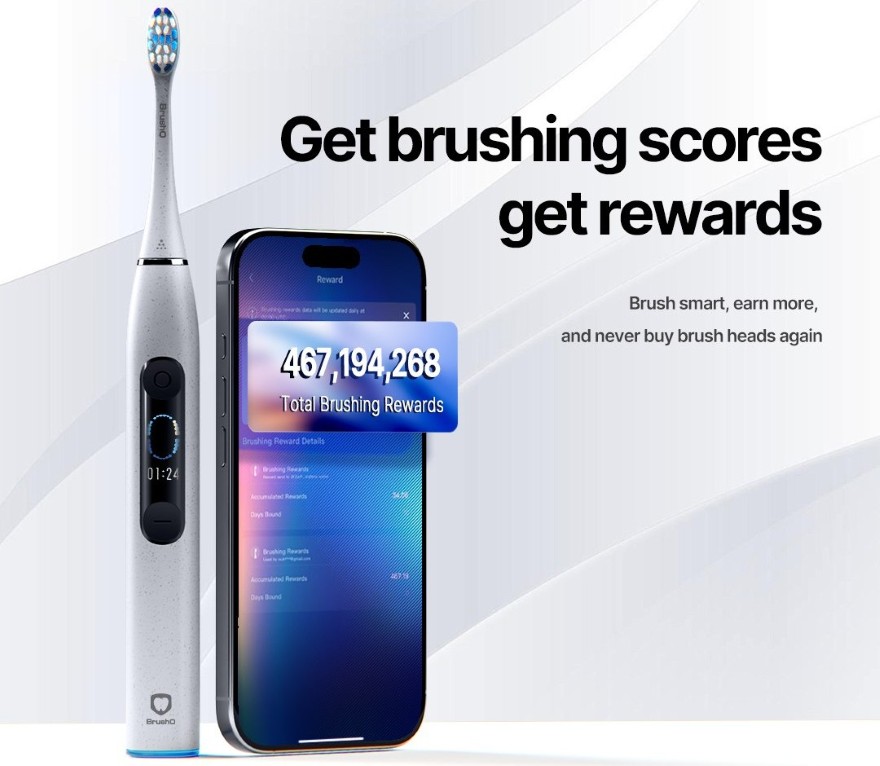
Let’s face it—brushing twice a day sounds easy in theory, but hard to maintain. BrushO understands that and flips the script by transforming brushing into something you look forward to. Its built-in rewards system turns your routine into a habit with real-world value.
Instead of guilt-based reminders or dentist lectures, BrushO offers positive reinforcement. Each time you brush correctly—with the right pressure, full coverage, and consistency—you earn points. These points go toward free brush head refills, helping you save money and reduce waste.
BrushO doesn’t penalize you for missing a day. Instead, it celebrates the effort you put in. Stick to brushing twice daily, and you’ll earn daily streak points. It’s a simple idea—brush regularly, collect rewards.
Using AI sensors and the companion app, BrushO tracks your:
• Brushing duration
• Surface coverage
• Brushing pressure
• Frequency & streaks
The data is shown in easy-to-read charts and reminders. Over time, this creates visible progress that keeps you motivated.
Once you reach a point threshold, you can redeem lifetime brush head refills—a core part of BrushO’s sustainable commitment. It eliminates the guesswork of when to replace your brush head and helps reduce plastic waste.
The reward system isn’t just for adults. Many parents report that children are more engaged in brushing when it becomes a “game.” By showing streaks and setting shared goals, BrushO helps families build oral care habits together.
There’s no competition—just small victories celebrated. Kids learn to view brushing as a daily routine, not a chore.
Behavioral psychology tells us: small rewards drive lasting change. That’s exactly what BrushO delivers. The app provides:
• Gentle reminders (instead of guilt)
• Encouraging messages when you hit a milestone
• Personalized brushing tips to help you improve
And when life gets hectic? BrushO simply helps you get back on track.
Beyond oral health, BrushO is on a mission to make dental care more sustainable and accessible:
• Lifetime brush head refills (through brushing points)
• No subscriptions required
• Web3-powered data ownership—you control your brushing records
• AI-guided feedback for smarter brushing
• Community support for progress sharing and dental advice
This is oral care built for the long term—not a one-time product, but a habit-building ecosystem.
BrushO is a smart electric toothbrush brand. Powered by adaptive AI and real-time coaching, it helps users improve brushing habits while earning rewards. Backed by 40+ UK dental clinics and introduced by Stanford, BrushO also offers a global vision—to make good habits valuable through its reward-based ecosystem.
Nov 4
Nov 4

Squamous cell carcinoma is not a single, uniform disease, and two of its oral variants illustrate the extremes of its behavior. Verrucous carcinoma is a slow-growing, exophytic tumor that almost never metastasizes, while spindle cell carcinoma is an aggressive, sarcomatoid malignancy that can be ...

Most people expect a toothache to be the first sign of pulp disease, but some forms of pulpitis are surprisingly silent. A pulp polyp is the visible result of chronic hyperplastic pulpitis, a condition in which the dental pulp grows out of a large carious opening as a fleshy mass. Recognizing thi...

Dry mouth is not merely uncomfortable; it is a medical condition with real consequences for teeth, speech, swallowing and quality of life. When the salivary glands cannot produce enough saliva, medications called sialogogues can restore some of the missing fluid. Pilocarpine and cevimeline are th...

A blister in the mouth can be the first warning of a systemic autoimmune disease, and two disorders deserve particular attention in the dental chair: pemphigus vulgaris and mucous membrane pemphigoid. Both produce chronic oral ulceration, yet their immunologic targets, clinical behavior and long-...

When infection drains from a tooth, the body often creates a visible escape route, and the dentist must interpret these fistulous openings correctly. A parulis is the common gum boil that signals chronic periapical infection, while an oroantral fistula is a communication between the mouth and the...

Among the fibro-osseous lesions of the jaws, the ossifying fibroma holds a unique position because it is a true neoplasm, unlike the reactive cemento-osseous dysplasia discussed in an earlier article. It grows continuously, expands bone and requires surgical removal, and its cemental variant adds...

Not all keratocystic lesions of the jaw behave alike, and one of the most important distinctions in oral pathology separates the orthokeratinized odontogenic cyst from its better-known relative, the odontogenic keratocyst. Although the two lesions look similar under the microscope at first glance...

Periodontal disease is usually a slowly progressive infection, but a rare form called necrotizing ulcerative periodontitis destroys tissue with alarming speed. Unlike ordinary periodontitis, this condition produces necrotic, cratered papillae, deep pocketing and rapid bone loss, and it appears al...

Every parent has met the child who refuses to eat because of painful mouth sores, and most of these children have one of two viral illnesses: herpangina or hand, foot and mouth disease. Both are caused by enteroviruses, both produce fever and oral ulcers, and both are overwhelmingly common in you...

Cementoosseous dysplasia is one of the most common fibro-osseous lesions found on dental radiographs, yet it is also one of the most frequently misdiagnosed. The lesion replaces normal bone with cellular fibrous tissue and cementum-like material, and it appears in several forms that range from a ...

Construire rapidement et à faible coût un réseau de données sur la santé bucco-dentaire de manière que tout le monde puisse y contribuer.
Construire rapidement et à faible coût un réseau de données sur la santé bucco-dentaire de manière que tout le monde puisse y contribuer.


Address: RM 1427, 14/F RADIO CITY 505, HENNESSY RD CAUSEWAY BAY, HONG KONG
Code: 000000
Phone: +852-53758652
Email: customerservice@brusho.com