
Yellow teeth can feel embarrassing, but they’re also incredibly common. The good news? There are safe, effective ways to brighten your smile—without damaging enamel or wasting money on gimmicks. In this article, we’ll explain what causes yellowing, what works (and what doesn’t), and how to adopt a daily oral care routine that actually delivers visible results. Plus, discover how BrushO helps you brush smarter for long-term whitening benefits.
Understanding the cause helps you fix it. Common culprits include:
• Surface stains from coffee, tea, wine, and tobacco
• Plaque buildup from poor brushing technique
• Thinning enamel with age, revealing more of the yellow dentin
• Acidic foods that erode the tooth’s white surface
• Genetics—some people naturally have darker enamel tones
Here’s what dental experts recommend—and what BrushO supports through smarter brushing:
Dentist-supervised whitening treatments offer fast, dramatic results but may cause sensitivity. Ideal for short-term fixes.
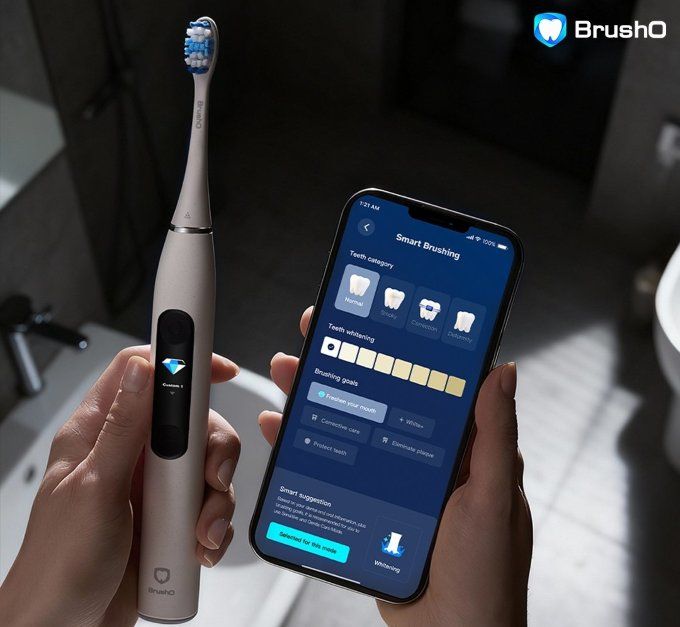
Using a sonic smart toothbrush like BrushO removes more surface stains and prevents new ones from forming. Its real-time feedback ensures you brush all 16 surfaces evenly and gently.
Many whitening toothpastes are too abrasive. Opt for ADA-approved formulas, and pair with BrushO’s pressure sensors to avoid enamel damage.
Gentle abrasive, and pH-balancing. Use only once a week, and always with soft brushing to prevent scratching enamel.
Cut back on dark liquids like coffee, cola, and wine—or rinse with water afterward to minimize staining.
Don’t fall for internet myths. These methods may do more harm than good:
❌ Lemon juice or vinegar – Acidic and highly erosive to enamel
❌ Charcoal toothpaste – Too abrasive for daily use
❌ Overbrushing – Can damage enamel and expose dentin, making teeth appear more yellow
❌ Whitening too frequently – Leads to sensitivity and gum irritation
BrushO helps you avoid these pitfalls by tracking brushing pressure and frequency, and giving gentle guidance via its AI-powered app.
Create a sustainable whitening routine:
🦷 Brush twice daily with a smart toothbrush that ensures full coverage
💧 Floss once a day to prevent yellow plaque between teeth
🥤 Rinse after dark liquids or acidic foods
🪥 Replace brush heads regularly (BrushO provides lifetime free heads with point redemption!)
📊 Track your brushing to catch bad habits early
📱 Use a brushing app like BrushO’s to get real-time performance scores
BrushO isn’t just an electric toothbrush—it’s a whitening partner. Here’s how:
🎯 Smart sensors detect missed zones and uneven coverage
🧠 AI-driven app teaches gentle, consistent brushing technique
⚖️ Pressure alerts protect your enamel from overbrushing
🪄 Surface-level stain removal with optimal sonic frequency
💬 Progress tracking lets you monitor visible improvements over time
BrushO doesn’t promise overnight miracles—but it helps you build habits that lead to a naturally brighter smile.
There’s no magic fix for yellow teeth—but there is a smart one. By combining safe whitening methods with consistent brushing, smart tools, and daily mindfulness, you can gradually reveal a whiter, healthier smile that lasts.
BrushO is a next-gen AI-powered toothbrush built to improve oral health through intelligent zone tracking, real-time feedback, and habit reinforcement. With advanced pressure detection and a sleek, hygienic design, BrushO makes brushing not only smarter—but cleaner, gentler, and more effective.

Squamous cell carcinoma is not a single, uniform disease, and two of its oral variants illustrate the extremes of its behavior. Verrucous carcinoma is a slow-growing, exophytic tumor that almost never metastasizes, while spindle cell carcinoma is an aggressive, sarcomatoid malignancy that can be ...

Most people expect a toothache to be the first sign of pulp disease, but some forms of pulpitis are surprisingly silent. A pulp polyp is the visible result of chronic hyperplastic pulpitis, a condition in which the dental pulp grows out of a large carious opening as a fleshy mass. Recognizing thi...

Dry mouth is not merely uncomfortable; it is a medical condition with real consequences for teeth, speech, swallowing and quality of life. When the salivary glands cannot produce enough saliva, medications called sialogogues can restore some of the missing fluid. Pilocarpine and cevimeline are th...

A blister in the mouth can be the first warning of a systemic autoimmune disease, and two disorders deserve particular attention in the dental chair: pemphigus vulgaris and mucous membrane pemphigoid. Both produce chronic oral ulceration, yet their immunologic targets, clinical behavior and long-...

When infection drains from a tooth, the body often creates a visible escape route, and the dentist must interpret these fistulous openings correctly. A parulis is the common gum boil that signals chronic periapical infection, while an oroantral fistula is a communication between the mouth and the...

Among the fibro-osseous lesions of the jaws, the ossifying fibroma holds a unique position because it is a true neoplasm, unlike the reactive cemento-osseous dysplasia discussed in an earlier article. It grows continuously, expands bone and requires surgical removal, and its cemental variant adds...

Not all keratocystic lesions of the jaw behave alike, and one of the most important distinctions in oral pathology separates the orthokeratinized odontogenic cyst from its better-known relative, the odontogenic keratocyst. Although the two lesions look similar under the microscope at first glance...

Periodontal disease is usually a slowly progressive infection, but a rare form called necrotizing ulcerative periodontitis destroys tissue with alarming speed. Unlike ordinary periodontitis, this condition produces necrotic, cratered papillae, deep pocketing and rapid bone loss, and it appears al...

Every parent has met the child who refuses to eat because of painful mouth sores, and most of these children have one of two viral illnesses: herpangina or hand, foot and mouth disease. Both are caused by enteroviruses, both produce fever and oral ulcers, and both are overwhelmingly common in you...

Cementoosseous dysplasia is one of the most common fibro-osseous lesions found on dental radiographs, yet it is also one of the most frequently misdiagnosed. The lesion replaces normal bone with cellular fibrous tissue and cementum-like material, and it appears in several forms that range from a ...

Construire rapidement et à faible coût un réseau de données sur la santé bucco-dentaire de manière que tout le monde puisse y contribuer.
Construire rapidement et à faible coût un réseau de données sur la santé bucco-dentaire de manière que tout le monde puisse y contribuer.


Address: RM 1427, 14/F RADIO CITY 505, HENNESSY RD CAUSEWAY BAY, HONG KONG
Code: 000000
Phone: +852-53758652
Email: customerservice@brusho.com