
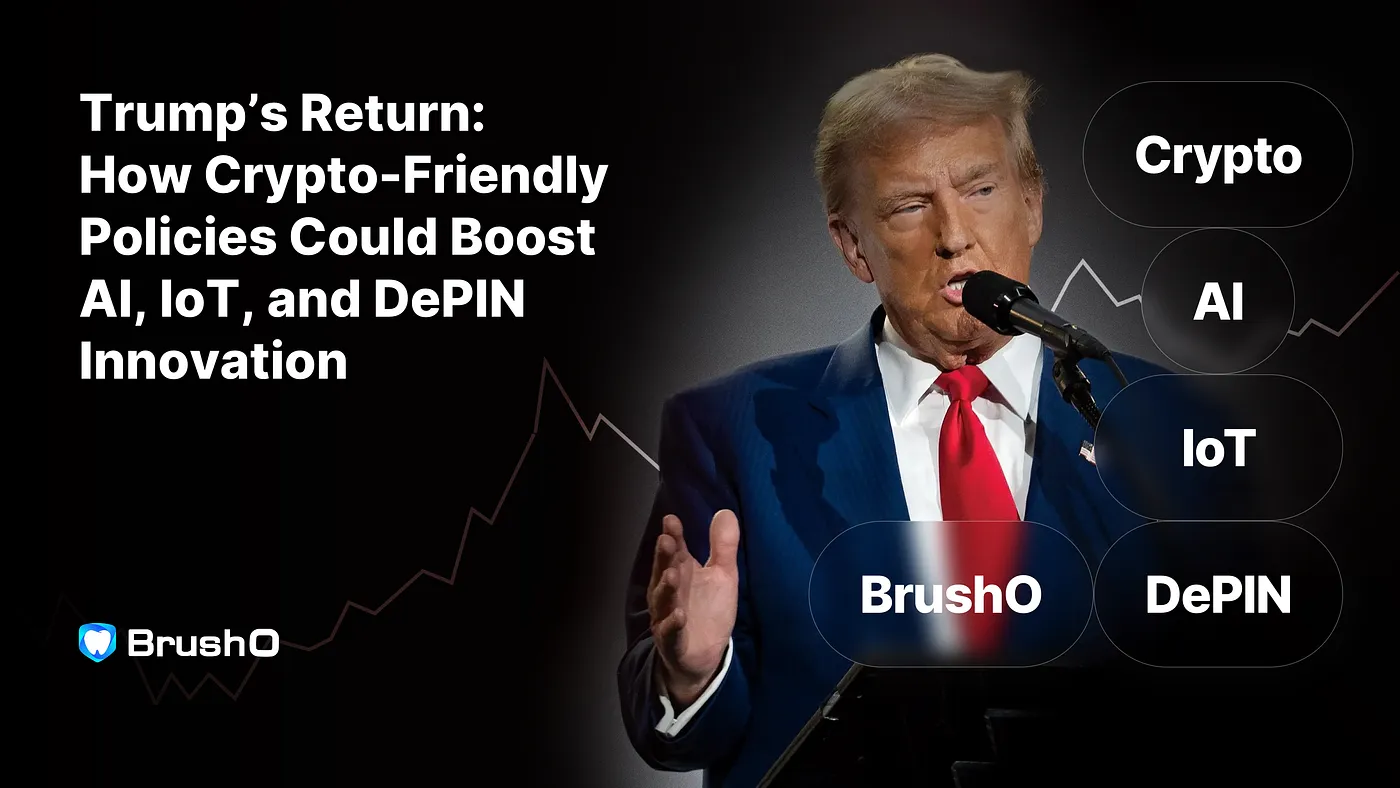
With Donald Trump now officially elected as President, the U.S. is poised for a shift towards policies that support decentralized technology and foster innovation. This could significantly accelerate the future of AI, IoT, and DePIN (Decentralized Physical Infrastructure Networks). Such policies would not only impact enterprise and industrial applications but also unlock transformative opportunities for consumer products. A prime example is BrushO, a smart IoT toothbrush that utilizes AI to enhance oral health while integrating with decentralized systems.
Clear regulatory guidelines on data ownership and privacy are crucial for decentralized consumer products to thrive. A blockchain and crypto friendly administration could prioritize frameworks that empower devices like BrushO to collect and analyze personal data in a secure, user-controlled manner. With decentralized data management, BrushO could allow users to store their health data securely on a decentralized file-sharing system , enabling seamless data sharing with healthcare providers or perhaps medical and dental manufactures while ensuring privacy.
A government that fosters business growth and R&D in emerging technologies could drive rapid innovation in consumer IoT products like BrushO. By reducing regulatory barriers and offering incentives, the new administration could accelerate the development of products that integrate AI, IoT, and decentralized technologies for real-time health insights. For example, BrushO’s AI could evolve to deliver more personalized health recommendations by learning users’ unique brushing habits and detecting early signs of oral health issues. Such an environment would help BrushO push the boundaries of its AI capabilities, benefiting users’ well-being.
Support for DePIN initiatives could fuel decentralized, community-driven projects that connect health data across secure networks. BrushO could leverage these networks to create a system where user data remains private, secure, and accessible only to authorized individuals or professionals. Decentralized health data storage not only ensures privacy but also enables the sharing of anonymized data with researchers, advancing dental science and improving overall healthcare outcomes.
Consumer health devices like BrushO, which collect and manage sensitive data, require robust privacy protections. Trump’s administration could potentially advocate for decentralized security standards, improving transparency and privacy across IoT devices. BrushO could adapt these technologies to secure data transfers, ensuring that sensitive health metrics remain private and tamper-proof. This would set the foundation for future health-focused IoT devices that prioritize user security.
Pro-technology policies could foster partnerships between public agencies and private companies developing health-oriented consumer devices. Collaboration with healthcare institutions and research organizations would enable BrushO to contribute to public health initiatives. For instance, BrushO could share anonymized data with dental health programs, providing valuable insights for preventive care while complying with privacy regulations.
A favorable policy environment could position the U.S. as a global leader in consumer tech innovation. By attracting talent and investment, the government could drive the development of IoT and AI-powered products that leverage decentralized networks.
BrushO could take advantage of this ecosystem to expand its offerings and integrate real-time health monitoring, contributing to a broader health-tech ecosystem built on secure, decentralized data management.
The application of decentralized technologies in supply chains could transform consumer trust in brands. By incorporating these solutions into production and logistics processes, BrushO could offer customers transparency regarding the sourcing and sustainability of materials. This level of openness could appeal to ethically-conscious consumers, allowing them to make informed purchasing decisions. Support for supply chain transparency could further elevate trust across the consumer goods sector.
The rise of decentralized finance (DeFi) could also change how consumers interact with IoT products. For BrushO, this involves exploring subscription-based models where users pay for usage or receive incentives for maintaining good oral health habits. Through DeFi systems, BrushO could offer rewards that users can redeem or use toward future purchases, all while maintaining full control over their financial interactions.
With Donald Trump’s administration in place, the U.S. is entering an era that could greatly accelerate the growth of decentralized technologies, empowering companies like BrushO to lead the way in AI, IoT, and consumer health tech. By providing regulatory clarity, enhancing privacy protections, offering financial incentives, and fostering public-private partnerships, Trump’s policies could set the stage for the next generation of consumer IoT products. These products will prioritize user privacy, personalized care, and decentralized control, making a lasting impact on consumers’ lives.
The Trump administration’s blockchain and crypto friendly stance offers a unique opportunity to innovate within the consumer tech landscape. With policies that support decentralized networks and technologies, the U.S. could solidify its leadership in developing secure, transparent, and privacy-conscious solutions for everyday consumer products like BrushO, improving lives and driving innovation on a global scale.
BrushO is a decentralized global oral health data platform, consisting of the BrushO AI-Powered Mining Toothbrush and the BrushO Network. BrushO’s mission is to empower users worldwide by establishing personal oral health Web3 IDs and accumulating personal oral health data assets, ultimately creating a global oral health Web3 identity network. Through user authorization, BrushO transforms the oral health industry by restructuring production relationships while safeguarding user privacy, driving industry upgrades, and raising global oral health standards.
Nov 8
Oct 28

Squamous cell carcinoma is not a single, uniform disease, and two of its oral variants illustrate the extremes of its behavior. Verrucous carcinoma is a slow-growing, exophytic tumor that almost never metastasizes, while spindle cell carcinoma is an aggressive, sarcomatoid malignancy that can be ...

Most people expect a toothache to be the first sign of pulp disease, but some forms of pulpitis are surprisingly silent. A pulp polyp is the visible result of chronic hyperplastic pulpitis, a condition in which the dental pulp grows out of a large carious opening as a fleshy mass. Recognizing thi...

Dry mouth is not merely uncomfortable; it is a medical condition with real consequences for teeth, speech, swallowing and quality of life. When the salivary glands cannot produce enough saliva, medications called sialogogues can restore some of the missing fluid. Pilocarpine and cevimeline are th...

A blister in the mouth can be the first warning of a systemic autoimmune disease, and two disorders deserve particular attention in the dental chair: pemphigus vulgaris and mucous membrane pemphigoid. Both produce chronic oral ulceration, yet their immunologic targets, clinical behavior and long-...

When infection drains from a tooth, the body often creates a visible escape route, and the dentist must interpret these fistulous openings correctly. A parulis is the common gum boil that signals chronic periapical infection, while an oroantral fistula is a communication between the mouth and the...

Among the fibro-osseous lesions of the jaws, the ossifying fibroma holds a unique position because it is a true neoplasm, unlike the reactive cemento-osseous dysplasia discussed in an earlier article. It grows continuously, expands bone and requires surgical removal, and its cemental variant adds...

Not all keratocystic lesions of the jaw behave alike, and one of the most important distinctions in oral pathology separates the orthokeratinized odontogenic cyst from its better-known relative, the odontogenic keratocyst. Although the two lesions look similar under the microscope at first glance...

Periodontal disease is usually a slowly progressive infection, but a rare form called necrotizing ulcerative periodontitis destroys tissue with alarming speed. Unlike ordinary periodontitis, this condition produces necrotic, cratered papillae, deep pocketing and rapid bone loss, and it appears al...

Every parent has met the child who refuses to eat because of painful mouth sores, and most of these children have one of two viral illnesses: herpangina or hand, foot and mouth disease. Both are caused by enteroviruses, both produce fever and oral ulcers, and both are overwhelmingly common in you...

Cementoosseous dysplasia is one of the most common fibro-osseous lesions found on dental radiographs, yet it is also one of the most frequently misdiagnosed. The lesion replaces normal bone with cellular fibrous tissue and cementum-like material, and it appears in several forms that range from a ...

एक मौखिक स्वास्थ्य डेटा नेटवर्क जल्दी और कम लागत पर इस तरह से बनाएं जिसमें हर कोई भाग ले सके।


Address: RM 1427, 14/F RADIO CITY 505, HENNESSY RD CAUSEWAY BAY, HONG KONG
Code: 000000
Phone: +852-53758652
Email: customerservice@brusho.com