
Your gumline—the point where your teeth meet your gums—is one of the most critical yet overlooked areas in oral hygiene. Gum recession, inflammation, and plaque buildup often begin here, quietly progressing until they cause serious damage. This article explores why the gumline matters, what risks emerge when it’s neglected, and how smart brushing tools like BrushO can guide users to properly clean this zone, helping to prevent gingivitis, periodontitis, and tooth sensitivity. Backed by dental science and equipped with AI-powered technology, BrushO empowers users to maintain healthy gums and long-lasting smiles.
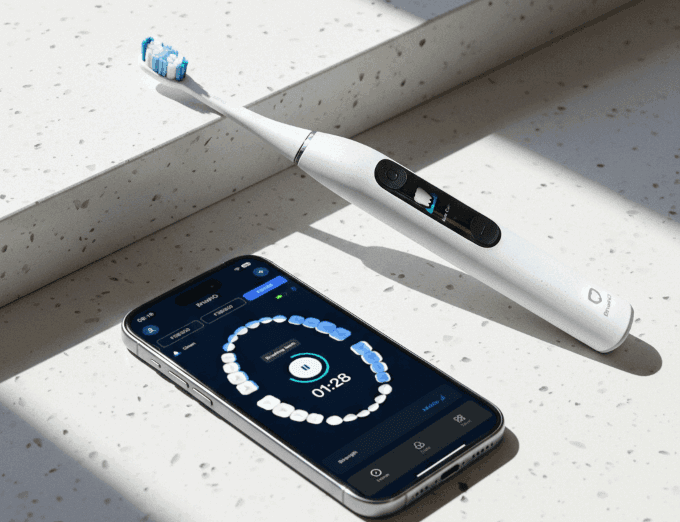
The gumline is the soft tissue margin where your gums surround the base of each tooth. It acts as a protective barrier for the underlying bone and root surfaces. Neglecting this area can open the door to:
• Plaque buildup and tartar accumulation
• Gum inflammation (gingivitis)
• Advanced gum disease (periodontitis)
• Root exposure and sensitivity
• Eventual tooth loosening or loss
Despite its importance, the gumline is often missed during daily brushing due to improper technique or lack of awareness.
Here are key indicators that your gumline may not be getting the attention it needs:
• Bleeding when brushing or flossing
• Swollen or puffy gums
• Persistent bad breath
• Gums that appear to be pulling away from teeth
• Teeth feeling longer due to gum recession
• Sensitivity to temperature or touch
These signs often point to early gum disease, which is reversible if addressed early.
Gingivitis begins with gumline neglect. Left untreated, it may progress to periodontitis—an advanced form of gum disease that damages the bone supporting your teeth. It’s the leading cause of adult tooth loss.
Plaque left at the gumline calcifies into tartar within 24–72 hours. Tartar cannot be removed by brushing alone and requires professional cleaning.
As gums recede, the root becomes exposed. Unlike enamel, root surfaces are more vulnerable to decay and sensitivity.
Hard bristles or aggressive brushing can cause trauma to the gums. A soft-bristled brush gently removes plaque without damaging tissue.
This angle helps the bristles sweep slightly under the gumline, targeting the plaque buildup where it starts.
Overbrushing causes gum recession. Let the brush do the work—there’s no need to scrub.
Consistency matters more than force. Time your brushing and avoid skipping the gumline.
BrushO’s AI-powered brushing system is engineered with gumline protection in mind:
• Zone Detection: BrushO divides the mouth into 6 zones and 16 surfaces, ensuring no area—including the gumline—is missed.
• Pressure Sensor Alerts: Real-time feedback prevents overbrushing and gum trauma.
• Smart Coverage Tracking: The app shows if you’ve effectively cleaned along the gumline and suggests corrections.
• Habit Reinforcement: Through rewards and daily reports, BrushO motivates you to maintain complete and balanced brushing habits.
Proactive gumline care helps you:
• Avoid expensive periodontal treatments
• Prevent irreversible gum recession
• Maintain aesthetic gum contours
• Reduce sensitivity and tooth loss
• Support overall oral and systemic health
Remember: healthy gums are the foundation of a healthy smile.
The gumline isn’t just a border—it’s a battleground. Neglecting it can silently invite inflammation, infection, and tooth loss. But with proper brushing techniques and tools like BrushO, you can effectively clean the gumline and fortify your oral health for years to come.

How long does it take to change a habit? The popular answer is 21 days, but reality is often more subtle than that. Many changes show up in the data long before you actually feel them. AI-powered toothbrushes deliver weekly and monthly reports, and many people just swipe past them as if they were an

You are sitting in the dentist's chair, listening to the ultrasonic scaler buzz against your teeth, when the dentist says, "You have quite a bit of tartar buildup behind your lower front teeth." You think to yourself: I brush every day. Why does it always collect there? Tartar is not distributed eve

Have you ever thought about what your teeth go through every time you eat, drink, or even sleep? Inside your mouth, a silent tug-of-war is constantly playing out. On one side is demineralization, the process where acid dissolves minerals from your enamel. On the other side is remineralization, where

Have you ever looked in the mirror and noticed your gum line seems to have crept a little lower than before? Your teeth look slightly longer, and you can almost see the root peeking out. That is gum recession happening right in front of you. Many people think gum recession is something only older ad

You have probably never heard the term "gingival crevicular fluid," but it is working silently in your mouth every single day, like an invisible health sentinel. Gingival crevicular fluid, or GCF for short, is the fluid that seeps out of the tiny groove between your gums and your teeth. Most of the

When it comes to taking care of your teeth, fluoride might be one of the most debated topics out there. Dentists call it a cavity-fighting superhero and recommend fluoride toothpaste for the whole family. But you have also probably seen articles online warning about fluorosis and even broader health

Enamel is the hardest substance in the human body, but it is not spread evenly across every tooth. Different teeth, and even different surfaces on the same tooth, can have dramatically different enamel thickness. Some spots are armored like a fortress wall, while others are as thin as a sheet of pap

"Should I brush my teeth right after eating?" This question sparks debates at dinner tables and in group chats that rival the great culinary divides. Some people swear by brushing immediately after a meal so food particles do not sit in their mouth causing cavities. Others insist that brushing right

Every parent has been there: your child comes to you holding a wobbly baby tooth, eyes wide with a mix of excitement and nerves. You give it a gentle tug, it comes right out, and you notice something odd. The root looks almost completely gone, as if something dissolved it away. For a split second, y

In the age of regular toothbrushes, everyone essentially brushed the same way. One type of bristle, one vibration mode, and you just went by feel. But every mouth is different. Some people have wide gaps between teeth, others have crowded arches. Some have sensitive gums, others have naturally thin

एक मौखिक स्वास्थ्य डेटा नेटवर्क जल्दी और कम लागत पर इस तरह से बनाएं जिसमें हर कोई भाग ले सके।


Address: RM 1427, 14/F RADIO CITY 505, HENNESSY RD CAUSEWAY BAY, HONG KONG
Code: 000000
Phone: +852-53758652
Email: customerservice@brusho.com