
Tooth wear is often blamed on diet or brushing technique, but one of the most overlooked contributors is oral muscle tension. Chronic clenching, jaw tightness, and facial strain subtly increase bite pressure and friction across tooth surfaces, leading to accelerated enamel loss, sensitivity, and structural fatigue. Because these forces occur daily — often unconsciously — their impact accumulates over time. Understanding how muscular tension interacts with dental biomechanics allows individuals to adopt preventive strategies, refine brushing habits, and protect long-term oral stability. With modern AI-guided brushing tools such as BrushO, monitoring pressure and ensuring gentle, balanced cleaning further reduces compounding stress on already strained teeth.
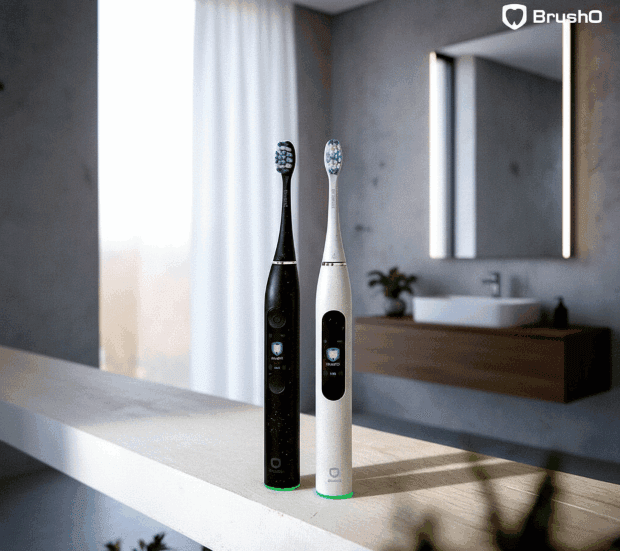
Tooth wear is a mechanical process influenced by friction, force, and repeated contact. While acidic beverages and aggressive brushing contribute, internal forces generated by oral muscles are equally significant.
The mouth contains powerful muscle groups responsible for:
• Chewing force generation
• Jaw stabilization
• Facial expression
• Swallowing coordination
These muscles can produce bite forces exceeding 70–150 pounds, and when tension becomes chronic, teeth experience sustained micro-loading that accelerates wear. This explains why individuals with seemingly healthy diets still develop enamel thinning or flattened cusps.
Common triggers include:
• Psychological stress or anxiety
• Night-time bruxism (grinding)
• Postural strain from screen use
• Jaw clenching during focus
• Poor breathing patterns
Many individuals are unaware that they maintain low-level tension throughout the day, creating constant pressure on tooth surfaces.
Muscle tension affects teeth through three main pathways:
Constant clenching raises contact intensity between upper and lower teeth, leading to:
• Surface flattening
• Micro-fractures in enamel
• Edge chipping
Grinding movements create lateral abrasion, wearing down protective enamel layers.
Stress-linked muscle tension often coincides with reduced salivary flow, weakening natural enamel protection and lubrication.
Because damage accumulates gradually, early warning signs are subtle:
• Teeth appearing shorter or flatter
• Increased sensitivity
• Jaw fatigue or soreness
• Hairline enamel cracks
• Headaches upon waking
Recognizing these indicators allows early behavioral adjustment before structural damage escalates.
Brushing cannot eliminate muscle tension, but improper brushing can amplify wear when enamel is already stressed.
High-risk brushing behaviors include:
• Applying excessive pressure
• Using abrasive motions
• Over-brushing frequency
• Uneven zone coverage
Smart brushing systems such as BrushO mitigate these risks by:
• Monitoring pressure levels
• Ensuring balanced coverage across 6 zones and 16 surfaces
• Providing technique feedback
• Supporting consistent, gentle brushing habits
Reducing brushing-induced friction prevents cumulative damage layered on top of muscle-related stress.
• Relax jaw posture when not chewing
• Avoid resting teeth together
• Maintain ergonomic posture during screen work
• Hydrate to support saliva function
• Night guards for grinding
• Stress management routines
• Personalized brushing analytics
• Routine dental monitoring
Combining muscular awareness with optimized brushing technique produces measurable long-term stability.
Modern preventive oral health focuses on behavioral biomechanics — understanding how daily actions shape long-term outcomes.
Tooth wear rarely stems from a single cause. Instead, it reflects:
• Mechanical stress
• Habit patterns
• Brushing dynamics
• Muscular tension
AI-powered brushing ecosystems like BrushO help transform oral care from a passive routine into measurable habit optimization, reducing compounding mechanical stress across years of daily use.
Oral muscle tension represents a silent but powerful force influencing tooth wear. Chronic clenching, grinding, and jaw strain generate pressure patterns that gradually reshape enamel and dental structure. While these forces cannot always be eliminated, awareness, behavioral adjustments, and intelligent brushing tools significantly reduce long-term impact. Protecting teeth is not only about cleaning them — it is about managing the forces acting on them every day.
Feb 10
Feb 9

The xerostomia is the symptom that the patient describes as the dry mouth, and the Sjogren syndrome is the systemic autoimmune condition that the clinician identifies as one of the causes that the symptom reveals. The dry mouth that the patient reports may follow the medication, the radiation, th...

The sinus lift is the augmentation procedure that the clinician performs to create the bone height that the posterior maxilla requires for the implant, and the choice between the lateral window and the transcrestal approach determines the surgical trauma, the healing, and the implant that the sit...

Post-extraction bleeding is one of the most common and most distressing experiences after a tooth extraction. For most patients, a small amount of oozing from the extraction site for 24 to 48 hours after the procedure is completely normal. However, when bleeding becomes excessive, prolonged, or d...

The skeletal class III malocclusion is the condition that the clinician treats with the orthognathic surgery or the camouflage orthodontic treatment, and the decision between the two paths determines the function, the aesthetics, and the stability that the patient receives. The orthognathic surge...

Interproximal enamel reduction — commonly referred to as IPR, slenderizing, stripping, or contouring — is the controlled removal of small amounts of enamel from the proximal surfaces of teeth. Despite sounding more invasive than it is, IPR is one of the most widely used and clinically safe proced...

The gingival graft is the surgical procedure that the periodontist performs to restore the keratinized tissue and to cover the exposed root, and the choice between the free gingival graft and the connective tissue graft determines the outcome that the patient receives. The free gingival graft har...

Denture adhesives — commonly known as fixatives or denture creams — are among the most widely used adjuncts in prosthodontic care. Millions of complete and partial denture wearers use some form of adhesive daily, often without a clear understanding of what these products do, when they should be u...

When a young patient presents with an immature tooth that has lost its vitality — typically due to trauma or deep caries — the endodontist faces one of the most consequential decisions in paediatric endodontics. The permanent root has not finished forming, the apex remains open, and the tooth is ...

The ankyloglossia is the condition that the lingual frenulum restricts the movement of the tongue, and the release of the frenulum in the infant is the procedure that the clinician performs to restore the function that the feeding and the speech require. The assessment that the clinician performs...

Dental amalgam fillings have been in clinical use since the mid-19th century, making them one of the most historically established restorative materials. In 2026, the conversation around amalgam replacement has shifted from a simple material preference debate to a nuanced clinical assessment of w...

Costruire rapidamente e a basso costo una rete di dati sulla salute orale in modo che tutti possano creare.
Costruire rapidamente e a basso costo una rete di dati sulla salute orale in modo che tutti possano creare.


Address: RM 1427, 14/F RADIO CITY 505, HENNESSY RD CAUSEWAY BAY, HONG KONG
Code: 000000
Phone: +852-53758652
Email: customerservice@brusho.com