
The BrushO Reward System is revolutionizing the way we think about daily oral care. By transforming your brushing routine into a data-driven habit loop, BrushO incentivizes consistency and good technique through a unique reward model. From earning points to unlocking free brush heads and even digital tokens, this system isn’t just about cleaning your teeth—it’s about making every brush count. With rising awareness of preventive health and habit tracking, consumers expect more from their health devices. BrushO, an AI-powered smart toothbrush, goes beyond just improving your brushing technique. Its built-in Reward System motivates users to brush properly and consistently by offering real, redeemable rewards for positive behaviors. The result? Healthier smiles—and a deeper commitment to daily oral care.
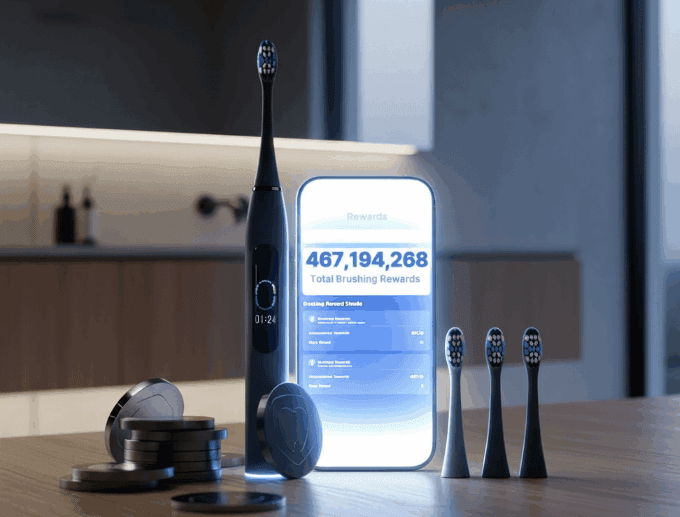
Every time you brush with your BrushO smart toothbrush, the built-in AI tracks key performance metrics:
• Brushing time
• Coverage of all 6 zones / 16 surfaces
• Pressure control
• Daily consistency
Based on your performance, the system awards you Brush Points—a gamified score that turns your routine into a trackable habit.
✅ Example: Brushing twice a day with full zone coverage = 10 points/day
❌ Brushing too quickly or missing zones = fewer or no points
Unlike typical apps that offer digital badges, BrushO’s rewards have real-world value:
• Redeem points for free brush heads
• Unlock exclusive member offers
• Access limited-edition accessories
• Earn tokens in eligible regions
This system not only reinforces good habits but also reduces the cost of maintaining high-quality oral hygiene.
The BrushO app serves as your personal brushing coach and reward dashboard, showing:
• Daily/Weekly/Monthly brushing reports
• Reward history and point balance
• Redemption options
• Habit streaks and personal progress
Through this transparent and data-driven platform, users can visually track their journey to better oral health—and enjoy tangible perks along the way.
Behavioral science shows that immediate feedback and small rewards enhance motivation. BrushO taps into this principle by making each brushing session count towards your reward goals.
Because rewards are cumulative, users are more likely to:
• Stick to proper technique
• Brush twice daily
• Return to the app regularly
This long-term engagement is essential for preventing plaque buildup, gum disease, and enamel erosion.
Traditional toothbrush brands profit from selling disposable brush heads. BrushO flips the model by offering free brush heads for consistent users, funded by brand loyalty and long-term engagement, not by overcharging on consumables.
BrushO is also pioneering a reward ecosystem, where loyal users can earn tokens by maintaining healthy routines. These tokens may be used for:
• In-app purchases
• Health-related digital goods
• Future staking or community governance features
This positions BrushO as the first oral care device with real economic incentives tied to health behavior.
Here’s how to make the most out of your BrushO experience:
| Strategy | Benefit |
| Brush twice a day, every day | Max points and build streaks |
| Cover all 6 zones & 16 surfaces | Higher brushing score |
| Avoid overpressure | Protect enamel and improve reward accuracy |
| Use the app for tracking | Monitor your habits and redeem rewards |
| Refer friends | Unlock bonus tokens or brush heads |
The BrushO Reward System isn’t just a marketing gimmick—it’s a powerful tool backed by behavioral science and digital innovation. By rewarding proper brushing technique, it fosters lifelong oral care habits while giving users something in return. Whether you’re a parent encouraging kids to brush better, a tech-savvy adult tracking habits, or someone seeking smarter wellness tools, BrushO’s reward model makes brushing not just essential—but rewarding. BrushO is an AI-powered smart toothbrush brand founded with the mission to make oral care smarter, personalized, and value-driven. Endorsed by dental professionals across the UK and introduced by Stanford, BrushO transforms brushing into an intelligent daily ritual—complete with real-time feedback, advanced pressure sensors, and a powerful reward ecosystem.
Jan 27
Jan 26

Saliva has moved from the byproduct of the examination to the fluid that the modern practice can read, and the diagnostics that the salivary sample supports now reach from the caries risk to the periodontal inflammation and beyond. The fluid is easy to collect, safe to handle, and rich in the pro...

The narrow alveolar ridge is the common obstacle that the implant plan meets in the healed posterior site, and the ridge split technique is the approach that widens the crest without the block graft and the second surgical site. The technique uses the viscoelastic property of the bone, and the co...

The resin-bonded bridge is the conservative alternative to the conventional fixed prosthesis, and its place in the modern practice has widened as the adhesive dentistry matured. The prosthesis replaces the missing tooth with the minimal removal of the enamel from the abutment, and the retention i...

The systemic antibiotic has a defined and a narrow place in the periodontal therapy, and the clinician who respects its limits uses it well while the clinician who reaches for it routinely erodes both the result and the antibiotic stewardship. The mechanical debridement remains the foundation of ...

The bond failure of the bracket is the interruption that the fixed orthodontic treatment can tolerate in the small number but not in the pattern, and the clinician who understands the cause reduces the frequency that the repeated rebonding records. The failure that recurs on the single tooth poin...

The prescription pad is one of the most common sources of the oral complaint that the patient brings to the dental office, and the clinician who does not think of the medication may spend the appointment treating the symptom that the drug created. The list of the agents that affect the mouth grow...

The intraoral scanner has moved from the novelty of the early adopters to the standard equipment of the modern prosthodontic practice, and the comparison with the conventional impression has become a daily question rather than an academic one. The scanner captures the surface of the teeth and the...

The endodontic retreatment is the second chance that the tooth receives when the initial treatment fails to resolve the infection or the symptoms, and the procedure is both more demanding and more rewarding than the primary treatment. The clinician who retreats the tooth encounters the filling ma...

The access preparation is the gateway of every root canal treatment, and it is the step at which the outcome of the case is most often decided, for good or for ill. A well-designed access straightens the canal system, removes the coronal obstruction, and allows the instruments and the irrigants t...

The restoration that the laboratory returns is only as good as the information that the clinician sends, and the communication between the dentist and the technician is the step that determines whether the crown, the veneer, or the bridge meets the expectation of the patient. The shade, the form,...


Address: RM 1427, 14/F RADIO CITY 505, HENNESSY RD CAUSEWAY BAY, HONG KONG
Code: 000000
Phone: +852-53758652
Email: customerservice@brusho.com
