
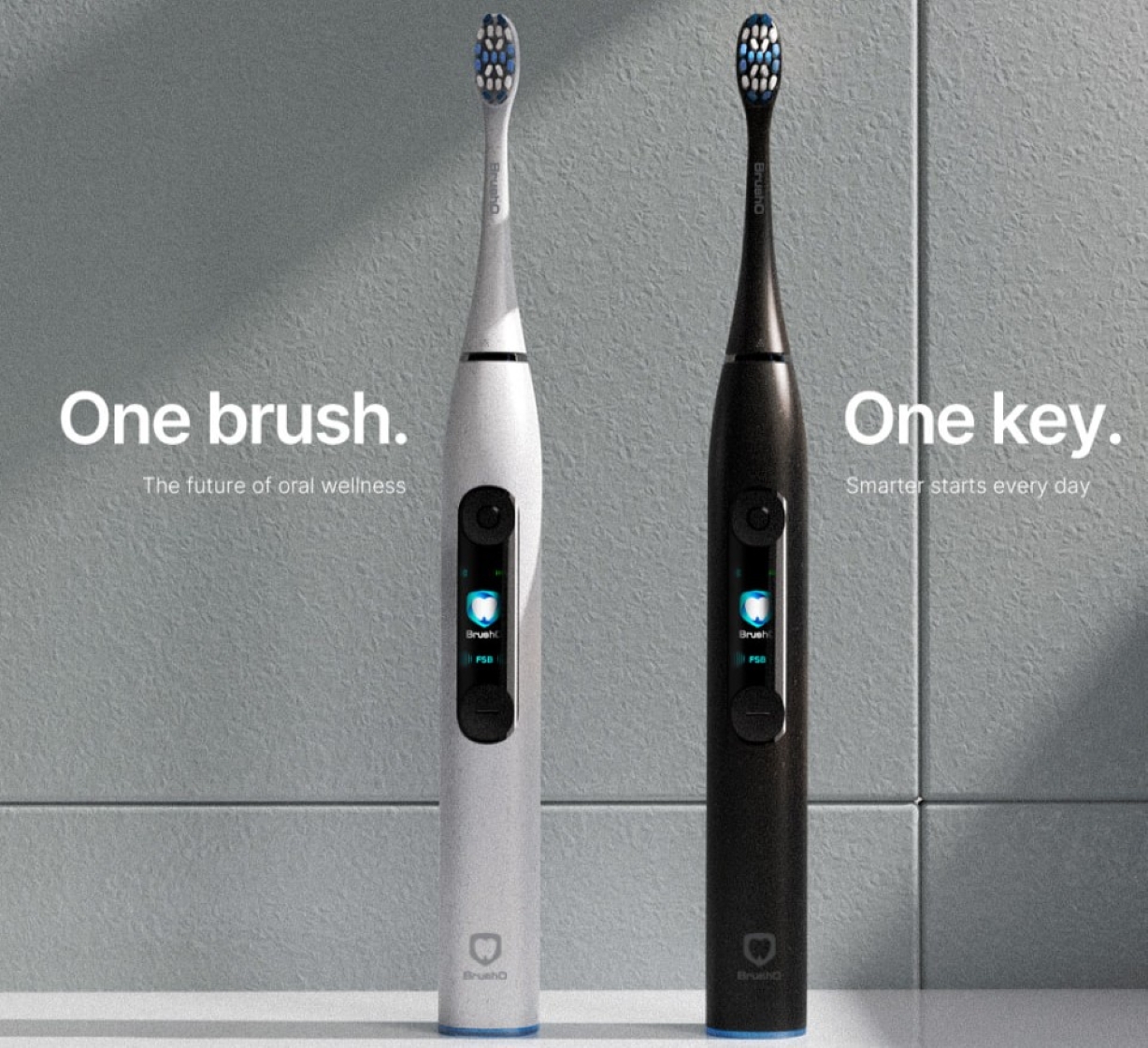
Visible stains aren’t the only sign of wear. Over hundreds of brushing sessions, filaments gradually lose their stiffness, splay outward, and the end-rounded tips flatten—dramatically reducing plaque removal along your gumline and between teeth. Meanwhile, unseen bacteria and food particles can lodge deep within the bristle base.
🪄 BrushO Fix:
Replace your brush head every three to four months regardless of appearance, per ADA guidelines. On BrushO middle and hard heads, a pale-pink wear-indicator stripe fades to signal exactly when to swap.
Topping off your brush after every use may seem safe, but lithium-ion cells actually prefer moderate discharge cycles. Constantly maintaining 100% charge stresses the battery’s chemistry, while allowing it to fully deplete risks deep-discharge damage that can shorten overall lifespan.
🪄 BrushO Fix:
Wait until your battery level drops to around 20% before recharging, then disconnect once full. Plus, run a complete 0→100% cycle every 4–6 weeks to recalibrate the battery management system and preserve long-term capacity.
A damp, enclosed environment is a breeding ground for mold and bacteria—especially in those hard-to-reach bristle bases. Capping or storing your brush head before it fully dries traps moisture, leading to musty odors and potential microbial growth that defeats every brushing effort.
🪄 BrushO Fix:
After rinsing, vigorously shake off excess water, then stand your brush upright in open air until completely dry. Only cap or cover the head once no visible moisture remains.
Relying on feel alone means you miss out on BrushO’s data-driven insights. The app doesn’t just tell you when to replace your head or when to charge; it shows where you’re over- or under-brushing with live coverage heat-maps, logs pressure patterns to protect your gums, and delivers firmware updates that fine-tune brushing modes.
🪄 BrushO Fix:
Sync after every session. Let the app track your pressure, coverage, and wear—then act on its “Head Replacement Recommended” and “Time to Charge” alerts based on real-use metrics, not a calendar.
Neglecting chargers, holders, and any storage cases can silently undermine performance. Dust or toothpaste residue on charging contacts increases resistance and can lead to slow or incomplete charging. Unclean storage stands and travel cases can reintroduce contaminants back onto your brush.
🪄 BrushO Fix:
- Charging Base: Wipe metal contacts weekly with a dry cloth or cotton swab.
- Storage Stands/Travel Cases: Clean monthly with mild soap and warm water; air-dry fully before reassembling.
- Spare Heads: Store extras in a cool, dry place and use color-coded rings to avoid mix-ups and cross-contamination.
Don’t let these myths short-circuit your BrushO’s performance. 🥺
Follow these official care tips—swap heads on schedule, charge smart, dry thoroughly, sync faithfully, and maintain accessories—to unlock the full power of your AI-driven oral-care routine.
Ready to transform your brushing routine?
Discover the full BrushO experience—shop brush heads, download the app, and unlock AI-powered clean at BrushO. Join the smart-brushing revolution today!
Aug 8
Aug 7

Coffee and red wine are two of the most common causes of teeth staining, and the stains they leave behind are often considered a cosmetic nuisance rather than a dental health issue. However, these extrinsic stains can make teeth look dull, yellow or brown, and they can affect a person's confidenc...

Mouth sores and ulcers are common oral health issues that can cause significant discomfort and pain. These lesions can affect eating, speaking, and overall quality of life, and understanding their healing times and treatment options can help patients manage them effectively. From common canker so...

X-ray imaging has been the gold standard for detecting cavities for decades, but laser-based technologies now offer a different approach to finding tooth decay. Laser cavity detection uses fluorescence and laser light to identify changes in tooth structure before they appear on an x-ray, and unde...

Facial furrows are not just a cosmetic concern, they are visible markers of the way skin ages and how it responds to dehydration. Dry skin is one of the most common contributors to early and deepening facial lines, and understanding the underlying causes helps explain why certain areas of the fac...

Grinding or clenching the teeth at night, known as bruxism, is more than a dental issue. The muscles that close the jaw are among the strongest in the body, and their chronic overactivation can trigger headaches, ear pain, facial discomfort and disrupted sleep. The connection between bruxism and ...

Decortication, the deliberate removal of a cortical plate to expose or to decompress the tissue beneath it, appears in oral surgery under several names and in several contexts, from transalveolar extraction of a deeply impacted third molar to alveoloplasty of an irregular ridge and to decompressi...

Lichenoid lesions of the oral mucosa present a diagnostic problem before they present a therapeutic one, because the same white reticulated pattern can represent idiopathic oral lichen planus, a contact reaction to a restoration, a drug eruption, or an entirely benign variation such as leukoedema...

Bone in the adult jaw is never quiescent. Roughly 10 percent of the human skeleton is replaced every year, and the alveolar process turns over faster than most skeletal sites because it is loaded intermittently by mastication and by the forces transmitted through the periodontal ligament. The ost...

Root canal treatment succeeds or fails at the interface between the filling material and the dentin wall, and no material has changed that interface more in the past two decades than the calcium silicate bioceramic sealer. These materials descend from Portland cement, set in the presence of moist...

Ameloblastoma is the most common clinically significant odontogenic tumor, and its behaviour is defined less by its ability to spread than by its tendency to return after apparently complete removal. Conservative surgery preserves function and facial contour, and decortication is the procedure mo...

모두가 쉽게 구축할 수 있는 방식으로 구강 건강 데이터 네트워크를 저렴한 비용으로 빠르게 구축하세요.


Address: RM 1427, 14/F RADIO CITY 505, HENNESSY RD CAUSEWAY BAY, HONG KONG
Code: 000000
Phone: +852-53758652
Email: customerservice@brusho.com