
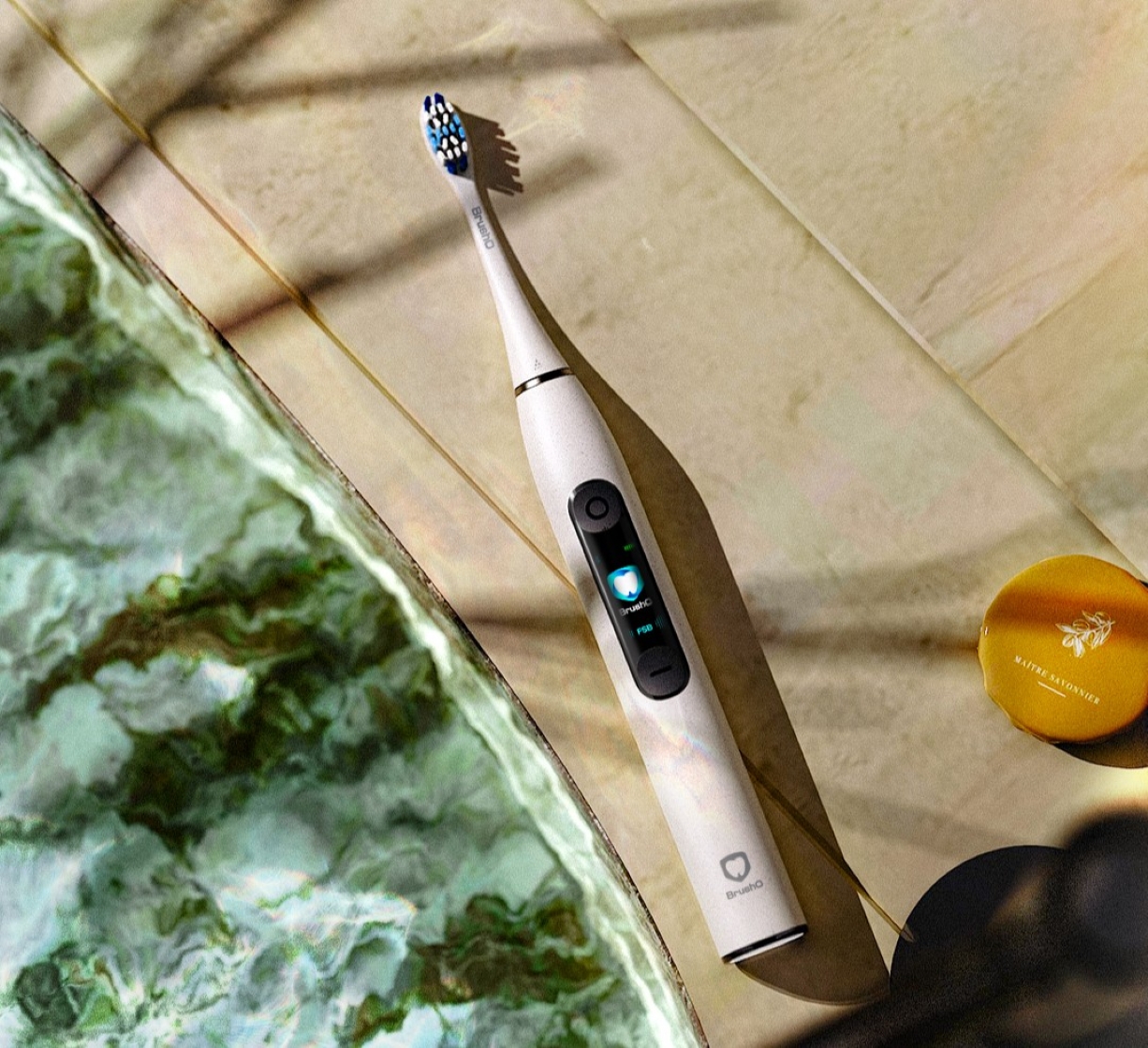
Over time, even premium brush heads wear down. Stiffness fades, bristles fray, and plaque removal power decreases. Regular replacement ensures:
✔️ Complete Plaque Clearance: Fresh end-rounded bristles effectively sweep away plaque at the gumline and interdental spaces.
✔️ Gum Protection: Intact filaments maintain gentle contact; frayed bristles can scratch or irritate.
✔️ Hygienic Freshness: Damp bristles can harbor bacteria; new heads reduce microbial buildup and risk of reinfection.
Trusted dental sources like the American Dental Association and MouthHealthy recommend changing brush heads every three to four months—or sooner if you see visible fraying. At BrushO, our wear-indicator stripe on middle and hard models provides a quick visual cue: when the pale-pink band fades significantly, it’s time for a replacement. This simple color fade aligns with clinical testing and helps you stay on schedule without guessing.
Fighting off a cold, flu, or stomach bug? Microbes can linger on bristles for days after recovery. To break the germ cycle and avoid reinfection, always swap in a new BrushO head once you’re symptom-free. We recommend keeping an extra head in your bathroom caddy or travel kit—so a clean, germ-free brush is always within reach.
With 11 brushing modes—from Standard and Gum-Care to Whitening and Deep-Clean—your usage pattern affects how quickly bristles wear:
✔️ Standard Daily Mode: Designed for gentle, everyday cleaning; most users find 3–4 months ideal.
✔️ Gum-Care & Sensitive Modes: Softer filaments deliver gentle pressure but may splay slightly faster—consider checking for wear at the 8–10 week mark.
✔️ Whitening & Deep-Clean Modes: Firmer filaments polish enamel and remove stains; check wear around 10–12 weeks to maintain peak efficacy.
Your BrushO app monitors head health and sends a “Head Replacement Recommended” alert based on actual wear indicators, so you replace exactly when needed.
Ready to swap? Follow these simple steps to install your fresh BrushO head:
1️⃣ Power Down: Turn off your BrushO handle.
2️⃣ Remove Old Head: Press the release button or twist the head off.
3️⃣ Attach New Head: Line up and slide or twist on a fresh BrushO head until it clicks securely.
4️⃣ Verify & Reset: Gently tug to confirm it’s locked in place, then open the BrushO app and tap “Reset Head Status” to restart your replacement tracker.
Proper storage extends bristle life and hygiene:
∙ Rinse Thoroughly: Flush bristles under running water to remove debris.
∙ Shake Excess Water: A quick flick removes moisture that could harbor bacteria.
∙ Dry Upright in Open Air: Avoid sealed holders until fully dry to prevent mold.
∙ Separate Multiple Heads: If sharing storage, keep brush heads apart to avoid cross-contamination.
Scenario Replace Every BrushO Reminder
Routine daily brushing 3–4 months Wear-indicator stripe + app alert
Gum-Care & Sensitive Modes ~2–2.5 months App alert when gentle filaments splay
Whitening & Deep-Clean Modes ~2.5–3 months App alert when firmer filaments show wear
After illness recovery Immediately Manual swap reminder in app
🛡️ With BrushO’s verified features—DuPont® Tynex® bristles, wear-indicator stripe, and data-driven app nudges—you can trust this guide to keep your brush head fresh and your oral care game strong.
📲 Learn more: www.brusho.com
👥 Join our community: t.me/BrushOcommunity
🛒 Try it now: AI-Powered + 40-day battery + 11 modes + IPX7 Waterproof
Aug 7
Aug 6

Squamous cell carcinoma is not a single, uniform disease, and two of its oral variants illustrate the extremes of its behavior. Verrucous carcinoma is a slow-growing, exophytic tumor that almost never metastasizes, while spindle cell carcinoma is an aggressive, sarcomatoid malignancy that can be ...

Most people expect a toothache to be the first sign of pulp disease, but some forms of pulpitis are surprisingly silent. A pulp polyp is the visible result of chronic hyperplastic pulpitis, a condition in which the dental pulp grows out of a large carious opening as a fleshy mass. Recognizing thi...

Dry mouth is not merely uncomfortable; it is a medical condition with real consequences for teeth, speech, swallowing and quality of life. When the salivary glands cannot produce enough saliva, medications called sialogogues can restore some of the missing fluid. Pilocarpine and cevimeline are th...

A blister in the mouth can be the first warning of a systemic autoimmune disease, and two disorders deserve particular attention in the dental chair: pemphigus vulgaris and mucous membrane pemphigoid. Both produce chronic oral ulceration, yet their immunologic targets, clinical behavior and long-...

When infection drains from a tooth, the body often creates a visible escape route, and the dentist must interpret these fistulous openings correctly. A parulis is the common gum boil that signals chronic periapical infection, while an oroantral fistula is a communication between the mouth and the...

Among the fibro-osseous lesions of the jaws, the ossifying fibroma holds a unique position because it is a true neoplasm, unlike the reactive cemento-osseous dysplasia discussed in an earlier article. It grows continuously, expands bone and requires surgical removal, and its cemental variant adds...

Not all keratocystic lesions of the jaw behave alike, and one of the most important distinctions in oral pathology separates the orthokeratinized odontogenic cyst from its better-known relative, the odontogenic keratocyst. Although the two lesions look similar under the microscope at first glance...

Periodontal disease is usually a slowly progressive infection, but a rare form called necrotizing ulcerative periodontitis destroys tissue with alarming speed. Unlike ordinary periodontitis, this condition produces necrotic, cratered papillae, deep pocketing and rapid bone loss, and it appears al...

Every parent has met the child who refuses to eat because of painful mouth sores, and most of these children have one of two viral illnesses: herpangina or hand, foot and mouth disease. Both are caused by enteroviruses, both produce fever and oral ulcers, and both are overwhelmingly common in you...

Cementoosseous dysplasia is one of the most common fibro-osseous lesions found on dental radiographs, yet it is also one of the most frequently misdiagnosed. The lesion replaces normal bone with cellular fibrous tissue and cementum-like material, and it appears in several forms that range from a ...

Build an oral health data network quickly and at low cost in a way that everyone can build.


Address: RM 1427, 14/F RADIO CITY 505, HENNESSY RD CAUSEWAY BAY, HONG KONG
Code: 000000
Phone: +852-53758652
Email: customerservice@brusho.com