
Not sure when to toss your old toothbrush? You’re not alone. Worn-out bristles, bacteria buildup, and decreased cleaning power could all mean it’s time for a replacement. In this post, we’ll help you recognize the signs your toothbrush is too old—and show how BrushO’s AI-powered tracking and lifetime free brush head program make replacements easy.
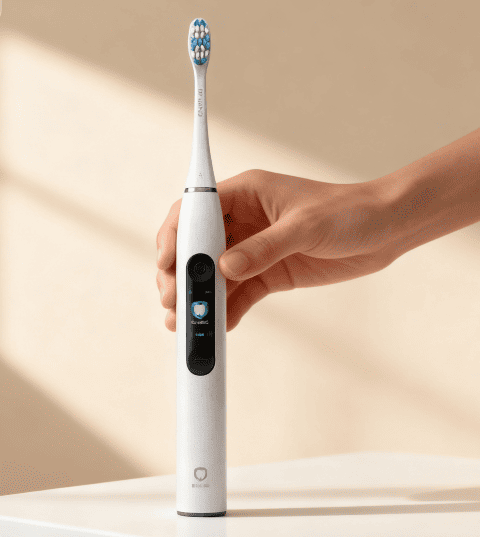
Your toothbrush is the frontline tool in maintaining oral hygiene. But over time, even the best toothbrush—manual or electric—loses its effectiveness. Old toothbrushes can harbor bacteria, lose their cleaning power, and even harm your gums. So, how do you know when it’s time to replace your brush head?
This is the most obvious sign. Worn bristles can’t clean your teeth properly and may irritate your gums. If you notice the bristles have lost their original shape, it’s time for a replacement.
Dentists recommend replacing your toothbrush or brush head every 3 months. After this period, bristles lose effectiveness and bacteria begin to accumulate.
If brushing doesn’t leave your mouth feeling as fresh or clean as before, it could be because the bristles aren’t reaching plaque and debris as effectively.
After an illness, it’s smart to change your brush head. Germs can linger on bristles and potentially lead to reinfection.
Using an old toothbrush can lead to:
-Increased plaque buildup
-Bad breath
-Gum irritation or recession
-Less effective fluoride delivery from toothpaste
-Risk of bacteria or fungal contamination
BrushO isn’t just a smart toothbrush—it’s a brushing partner. With AI-powered usage tracking, BrushO monitors your brushing frequency, pressure, and duration. When it detects your brush head is due for a change, it reminds you directly in the app or via smart alerts.
And here’s the game-changer:
That’s right. As part of the BrushO Reward System, you can earn points by maintaining healthy brushing habits. Once you’ve earned enough points, you can redeem them for free brush heads—forever. This disrupts the traditional model of toothbrush companies profiting from expensive refills.
📌 BrushO’s lifetime brush head plan requires consistent daily brushing to earn points and qualify for free redemptions.
Use a calendar app or your phone’s reminder system. Or better—let BrushO handle this for you automatically.
Always have at least one new brush head on hand, so you can switch as soon as needed.
Your oral health is too important to rely on worn-out tools. Replacing your toothbrush—or better, switching to a smart solution like BrushO—ensures your brushing is always effective, hygienic, and safe. With BrushO’s AI-powered tracking and free lifetime brush head plan, you’ll never worry about brushing with an old toothbrush again.
Nov 3
Nov 3

Fluoride in drinking water is the most cost-effective caries preventive measure in public health, and it is also the source of most avoidable fluoride exposure in young children. The balance between benefit and risk depends on concentration, on total intake from all sources and on the age of the ...

A mouthguard is the only piece of protective equipment that a dentist can prescribe, and the difference between the cheapest and the best version is often less than the cost of a single repair. This guide explains what each type of mouthguard actually protects, how to judge fit, and what to check...

Distinguishing reversible from irreversible pulpitis is the single most consequential decision in endodontic diagnosis, because one leads to a restoration and the other to root canal treatment or extraction. The distinction rests on symptoms and pulp testing rather than on radiographs alone, and ...

A pregnancy epulis is a benign overgrowth of gum tissue that appears during pregnancy, most often in the second or third trimester. It can alarm patients because it grows quickly and bleeds easily, yet in most cases it needs no surgery and settles after delivery. Understanding what drives the gro...

When several teeth are missing, the choice usually narrows to a removable partial denture or a fixed implant-supported restoration, and cost is the factor patients raise first. Upfront price is only part of the comparison, because the two options differ in maintenance, comfort, effects on neighbo...

Most root canal failures are not caused by inadequate cleaning of canals that were found, but by canals that were never located. Molar anatomy varies widely, and the variation is not random: specific teeth in specific populations have predictable additional canals. Knowing where they hide is the ...

Gum massage is one of the oldest recommendations in oral care and one of the least understood. It has been described as a treatment for bleeding gums, a route to firmer tissue and, more recently, a way to reduce brushing force. This article separates the mechanisms that are supported by physiolog...

Interdental cleaning is the part of oral hygiene most people abandon first, and the choice between a floss pick and a length of string floss is often made on convenience. Convenience matters, because a tool that is used daily outperforms a superior tool that stays in the drawer, but the two devic...

Dementia changes the way a denture is worn, cleaned and tolerated, and the people who notice the change first are usually family carers rather than clinicians. Poor denture hygiene in this group is associated with mucosal infection, reduced food intake and, in frail patients, respiratory complica...

Chewing tobacco keeps nicotine and plant irritants in prolonged contact with a small area of mucosa, and the damage that results is concentrated exactly where the quid is held. The lesions that develop are often painless, which is why they are discovered during routine examination rather than bec...

모두가 쉽게 구축할 수 있는 방식으로 구강 건강 데이터 네트워크를 저렴한 비용으로 빠르게 구축하세요.


Address: RM 1427, 14/F RADIO CITY 505, HENNESSY RD CAUSEWAY BAY, HONG KONG
Code: 000000
Phone: +852-53758652
Email: customerservice@brusho.com