
Getting kids to brush their teeth regularly — and properly — can be a daily struggle. But what if brushing was a game, not a chore? BrushO makes brushing fun and rewarding for children by introducing real-time scores, brushing streaks, and competitive leaderboards — all driven by its AI-powered Fully Smart Brushing (FSB) system. In this article, we’ll show how BrushO turns daily oral care into a playful, positive competition that motivates kids to build lifelong brushing habits.
Many parents are familiar with the morning and bedtime brushing battles:
• Kids forget, rush, or don’t clean thoroughly.
• Traditional brushes offer no feedback or motivation.
• Children see brushing as boring or unnecessary.
Without consistent and correct brushing, kids are vulnerable to early cavities, plaque buildup, and gum issues. This is where BrushO changes the game.
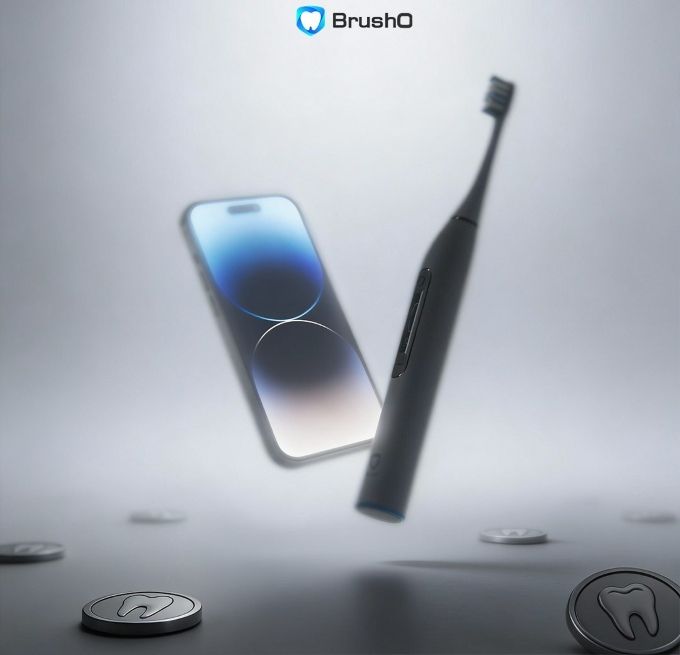
BrushO is not just another electric toothbrush — it’s a smart brushing assistant with built-in AI and real-time feedback. For kids, it feels more like a fun brushing game than a routine.
• Each brushing session is scored based on accuracy, time, and coverage.
• Kids earn points for brushing thoroughly in all 6 zones (not just front teeth).
• Daily streaks, improvement badges, and “best scores” add excitement.
• Progress is shown clearly in the BrushO Kids App Dashboard, perfect for parental encouragement and sibling competition.
• Each child’s profile is tracked individually.
• Weekly brushing scores are compared on a family leaderboard.
• “Brusher of the Week” gets recognition — and maybe even a small prize!
• Kids can join safe, anonymous brushing leagues with peers.
• Compete in brushing consistency streaks and accuracy leaderboards.
• Winners may earn bonus BRUSH tokens (if guardians enable token mode).
BrushO lets children earn actual rewards by brushing consistently:
• BRUSH Tokens are awarded for daily brushing, improvement, and streaks.
• Tokens can be redeemed for free brush heads or fun merchandise.
• Parents can even assign custom rewards — like more screen time or a sticker!
✅ Unlike gimmicky brushes, BrushO rewards technique, not just participation.
• Daily reports are sent to parents for visibility.
• The app shows brushing areas that need improvement — great for coaching.
• Parents can enable/disable competition mode or set family-friendly goals.
Studies show that positive reinforcement is the most effective way to shape children’s habits. With BrushO:
• Kids associate brushing with fun, not punishment.
• Visual progress tracking helps them understand their improvement.
• Long-term, they develop self-motivated brushing discipline — even without adult reminders.
“My 7-year-old used to hate brushing. Now she’s checking her score every day and trying to beat her big brother!” — Emma T., BrushO Parent User
“This is the first toothbrush that actually teaches my kids how to brush properly. And they want to do it!” — James K., Father of 2
If you want your kids to brush better, longer, and with real motivation, it’s time to upgrade to BrushO. With gamified brushing, friendly competition, and daily rewards, BrushO transforms dental care into an experience kids love — and parents trust.

Hyperdontia is the presence of one or more teeth in excess of the normal dental formula, and the resulting teeth are described as supernumerary. The condition is common enough to appear in routine practice but variable enough in presentation that the decision to intervene is rarely straightforwar...

Few patients complete orthodontic treatment without asking whether their teeth will move back. The honest answer is that they will, to some degree, in the majority of cases. Relapse is not a failure of treatment but a predictable biological response, and understanding why it happens is the basis ...

The mandible is the largest and most frequently fractured bone of the facial skeleton, and its management sits at the interface between trauma surgery and restorative dentistry. Treatment has shifted over four decades from prolonged maxillomandibular fixation towards rigid internal fixation with ...

Chronic liver disease affects hundreds of millions of people worldwide, and its prevalence continues to rise with the epidemic of metabolic liver disease. The liver is central to haemostasis, drug metabolism and immune competence, and its failure therefore alters the risk profile of almost every ...

Excessive gingival display, commonly described as a gummy smile, is one of the most frequent aesthetic concerns presented to dental practitioners. The condition is not a single entity but a clinical presentation that can arise from skeletal, gingival, muscular or dental factors, and the treatment...

Drug-induced gingival overgrowth is a well-recognised adverse effect of several widely prescribed medications, and it remains one of the most common drug-related findings in periodontal practice. The condition produces firm, fibrous enlargement of the gingiva that can interfere with speech, masti...

Denture stomatitis is an inflammatory condition of the denture-bearing mucosa that affects a large proportion of removable prosthesis wearers, yet it is frequently dismissed as a cosmetic annoyance. The condition is driven by a Candida biofilm on the fitting surface of the prosthesis, and it is m...

Chronic kidney disease affects an estimated 850 million people worldwide, and the number of patients surviving on dialysis or with a renal transplant continues to rise. These patients carry an oral disease burden that is substantially higher than that of the general population, and their medical ...

Angular cheilitis is an inflammatory lesion of the labial commissures that presents with erythema, fissuring and crusting at the corners of the mouth. It is one of the most common conditions encountered in general dental practice, yet it is frequently treated as a simple fungal infection and allo...

Adverse reactions to dental materials are uncommon but they are not rare, and they are frequently misdiagnosed because the oral mucosa responds to allergens in a limited number of ways. A burning sensation, a persistent ulcer or an unexplained area of erythema may all represent a hypersensitivity...

Build an oral health data network quickly and at low cost in a way that everyone can build.


Address: RM 1427, 14/F RADIO CITY 505, HENNESSY RD CAUSEWAY BAY, HONG KONG
Code: 000000
Phone: +852-53758652
Email: customerservice@brusho.com