What Makes Smart Toothbrushes More Effective Than Manual Ones
Jan 23

Jan 23
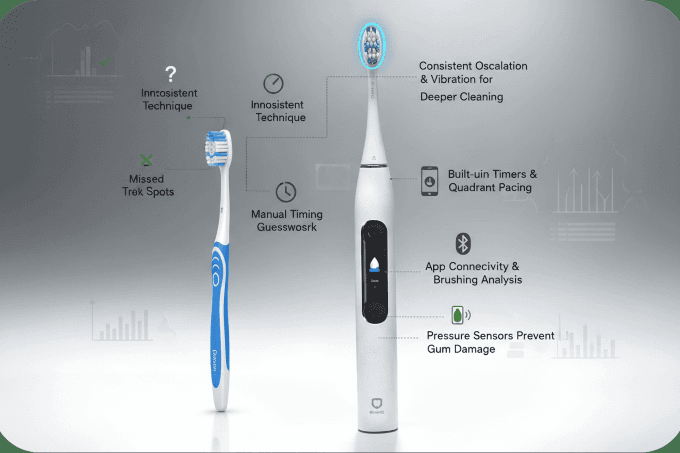
BrushO's smart toothbrushes go beyond traditional manual brushes by incorporating cutting-edge technology designed to enhance every aspect of your oral care routine. With built-in features like advanced pressure sensors, real-time feedback, dynamic brushing modes tailored to your specific needs, and comprehensive data tracking, BrushO’s smart toothbrushes ensure optimal brushing technique. These technologies not only help you remove more plaque with greater efficiency but also protect your gums and enamel from overbrushing, which is common with manual toothbrushes. By adapting to individual brushing habits and providing personalized guidance, BrushO's smart toothbrushes promote healthier teeth and gums, supporting long-term oral health and making daily brushing more effective than ever before. This article delves into the science behind these innovations and highlights the advantages that set smart toothbrushes apart from traditional manual ones.
 

Manual vs. Smart — A New Era in Oral Care

For decades, manual toothbrushes have been the standard tool for daily oral care. While they are inexpensive and widely used, manual brushes rely entirely on user technique and consistency—factors that vary significantly among individuals. BrushO's smart toothbrushes, on the other hand, combine modern electronics, sensors, and software to actively guide users toward better brushing habits, more thorough plaque removal, and healthier gums. These technological enhancements make BrushO smart brushes consistently more effective than manual ones for oral hygiene. In this article, we’ll explore what makes BrushO's smart toothbrushes superior and how they help users achieve better long-term dental health.

Intelligent Sensors Improve Brushing Technique

One of the biggest limitations of manual toothbrushes is that they offer no feedback on brushing force, angle, or duration. This often results in:
  • Brushing too hard (damaging enamel and gums)
  • Brushing too softly (missing plaque)
  • Uneven coverage of the tooth surfaces
BrushO's smart toothbrushes are equipped with real-time sensors that measure pressure, motion, and orientation. These detect whether you are applying too much force or missing areas of your mouth. When used with the BrushO app, the brush can generate:
  • Alerts for excessive pressure
  • Suggestions to slow down or speed up
  • Notifications for missed zones
This active guidance ensures users clean more effectively than when brushing manually, where no feedback exists. Technologies like AI motion detection and adaptive feedback take brushing well beyond what any manual brush can offer.

Consistent Cleaning With Built‑In Timers

Dentists recommend brushing for at least two minutes, twice a day, yet many people fall short. Studies show most manual brushing sessions are significantly shorter than recommended—especially without timing cues.
BrushO's smart toothbrushes solve this by incorporating built-in timers and quadrant pacing alerts, which make sure users brush:
  • The full two minutes
  • Each mouth quadrant evenly (upper left, lower right, etc.)
These timers help enforce proper brushing duration and improve cleaning consistency—something manual brushes simply cannot enforce.

Brushing Modes Tailored to Individual Needs

Manual toothbrushes offer a single mode: user-controlled scrubbing. BrushO's smart toothbrushes deliver multiple brushing modes that adapt to specific oral concerns, such as:
  • Sensitive Mode – gentler vibrations for sensitive enamel or gums
  • Gum Care Mode – focused stimulation around the gumline
  • Deep Clean Mode – enhanced plaque removal
  • Whitening Mode – targeting surface stains
These modes adjust speed, pressure, and vibration patterns, creating a customized experience that meets diverse oral health needs—far beyond the capabilities of a manual brush.

Real‑Time Feedback for Better Habits

BrushO's smart toothbrushes, connected to mobile apps, provide real‑time, visual feedback during brushing. Features commonly include:
  • Brushing coverage maps
  • Pressure analysis charts
  • Areas indicating missed brushing spots.
  • Daily, weekly, and monthly performance tracking
This interactive data helps users develop healthier brushing habits over time—a level of coaching unavailable with manual brushes. Users gain insight into their technique and improve it consciously, while manual brushing remains a subjective, untracked practice.

Enhanced Plaque Removal and Gum Health

Good technique is essential, but removing plaque effectively is the core goal of brushing. BrushO's smart toothbrushes use advanced technology such as:
  • Sonic or oscillating‑rotating motors to dislodge plaque more efficiently
  • Adaptive brushing algorithms that maintain optimal stroke patterns
  • Pressure modulation to protect gums while maximizing cleaning
Clinical studies show that powered brushes—especially BrushO's smart ones—can remove significantly more plaque than manual ones, reducing gingivitis and improving gum health when used consistently.

Behavior‑Driven Data Tracking and Motivation

Another advantage unique to BrushO's smart toothbrushes is long‑term data tracking. These devices monitor brushing trends and provide:
  • Streaks and progress reports
  • Bad habit warnings
  • Oral health scorecards
  • Recommendations for improvement
This ongoing tracking supports user accountability and encourages consistency—something manual brushing cannot accomplish because it lacks traceable metrics.

AI Assistance for Personalized Performance

Many of today’s BrushO smart toothbrushes integrate AI capabilities that learn from your brushing data over time. This leads to:
  • Personalized brushing guidance
  • Smart suggestions for pressure and speed
  • Customized reminders
  • Longitudinal brushing performance insights
By recognizing patterns in user data, AI empowers better decision‑making and improved outcomes, an advantage that manual brushes do not and cannot offer.

Smart Toothbrushes Elevate Oral Care Performance

While manual toothbrushes remain an accessible and familiar tool, they simply cannot match the effectiveness of BrushO's smart toothbrushes when it comes to:
  • Guided brushing technique
  • Adaptive cleaning modes
  • Real‑time feedback
  • Behavioral tracking
  • Long‑term oral health improvement
BrushO's smart toothbrushes bridge the gap between proper dental recommendations and real‑world habits, making superior oral care achievable for everyone. By combining modern technology with scientific design, these devices redefine how we brush—and why it matters for lifelong dental health.

Recent Posts

Evidence-Based Dentistry: Integrating Research into Clinical Decision Making

Evidence-Based Dentistry: Integrating Research into Clinical Decision Making

Evidence-based dentistry (EBD) represents a fundamental paradigm shift in how dental professionals approach clinical decision making. Rather than relying solely on tradition, anecdotal experience, or expert opinion, EBD provides a systematic framework for integrating the best available scientific ev

Xerostomia and Hyposalivation: Etiology, Diagnosis, and Management Strategies

Xerostomia and Hyposalivation: Etiology, Diagnosis, and Management Strategies

Xerostomia, the subjective sensation of oral dryness, and hyposalivation, the objective reduction in salivary flow, represent one of the most common yet underrecognized complaints encountered in dental practice. Affecting an estimated 20-30% of the general population and up to 40% of older adults, t

Orofacial Myofunctional Therapy: Clinical Applications in Airway and Craniofacial Development

Orofacial Myofunctional Therapy: Clinical Applications in Airway and Craniofacial Development

Orofacial myofunctional therapy (OMT) has emerged as a critical adjunctive intervention in modern dentistry, bridging the gap between orthodontics, sleep medicine, and pediatric airway management. This therapeutic approach targets the neuromuscular re-education of the orofacial musculature, addressi

Evidence-Based Dentistry: Integrating Research into Clinical Decision Making

Evidence-Based Dentistry: Integrating Research into Clinical Decision Making

Evidence-based dentistry (EBD) represents a fundamental paradigm shift in how dental professionals approach clinical decision making. Rather than relying solely on tradition, anecdotal experience, or expert opinion, EBD provides a systematic framework for integrating the best available scientific ev

Dental Practice Management: Modern Economics, Marketing, and Patient Retention

Dental Practice Management: Modern Economics, Marketing, and Patient Retention

The contemporary dental practice operates at the intersection of healthcare delivery and small business management, requiring practitioners to master competencies far beyond clinical excellence. Success in today's competitive landscape demands sophisticated understanding of practice economics, strat

Cleft Lip and Palate: Multidisciplinary Management from Birth to Adulthood

Cleft Lip and Palate: Multidisciplinary Management from Birth to Adulthood

Cleft lip and palate (CLP) represents the most common congenital craniofacial anomaly, occurring in approximately 1 in 700 live births worldwide, with significant variation across ethnic groups. The condition results from failure of fusion of the facial processes during early embryogenesis, specific

Zirconia and Lithium Disilicate: Contemporary All-Ceramic Restorations

Zirconia and Lithium Disilicate: Contemporary All-Ceramic Restorations

The transition from metal-ceramic to all-ceramic restorations represents one of the most significant material shifts in restorative dentistry over the past three decades. Driven by aesthetic demands, concerns about metal hypersensitivity, and remarkable advances in ceramic materials and CAD/CAM tech

Socket Preservation and Alveolar Ridge Augmentation: Evidence-Based Techniques

Socket Preservation and Alveolar Ridge Augmentation: Evidence-Based Techniques

Tooth extraction initiates a cascade of biological events that inevitably results in alveolar ridge remodeling—a process characterized by dimensional changes in both the horizontal and vertical planes that can compromise subsequent implant placement. The clinical significance of post-extraction ridg

Infection Control in Dentistry: Post-COVID Standards and Emerging Pathogens

Infection Control in Dentistry: Post-COVID Standards and Emerging Pathogens

Infection control has always been fundamental to safe dental practice, but the COVID-19 pandemic brought unprecedented scrutiny to dental infection prevention protocols. The recognition that SARS-CoV-2 transmits primarily through respiratory droplets and aerosols—and that dental procedures generate

Forensic Odontology: Identification Methods and Mass Disaster Response

Forensic Odontology: Identification Methods and Mass Disaster Response

Forensic odontology occupies a unique position at the intersection of dentistry, forensic science, and the legal system. The discipline applies dental knowledge to the identification of human remains, the analysis of bite mark evidence, and the estimation of age in both living and deceased individua
