
Have you ever noticed your food tastes different lately—or that some flavors seem duller than before? It may not be the food—it could be your oral habits. Your tastebuds are directly influenced by your dental hygiene, diet, and even brushing technique. From gum health to plaque buildup, your daily oral care routine plays a bigger role in how you experience flavor than you might think. In this article, we explore how your tastebuds reflect your oral health and how smart brushing with tools like BrushO can help restore your full sense of taste.
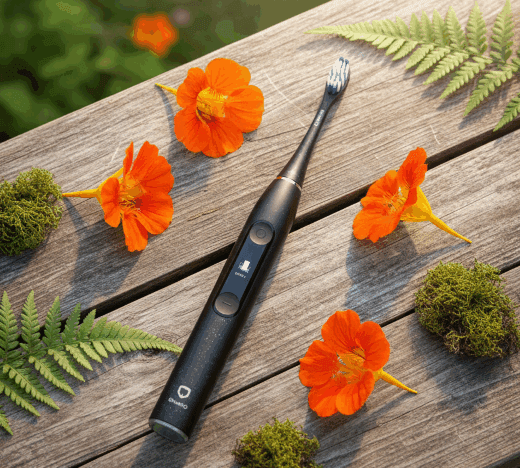
Your tongue is covered with thousands of tastebuds—but it’s also a common hiding place for bacteria, food debris, and plaque. Poor brushing or skipping tongue cleaning allows these bacteria to form biofilms, coating your taste receptors and dulling your ability to perceive flavors.
• Diminished taste for salty, sweet, or sour flavors
• Metallic or bitter aftertastes
• Bad breath or tongue coating
• Increased sensitivity to spicy foods (often linked to inflamed tissues)
Not brushing your tongue allows odor-causing bacteria and dead cells to accumulate. This layer can block taste receptors, leading to muted flavors and a “fuzzy tongue” feeling.
✅ Solution: BrushO encourages full-mouth cleaning, including gentle brushing of the tongue. Some models offer sensitive modes ideal for this.
Inflamed gums from plaque buildup or gingivitis can release compounds that affect saliva composition, subtly altering your perception of taste.
✅ Solution: BrushO’s pressure sensors help avoid over-brushing while ensuring gumline cleaning is consistent and gentle.
Saliva is essential for dissolving food particles and allowing taste molecules to reach your receptors. Inconsistent brushing, especially at night, can lead to dry mouth, which reduces taste sensitivity.
✅ Solution: BrushO reminds you to brush at the optimal times and encourages routine hydration as part of smart oral habits.
Some mouthwashes contain alcohol or strong antiseptics that temporarily numb tastebuds or alter their ability to detect flavors.
✅ Solution: Balance mouthwash use with gentle smart brushing, and avoid high-alcohol formulas.
BrushO is designed to improve every aspect of your oral routine:
• Real-time coverage alerts ensure you never miss the tongue or inner surfaces.
• Custom brushing modes like “sensitive” and “deep clean” help remove tongue film and plaque gently.
• Habit tracking and $BRUSH rewards motivate consistency so your mouth stays fresh and clean daily.
• Reports and feedback reveal patterns that may be causing taste dullness.
While many taste issues are linked to hygiene, some may signal underlying health problems:
• Persistent metallic taste
• Sudden loss of taste (could be due to infections or medications)
• Burning sensation on the tongue (possible vitamin deficiencies or oral infections)
If these symptoms persist, consult a dentist or physician.
• Brush your tongue daily, not just your teeth.
• Use a smart toothbrush like BrushO to maintain balanced pressure and complete coverage.
• Stay hydrated to support saliva production.
• Avoid sugary snacks that contribute to bacterial buildup.
• Don’t ignore gum inflammation or plaque at the back of the tongue.
Your tastebuds offer more than just flavor—they’re subtle messengers of your oral hygiene habits. If things aren’t tasting quite right lately, it may be time to evaluate your brushing technique, tongue cleaning, and oral routine. With BrushO’s smart guidance, you can keep your mouth clean, your gums healthy, and your tastebuds fully activated—so every bite tastes exactly as it should.
Jan 16
Jan 16

Thumb sucking and pacifier use are normal self-soothing behaviors in infancy, and most children give them up on their own by school age. The dental problem arises when the habit continues past the eruption of the permanent front teeth, because the persistent pressure reshapes the growing jaw and ...

Most people never think about the shape of their tooth roots, but root morphology determines how a tooth is treated when disease strikes. Taurodontism and dilaceration are two developmental anomalies that change root anatomy in distinctive ways, and both have major implications for endodontics, e...

Dental injuries are among the most common sports-related injuries, and a mouthguard is the simplest piece of equipment an athlete can wear. Yet many players still train without one, often because they have never been told which type to choose or how a well-fitted guard feels. Understanding the pr...

Piezoelectric surgery has changed the way oral surgeons cut bone. Instead of a rotating bur, a piezotome uses ultrasonic vibrations to cut mineralized tissue while leaving soft tissue largely untouched. The technique is now routine for osteotomies, sinus lifts and delicate procedures where precis...

Children's teeth vary naturally in size, but some variations are large enough to affect function, appearance and future orthodontic care. Microdontia means teeth that are smaller than normal, and macrodontia means teeth that are larger than normal, and both can appear as isolated findings or as p...

Two patients can have identical teeth and completely different treatment outcomes, and the reason is often hiding in the gums. Gingival biotype describes the thickness and morphology of the soft tissue around the teeth, and it influences how the gum reacts to surgery, implants, braces and even si...

Guided bone regeneration, or GBR, is the standard method for rebuilding bone before and around dental implants. The concept is simple: a membrane creates a protected space that allows bone-forming cells to grow while excluding competing soft tissue. Choosing a resorbable membrane changes the prot...

Periodontal disease destroys not only the gum but the bone and ligament that anchor teeth, and the goal of regenerative treatment is to rebuild all three. Emdogain, an enamel matrix derivative, has become one of the most studied biological agents for this task, and its results improve further whe...

A chipped tooth is one of the most common dental emergencies, affecting children and adults alike through falls, sports, biting on hard objects and even normal wear. The right repair depends less on the size of the fragment and more on which layer of the tooth is exposed. Bonding, veneers and cro...

A knocked-out tooth is one of the few dental emergencies where minutes decide the outcome. When a permanent tooth is completely displaced from its socket, immediate and correct handling can save it, while delays or mistakes can condemn it to loss. The steps are simple enough for any parent, coach...

Build an oral health data network quickly and at low cost in a way that everyone can build.


Address: RM 1427, 14/F RADIO CITY 505, HENNESSY RD CAUSEWAY BAY, HONG KONG
Code: 000000
Phone: +852-53758652
Email: customerservice@brusho.com